
Pulp Fiction, 1918 · page 165 of 194
Adventure Magazine Cover, April 3, 1918 — page 165: what you’re looking at
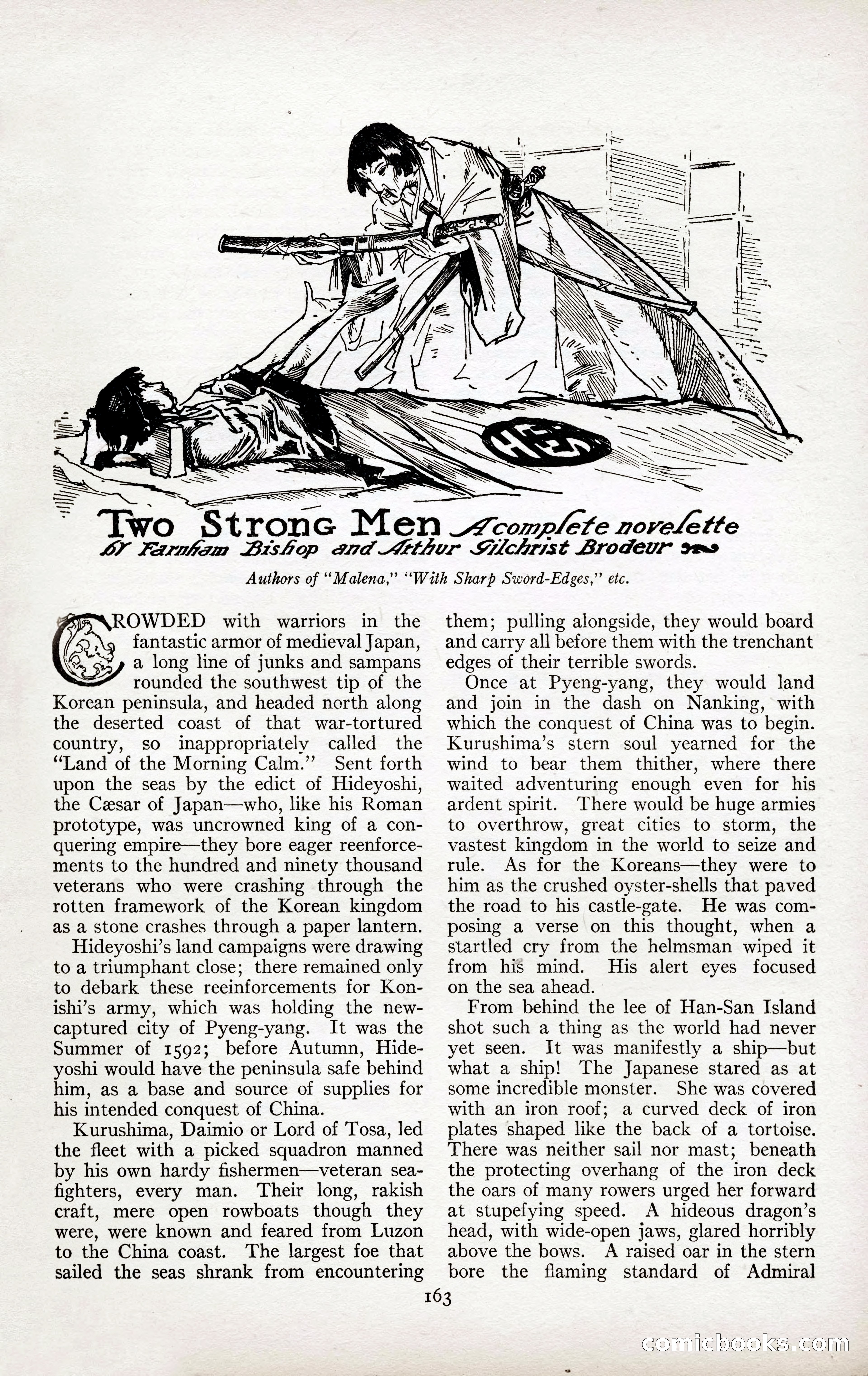
A restored page from Pulp Fiction, 1918. Page through the whole issue in the reader above.
📄 Transcribed text from this page (OCR, searchable)
Machine-transcribed from the original scan — historical spelling and the odd misread are preserved.
~ Two uh Stronc Men “conplere novelette LY Feuuham Bishop and Atthur Gilchrist Brodeur yes Authors of ‘‘Malena,” ‘With Sharp Sword-Edges,”’ etc. ROWDED with warriors in the fantastic armor of medieval Japan, a long line of junks and sampans rounded the southwest tip of the Korean peninsula, and headed north along the deserted coast of that war-tortured country, so inappropriately called the “Land of the Morning Calm.” Sent forth upon the seas by the edict of Hideyoshi, the Cesar of Japan—who, like his Roman prototype, was uncrowned king of a con- quering empire—they bore eager reenforce- ments to the hundred and ninety thousand veterans who were crashing through the rotten framework of the Korean kingdom as a stone crashes through a paper lantern. Hideyoshi’s land campaigns were drawing to a triumphant close; there remained only to debark these reeinforcements for Kon- ishi’s army, which was holding the new- captured city of Pyeng-yang. It was the Summer of 1592; before Autumn, Hide- yoshi would have the peninsula safe behind him, as a base and source of supplies for his intended conquest of China. Kurushima, Daimio or Lord of Tosa, led the fleet with a picked squadron manned by his own hardy fishermen—veteran sea- fighters, every man. Their long, rakish craft, mere open rowboats though they were, were known and feared from Luzon to the China coast. The largest foe that sailed the seas shrank from encountering them; pulling alongside, they would board and carry all before them with the trenchant edges of their terrible swords. Once at Pyeng-yang, they would land and join in the dash on Nanking, with which the conquest of China was to begin. Kurushima’s stern soul yearned for the wind to bear them thither, where there waited adventuring enough even for his ardent spirit. ‘There would be huge armies to overthrow, great cities to storm, the vastest kingdom in the world to seize and rule. As for the Koreans—they were to him as the crushed oyster-shells that paved the road to his castle-gate. He was com- posing a verse on this thought, when a startled cry from the helmsman wiped it from his mind. His alert eyes focused on the sea ahead. From behind the lee of Han-San Island shot such a thing as the world had never yet seen. It was manifestly a ship—but what a ship! The Japanese stared as at some incredible monster. She was covered with an iron roof; a curved deck of iron plates shaped like the back of a tortoise. There was neither sail nor mast; beneath the protecting overhang of the iron deck the oars of many rowers urged her forward at stupefying speed. A hideous dragon’s head, with wide-open jaws, glared horribly above the bows. A raised oar in the stern bore the flaming standard of Admiral 163 COnnicloool< (C@)