
Pulp Fiction, 1918 · page 159 of 194
Adventure Magazine Cover, April 3, 1918 — page 159: what you’re looking at
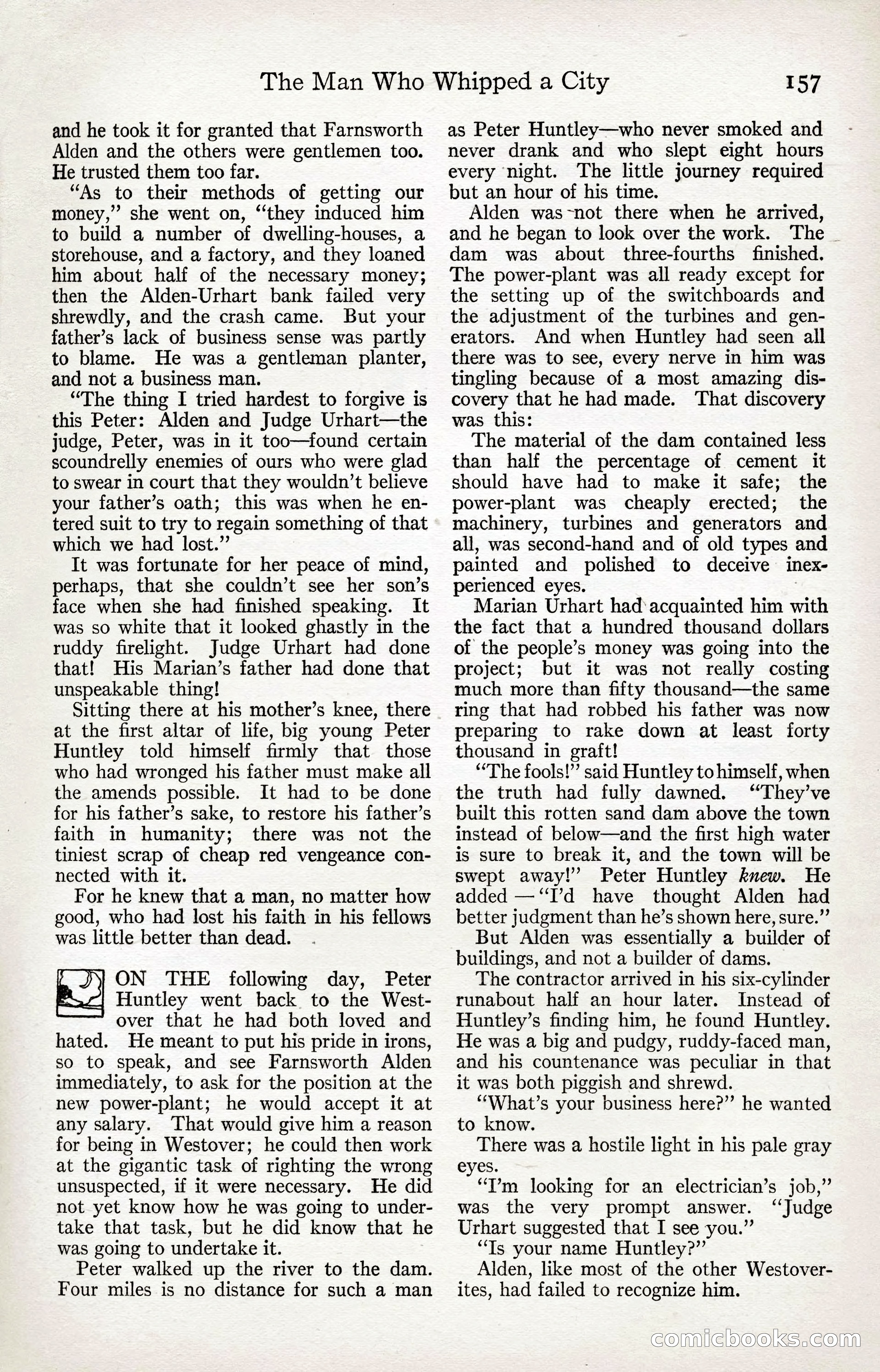
A restored page from Pulp Fiction, 1918. Page through the whole issue in the reader above.
📄 Transcribed text from this page (OCR, searchable)
Machine-transcribed from the original scan — historical spelling and the odd misread are preserved.
The Man Who Whipped a City and he took it for granted that Farnsworth Alden and the others were gentlemen too. He trusted them too far. “As to their methods of getting our money,” she went on, “‘they induced him to build a number of dwelling-houses, a storehouse, and a factory, and they loaned him about half of the necessary money; then the Alden-Urhart bank failed very shrewdly, and the crash came. But your father’s lack of business sense was partly to blame. He was a gentleman planter, and not a business man. “The thing I tried hardest to forgive is this Peter: Alden and Judge Urhart—the judge, Peter, was in it too—found certain scoundrelly enemies of ours who were glad to swear in court that they wouldn’t believe your father’s oath; this was when he en- tered suit to try to regain something of that which we had lost.” It was fortunate for her peace of mind, perhaps, that she couldn’t see her son’s face when she had finished speaking. It was so white that it looked ghastly in the ruddy firelight. Judge Urhart had done that! His Marian’s father had done that unspeakable thing! Sitting there at his mother’s knee, there at the first altar of life, big young Peter Huntley told himself firmly that those who had wronged his father must make all the amends possible. It had to be done for his father’s sake, to restore his father’s faith in humanity; there was not the tiniest scrap of cheap red vengeance con- nected with it. For he knew that a man, no matter how good, who had lost his faith in his fellows was little better than dead. Bp?) ON THE following day, Peter E.| Huntley went back to the West- — over that he had both loved and hated. He meant to put his pride in irons, so to speak, and see Farnsworth Alden immediately, to ask for the position at the new power-plant; he would accept it at any salary. ‘That would give him a reason for being in Westover; he could then work at the gigantic task of righting the wrong unsuspected, if it were necessary. He did not yet know how he was going to under- take that task, but he did know that he was going to undertake it. Peter walked up the river to the dam. Four miles is no distance for such a man 157 as Peter Huntley—who never smoked and never drank and who slept eight hours every night. The little journey required but an hour of his time. Alden was-not there when he arrived, and he began to look over the work. The _ dam was about three-fourths finished. The power-plant was all ready except for the setting up of the switchboards and the adjustment of the turbines and gen- erators. And when Huntley had seen all there was to see, every nerve in him was tingling because of a most amazing dis- covery that he had made. That discovery was this: The material of the dam contained less than half the percentage of cement it should have had to make it safe; the power-plant was cheaply erected; the machinery, turbines and generators and all, was second-hand and of old types and painted and polished to deceive inex- perienced eyes. : Marian Urhart had acquainted him with the fact that a hundred thousand dollars of the people’s money was going into the project; but it was not really costing much more than fifty thousand—the same ring that had robbed his father was now preparing to rake down at least forty thousand in graft! “The fools!”’ said Huntley to himself, when the truth had fully dawned. “They’ve built this rotten sand dam above the town instead of below—and the first high water is sure to break it, and the town will be swept away!’ Peter Huntley knew. He added —‘“‘I’d have thought Alden had better judgment than he’s shown here, sure.”’ But Alden was essentially a builder of buildings, and not a builder of dams. The contractor arrived in his six-cylinder runabout half an hour later. Instead of Huntley’s finding him, he found Huntley. He was a big and pudgy, ruddy-faced man, and his countenance was peculiar in that it was both piggish and shrewd. ‘“‘What’s your business here?” he wanted to know. There was a hostile light in his pale gray eyes. “Y’m looking for an electrician’s job,” was the very prompt answer. “Judge Urhart suggested that I see you.” “Ts your name Huntley?” Alden, like most of the other Westover- ites, had failed to recognize him. Go NOOK AMUG CO