
Pulp Fiction, 1918 · page 156 of 194
Adventure Magazine Cover, April 3, 1918 — page 156: what you’re looking at
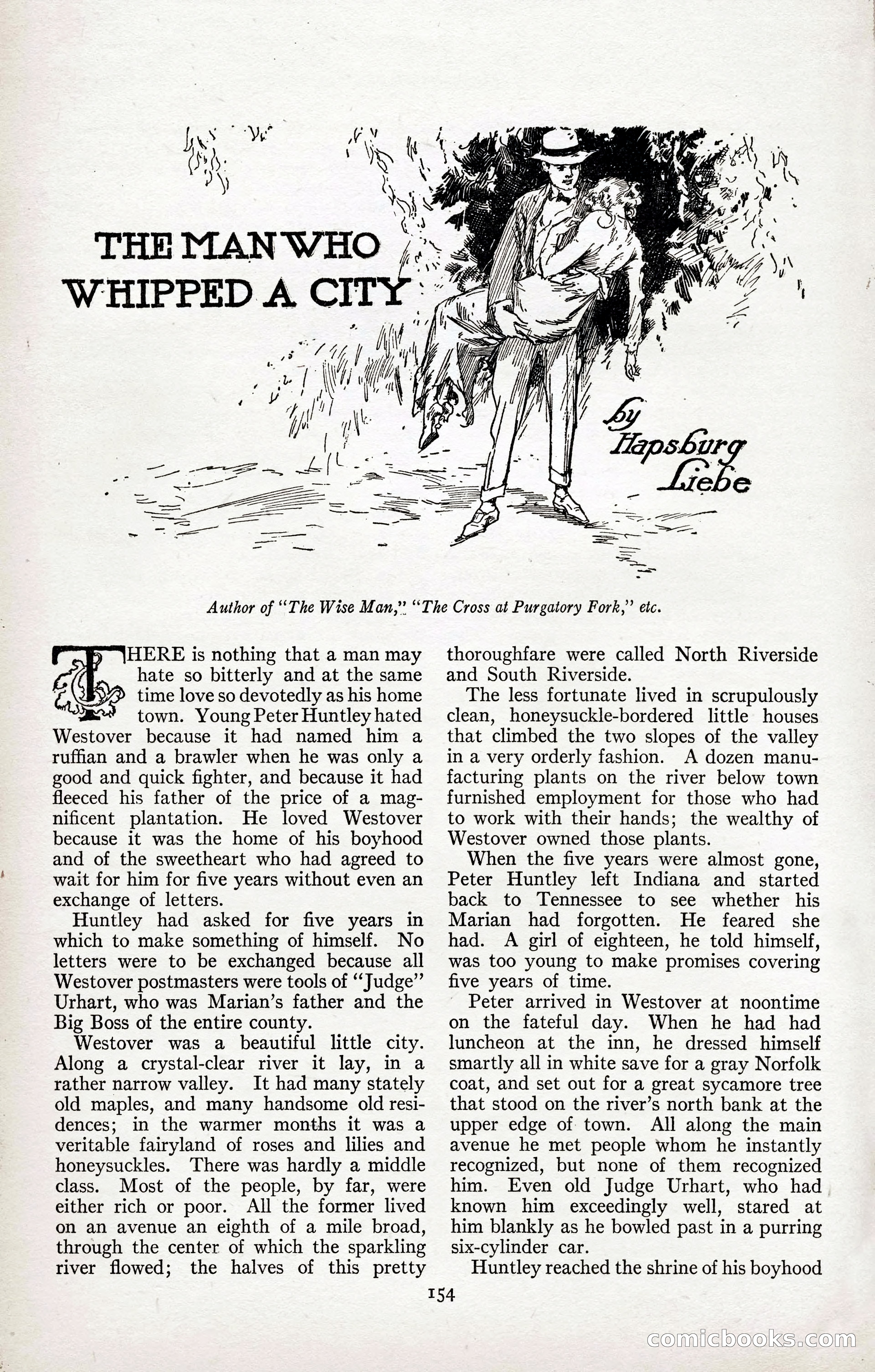
A restored page from Pulp Fiction, 1918. Page through the whole issue in the reader above.
📄 Transcribed text from this page (OCR, searchable)
Machine-transcribed from the original scan — historical spelling and the odd misread are preserved.
“ THE MAN WHO jer WHIPPED A city” Je ie WN ' ae \\, Dr ‘eae Author of “The Wise Man,” “The Cross at Purgatory Fork,’ etc HERE is nothing that a man may hate so bitterly and at the same aA time love so devotedly as his home town. Young Peter Huntley hated Westover because it had named him a ruffian and a brawler when he was only a good and quick fighter, and because it had fleeced his father of the price of a mag- nificent plantation. He loved Westover because it was the home of his boyhood and of the sweetheart who had agreed to wait for him for five years without even an exchange of letters. Huntley had asked for five years in which to make something of himself. No letters were to be exchanged because all Westover postmasters were tools of ‘‘Judge”’ Urhart, who was Marian’s father and the Big Boss of the entire county. Westover was a beautiful little city. Along a crystal-clear river it lay, in a rather narrow valley. It had many stately old maples, and many handsome old resi- dences; in the warmer months it was a veritable fairyland of roses and lilies and honeysuckles. ‘There was hardly a middle class. Most of the people, by far, were either rich or poor. All the former lived on an avenue an eighth of a mile broad, through the center of which the sparkling river flowed; the halves of this pretty thoroughfare were called North Riverside and South Riverside. The less fortunate lived in scrupulously clean, honeysuckle-bordered little houses that climbed the two slopes of the valley in a very orderly fashion. A dozen manu- facturing plants on the river below town furnished employment for those who had to work with their hands; the wealthy of Westover owned those plants. When the five years were almost gone, Peter Huntley left Indiana and started back to Tennessee to see whether his Marian had forgotten. He feared she had. A girl of eighteen, he told himself, was too young to make promises covering five years of time. Peter arrived in Westover at noontime on the fateful day. When he had had luncheon at the inn, he dressed himself smartly all in white save for a gray Norfolk coat, and set out for a great sycamore tree that stood on the river’s north bank at the upper edge of town. All along the main avenue he met people whom he instantly recognized, but none of them recognized him. Even old Judge Urhart, who had known him exceedingly well, stared at him blankly as he bowled past in a purring six-cylinder car. Huntley reached the shrine of his boyhood 154 COnnicloool< (C@