
Pulp Fiction, 1918 · page 12 of 194
Adventure Magazine Cover, April 3, 1918 — page 12: what you’re looking at
A restored page from Pulp Fiction, 1918. Page through the whole issue in the reader above.
📄 Transcribed text from this page (OCR, searchable)
Machine-transcribed from the original scan — historical spelling and the odd misread are preserved.
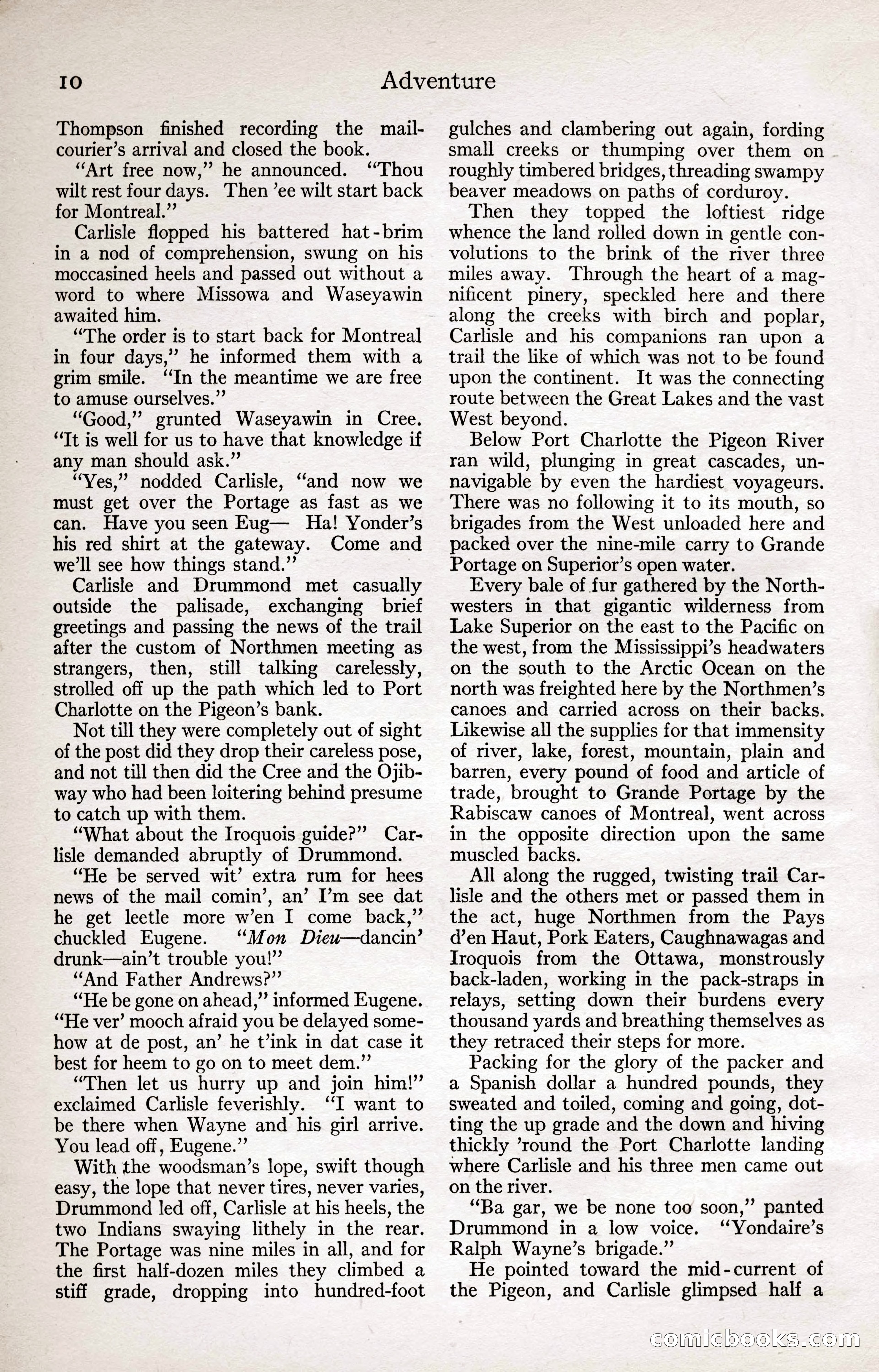
IO Thompson finished recording the mail- courier’s arrival and closed the book. “Art free now,” he announced. “Thou wilt rest four days. Then ’ee wilt start back for Montreal.” Carlisle flopped his battered hat-brim in a nod of comprehension, swung on his moccasined heels and passed out without a word to where Missowa and Waseyawin awaited him. “The order is to start back for Montreal in four days,” he informed them with a grim smile. ‘In the meantime we are free to amuse ourselves.”’ “Good,” grunted Waseyawin in Cree. “Tt is well for us to have that knowledge if any man should ask.” “Yes,”’ nodded Carlisle, “and now we must get over the Portage as fast as we can. Have you seen Eug— Ha! Yonder’s his red shirt at the gateway. Come and we'll see how things stand.”’ Carlisle and Drummond met casually outside the palisade, exchanging brief greetings and passing the news of the trail after the custom of Northmen meeting as strangers, then, still talking carelessly, strolled off up the path which led to Port Charlotte on the Pigeon’s bank. Not till they were completely out of sight of the post did they drop their careless pose, and not till then did the Cree and the Ojib- way who had been loitering behind presume to catch up with them. “What about the Iroquois guide?” Car- lisle demanded abruptly of Drummond. “He be served wit’ extra rum for hees news of the mail comin’, an’ I’m see dat he get leetle more w’en I come back,” chuckled Eugene. “Mon Dieu—dancin’ drunk—ain’t trouble you!”’ “And Father Andrews?” “He be gone on ahead,” informed Eugene. “He ver’ mooch afraid you be delayed some- how at de post, an’ he t’ink in dat case it best for heem to go on to meet dem.”’ “Then let us hurry up and join him!” exclaimed Carlisle feverishly. “I want to be there when Wayne and his girl arrive. You lead off, Eugene.” With the woodsman’s lope, swift though easy, the lope that never tires, never varies, Drummond led off, Carlisle at his heels, the two Indians swaying lithely in the rear. The Portage was nine miles in all, and for the first half-dozen miles they climbed a stiff grade, dropping into hundred-foot Adventure gulches and clambering out again, fording small creeks or thumping over them on roughly timbered bridges, threading swampy beaver meadows on paths of corduroy. Then they topped the loftiest ridge whence the land rolled down in gentle con- volutions to the brink of the river three miles away. Through the heart of a mag- nificent pinery, speckled here and there along the creeks with birch and poplar, Carlisle and his companions ran upon a trail the like of which was not to be found upon the continent. It was the connecting route between the Great Lakes and the vast West beyond. Below Port Charlotte the Pigeon River ran wild, plunging in great cascades, un- navigable by even the hardiest voyageurs. There was no following it to its mouth, so brigades from the West unloaded here and packed over the nine-mile carry to Grande Portage on Superior’s open water. Every bale of fur gathered by the North- westers in that gigantic wilderness from Lake Superior on the east to the Pacific on the west, from the Mississippi’s headwaters on the south to the Arctic Ocean on the north was freighted here by the Northmen’s canoes and carried across on their backs. Likewise all the supplies for that immensity of river, lake, forest, mountain, plain and barren, every pound of food and article of trade, brought to Grande Portage by the Rabiscaw canoes of Montreal, went across in the opposite direction upon the same muscled _ backs. All along the rugged, twisting trail Car- lisle and the others met or passed them in the act, huge Northmen from the Pays d’en Haut, Pork Eaters, Caughnawagas and Troquois from the Ottawa, monstrously back-laden, working in the pack-straps in relays, setting down their burdens every thousand yards and breathing themselves as they retraced their steps for more. Packing for the glory of the packer and a Spanish dollar a hundred pounds, they sweated and toiled, coming and going, dot- ting the up grade and the down and hiving thickly ’round the Port Charlotte landing where Carlisle and his three men came out on the river. “Ba gar, we be none too soon,” panted Drummond in a low voice. ‘Yondaire’s Ralph Wayne’s brigade.” He pointed toward the mid-current of the Pigeon, and Carlisle glimpsed half a GoOmicdooks (C@