
Pulp Fiction, 1918 · page 10 of 194
Adventure Magazine Cover, April 3, 1918 — page 10: what you’re looking at
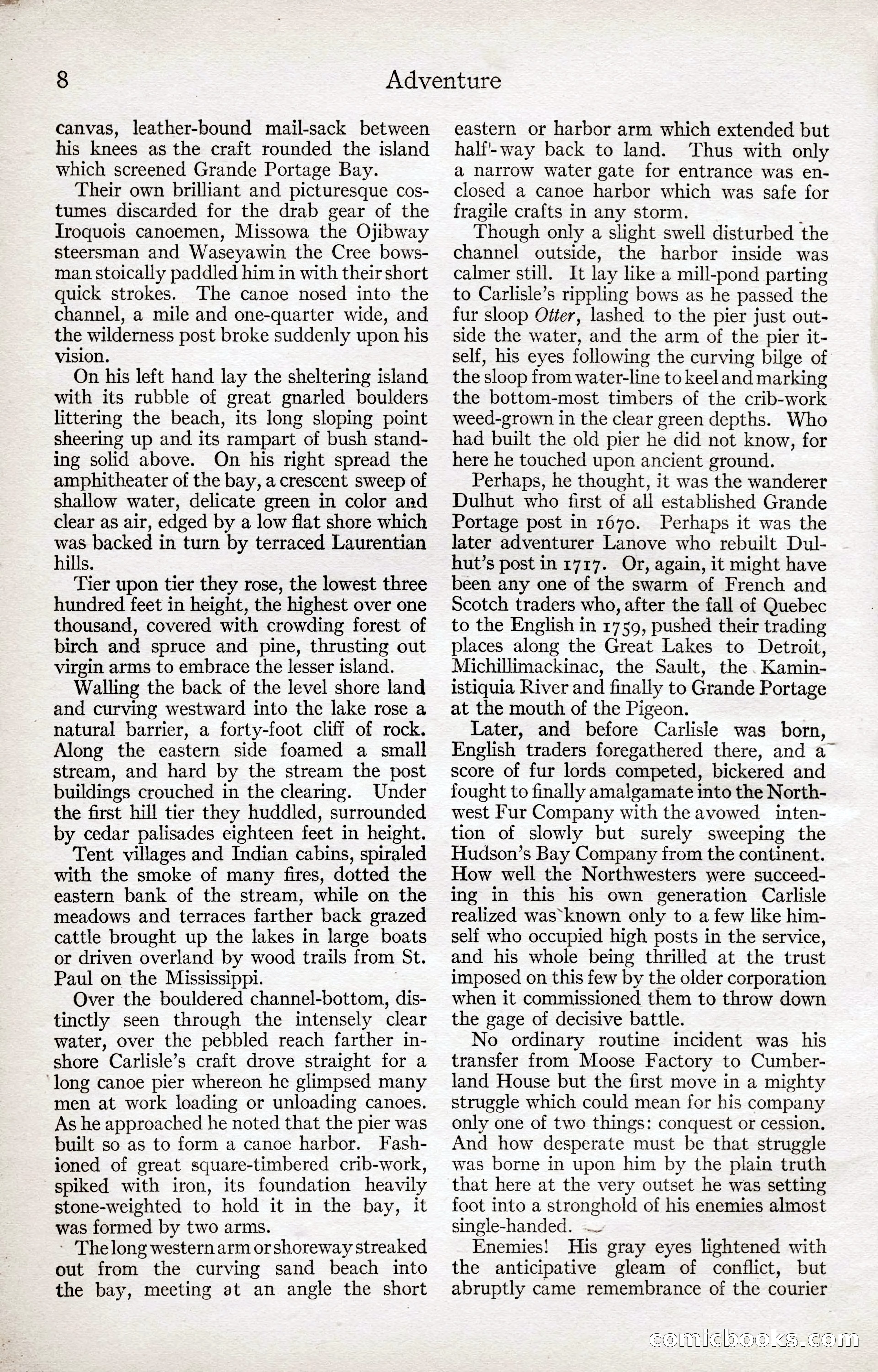
A restored page from Pulp Fiction, 1918. Page through the whole issue in the reader above.
📄 Transcribed text from this page (OCR, searchable)
Machine-transcribed from the original scan — historical spelling and the odd misread are preserved.
8 | Adventure canvas, leather-bound mail-sack between his knees as the craft rounded the island which screened Grande Portage Bay. Their own brilliant and picturesque cos- tumes discarded for the drab gear of the Iroquois canoemen, Missowa the Ojibway steersman and Waseyawin the Cree bows- man stoically paddled him in with their short quick strokes. The canoe nosed into the channel, a mile and one-quarter wide, and the wilderness post broke suddenly upon his vision. On his left hand lay the sheltering island with its rubble of great gnarled boulders littering the beach, its long sloping point sheering up and its rampart of bush stand- ing solid above. On his right spread the amphitheater of the bay, a crescent sweep of shallow water, delicate green in color and clear as air, edged by a low flat shore which was backed in turn by terraced Laurentian hills. Tier upon tier they rose, the lowest three hundred feet in height, the highest over one thousand, covered with crowding forest of birch and spruce and pine, thrusting out virgin arms to embrace the lesser island. Walling the back of the level shore land and curving westward into the lake rose a natural barrier, a forty-foot cliff of rock. Along the eastern side foamed a small Stream, and hard by the stream the post buildings crouched in the clearing. Under the first hill tier they huddled, surrounded by cedar palisades eighteen feet in height. Tent villages and Indian cabins, spiraled with the smoke of many fires, dotted the eastern bank of the stream, while on the meadows and terraces farther back grazed cattle brought up the lakes in large boats or driven overland by wood trails from St. Paul on the Mississippi. 3 Over the bouldered channel-bottom, dis- tinctly seen through the intensely clear water, over the pebbled reach farther in- shore Carlisle’s craft drove straight for a ‘long canoe pier whereon he glimpsed many men at work loading or unloading canoes. As he approached he noted that the pier was built so as to form a canoe harbor. Fash- ioned of great square-timbered crib-work, spiked with iron, its foundation heavily stone-weighted to hold it in the bay, it was formed by two arms. - The long western arm or shoreway streaked out from the curving sand beach into the bay, meeting at an angle the short eastern or harbor arm which extended but half-way back to land. Thus with only a narrow water gate for entrance was en- closed a canoe harbor which was safe for fragile crafts in any storm. Though only a slight swell disturbed the channel outside, the harbor inside was calmer still. It lay like a mill-pond parting to Carlisle’s rippling bows as he passed the fur sloop Otter, lashed to the pier just out- side the water, and the arm of the pier it- self, his eyes following the curving bilge of the sloop from water-line to keel and marking the bottom-most timbers of the crib-work weed-grown in the clear green depths. Who had built the old pier he did not know, for here he touched upon ancient ground. Perhaps, he thought, it was the wanderer Dulhut who first of all established Grande Portage post in 1670. Perhaps it was the later adventurer Lanove who rebuilt Dul- hut’s postin 1717. Or, again, it might have been any one of the swarm of French and Scotch traders who, after the fall of Quebec to the English in 1759, pushed their trading places along the Great Lakes to Detroit, Michillimackinac, the Sault, the . Kamin- istiquia River and finally to Grande Portage at the mouth of the Pigeon. Later, and before Carlisle was born, English traders foregathered there, and a score of fur lords competed, bickered and fought to finally amalgamate into the North- west Fur Company with the avowed inten- tion of slowly but surely sweeping the Hudson’s Bay Company from the continent. How well the Northwesters were succeed- ing in this his own generation Carlisle realized was*known only to a few like him- self who occupied high posts in the service, and his whole being thrilled at the trust imposed on this few by the older corporation when it commissioned them to throw down the gage of decisive battle. No ordinary routine incident was his transfer from Moose Factory to Cumber- land House but the first move in a mighty struggle which could mean for his company only one of two things: conquest or cession. And how desperate must be that struggle was borne in upon him by the plain truth that here at the very outset he was setting foot into a stronghold of his enemies almost single-handed. ~ Enemies! His gray eyes lightened with the anticipative gleam of conflict, but abruptly came remembrance of the courier GOmiGsooks (C@