
Pulp Fiction, 1917 · page 86 of 196
Adventure, August 1917 — page 86: what you’re looking at
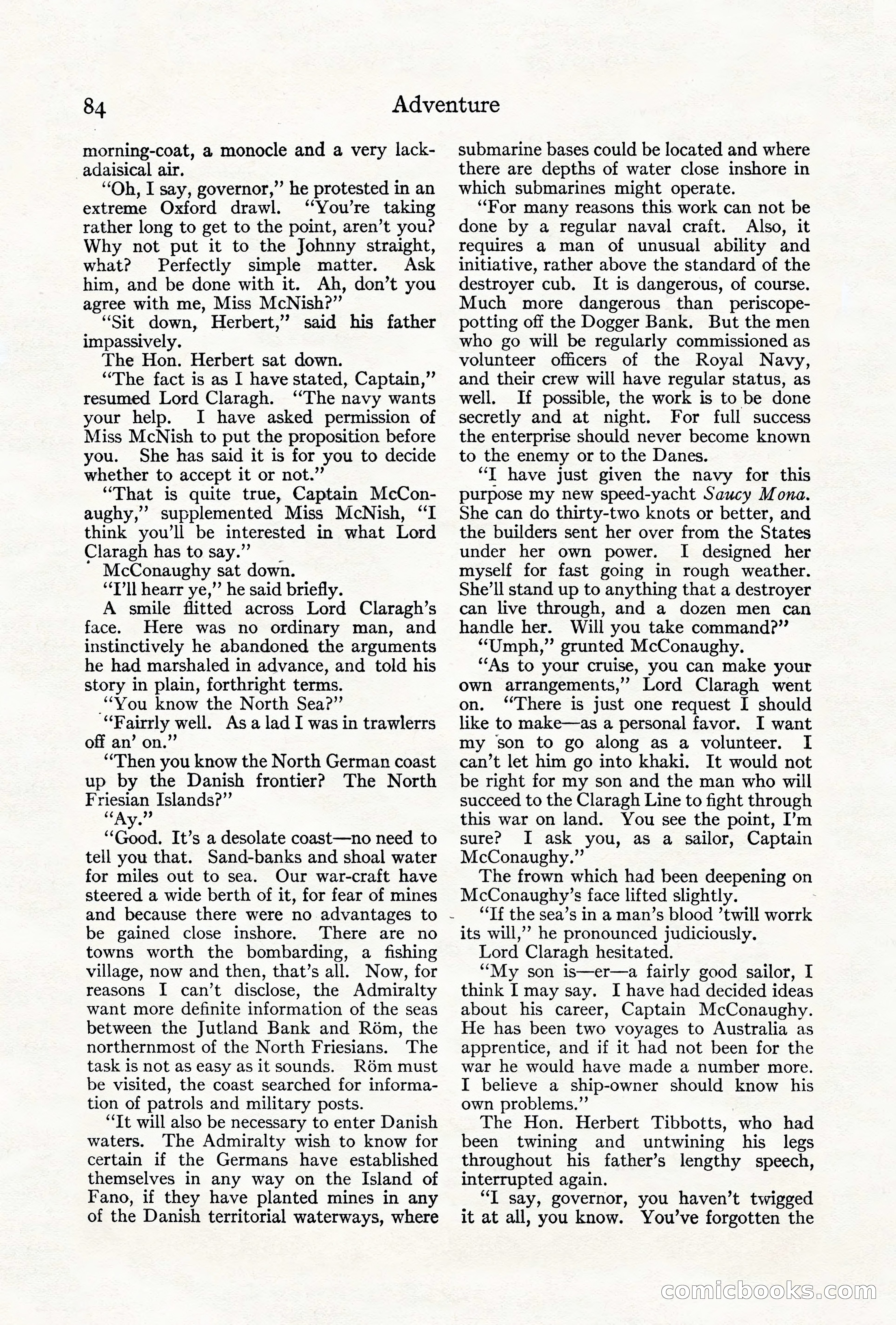
A restored page from Pulp Fiction, 1917. Page through the whole issue in the reader above.
📄 Transcribed text from this page (OCR, searchable)
Machine-transcribed from the original scan — historical spelling and the odd misread are preserved.
34 morning-coat, a monocle and a very lack- -adaisical air. “Oh, I say, governor,” he protested in an extreme Oxford drawl. ‘‘You’re taking rather long to get to the point, aren’t you? Why not put it to the Johnny straight, what? Perfectly simple matter. Ask him, and be done with it. Ah, don’t you agree with me, Miss McNish?” “Sit down, Herbert,” said his father impassively. The Hon. Herbert sat down. “The fact is as I have stated, Captain,” resumed Lord Claragh. “The navy wants your help. I have asked permission of Miss McNish to put the proposition before you. She has said it is for you to decide whether to accept it or not.” “That is quite true, Captain McCon- aughy,’’ supplemented Miss McNish, “I think you’ll be interested in what Lord Claragh has to say.” McConaughy sat down. “‘Y’ll hearr ye,” he said briefly. A smile flitted across Lord Claragh’s face. Here was no ordinary man, and instinctively he abandoned the arguments he had marshaled in advance, and told his story in plain, forthright terms. “You know the North Sea?” “Fairrly well. Asa lad I was in trawlerrs off an’ on.” ‘“‘Then you know the North German coast up by the Danish frontier? The North Friesian Islands?” cc Ay.” “‘Good. It’s a desolate coast—no need to tell you that. Sand-banks and shoal water for miles out to sea. Our war-craft have steered a wide berth of it, for fear of mines and because there were no advantages to - be gained close inshore. There are no towns worth the bombarding, a fishing village, now and then, that’s all. Now, for reasons I can’t disclose, the Admiralty want more definite information of the seas between the Jutland Bank and Ro6m, the northernmost of the North Friesians. The task is not as easy as it sounds. R6m must be visited, the coast searched for informa- tion of patrols and military posts. “It will also be necessary to enter Danish waters. The Admiralty wish to know for certain if the Germans have established themselves in any way on the Island of Fano, if they have planted mines in any of the Danish territorial waterways, where Adventure submarine bases could be located and where there are depths of water close inshore in which submarines might operate. “For many reasons this work can not be done by a regular naval craft. Also, it requires a man of unusual ability and initiative, rather above the standard of the destroyer cub. It is dangerous, of course. Much more dangerous than _periscope- potting off the Dogger Bank. But the men who go will be regularly commissioned as volunteer officers of the Royal Navy, and their crew will have regular status, as well. If possible, the work is to be done secretly and at night. For full success the enterprise should never become known to the enemy or to the Danes. 3 “TY have just given the navy for this purpose my new speed-yacht Saucy Mona. She can do thirty-two knots or better, and the builders sent her over from the States under her own power. I designed her myself for fast going in rough weather. She’ll stand up to anything that a destroyer can live through, and a dozen men can handle her. Will you take command?” ‘““Umph,” grunted McConaughy. ‘“‘As to your cruise, you can make your own arrangements,’ Lord Claragh went on. ‘There is just one request I should like to make—as a personal favor. I want my son to go along as a volunteer. I can’t let him go into khaki. It would not be right for my son and the man who will succeed to the Claragh Line to fight through this war on land. You see the point, I’m sure? I ask you, as a sailor, Captain McConaughy.”’ The frown which had been deepening on McConaughy’s face lifted slightly. “Tf the sea’s in a man’s blood ’twill worrk its will,’ he pronounced judiciously. Lord Claragh hesitated. “My son is—er—a fairly good sailor, I think I may say. I have had decided ideas about his career, Captain McConaughy. He has been two voyages to Australia as apprentice, and if it had not been for the war he would have made a number more. I believe a ship-owner should know his own problems.”’ The Hon. Herbert Tibbotts, who had been twining and untwining his legs throughout his father’s lengthy speech, interrupted again. “IT say, governor, you haven’t twigged it at all, you know. You’ve forgotten the cComicldook CO 5}