
Pulp Fiction, 1917 · page 84 of 196
Adventure, August 1917 — page 84: what you’re looking at
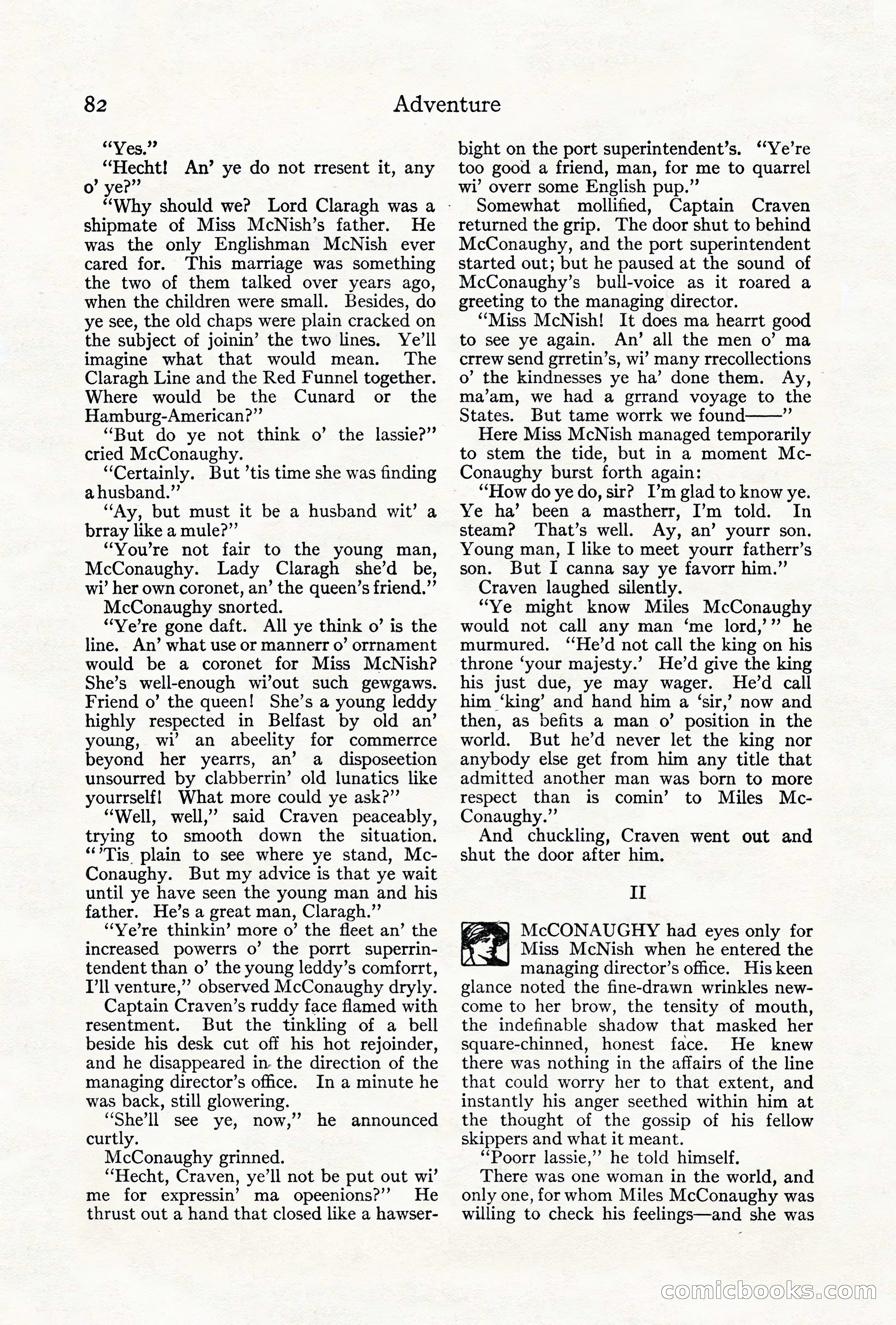
A restored page from Pulp Fiction, 1917. Page through the whole issue in the reader above.
📄 Transcribed text from this page (OCR, searchable)
Machine-transcribed from the original scan — historical spelling and the odd misread are preserved.
82 “Ves,”? “Hecht! An’ ye do not rresent it, any oO’ yer” ‘‘Why should we? Lord Claragh was a - shipmate of Miss McNish’s father. He was the only Englishman McNish ever cared for. This marriage was something the two of them talked over years ago, when the children were small. Besides, do ye see, the old chaps were plain cracked on the subject of joinin’ the two lines. Ye’ll imagine what that would mean. The Claragh Line and the Red Funnel together. Where would be the Cunard or the Hamburg-American?”’ “But do ye not think o’ the lassie?” cried McConaughy. “Certainly. But ’tis time she was finding a husband.” “Ay, but must it be a husband wit’ a brray like a mule?”’ “Youre not fair to the young man, McConaughy. Lady Claragh she’d be, wi’ her own coronet, an’ the queen’s friend.” McConaughy snorted. “Ye’re gone daft. All ye think o’ is the line. An’ what use or mannerr o’ orrnament would be a coronet for Miss McNish? She’s well-enough wi’out such gewgaws. Friend o’ the queen! She’s a young leddy highly respected in Belfast by old an’ young, wi an abeelity for commerrce beyond her yearrs, an’ a _ disposeetion unsourred by clabberrin’ old lunatics like yourrself! What more could ye ask?” “Well, well,’’ said Craven peaceably, trying to smooth down the situation. ‘Tis plain to see where ye stand, Mc- Conaughy. But my advice is that ye wait until ye have seen the young man and his father. He’s a great man, Claragh.”’ ‘“Ye’re thinkin’ more o’ the fleet an’ the increased powerrs o’ the porrt superrin- tendent than o’ the young leddy’s comforrt, I’ll venture,” observed McConaughy dryly. Captain Craven’s ruddy face flamed with resentment. But the tinkling of a bell beside his desk cut off his hot rejoinder, and he disappeared in- the direction of the managing director’s office. In a minute he was back, still glowering. “She'll see ye, now,’ curtly. McConaughy grinned. “Hecht, Craven, ye’ll not be put out wi’ me for expressin’ ma opeenions?”’ He thrust out a hand that closed like a hawser- > he announced Adventure bight on the port superintendent’s. ‘‘Ye’re too good a friend, man, for me to quarrel wi’ overr some English pup.” Somewhat mollified, Captain Craven returned the grip. The door shut to behind McConaughy, and the port superintendent started out; but he paused at the sound of McConaughy’s bull-voice as it roared a greeting to the managing director. “Miss McNish! It does ma hearrt good to see ye again. An’ all the men o’ ma crrew send grtretin’s, wi’ many rrecollections o’ the kindnesses ye ha’ done them. Ay, ma’am, we had a grrand voyage to the States. But tame worrk we found ss Here Miss McNish managed temporarily to stem the tide, but in a moment Mc- Conaughy burst forth again: “How do ye do, sir? I’m glad to know ye. Ye ha’ been a mastherr, I’m told. In steam? That’s well. Ay, an’ yourr son. Young man, I like to meet yourr fatherr’s son. But I canna say ye favorr him.” Craven laughed silently. “Ye might know Miles McConaughy would not call any man ‘me lord,’” he murmured. ‘‘He’d not call the king on his throne ‘your majesty.’ He’d give the king his just due, ye may wager. He’d call him ‘king’ and hand him a ‘sir,’ now and then, as befits a man o’ position in the world. But he’d never let the king nor anybody else get from him any title that admitted another man was born to more respect than is comin’ to Miles Mc- Conaughy.”’ And chuckling, Craven went out and shut the door after him. IT McCONAUGHY had eyes only for Miss McNish when he entered the managing director’s office. His keen glance noted the fine-drawn wrinkles new- come to her brow, the tensity of mouth, the indefinable shadow that masked her square-chinned, honest face. He knew there was nothing in the affairs of the line that could worry her to that extent, and instantly his anger seethed within him at the thought of the gossip of his fellow skippers and what it meant. ‘‘Poorr lassie,” he told himself. There was one woman in the world, and only one, for whom Miles McConaughy was willing to check his feelings—and she was A COMGHOO CS (© 5}