
Pulp Fiction, 1917 · page 72 of 196
Adventure, August 1917 — page 72: what you’re looking at
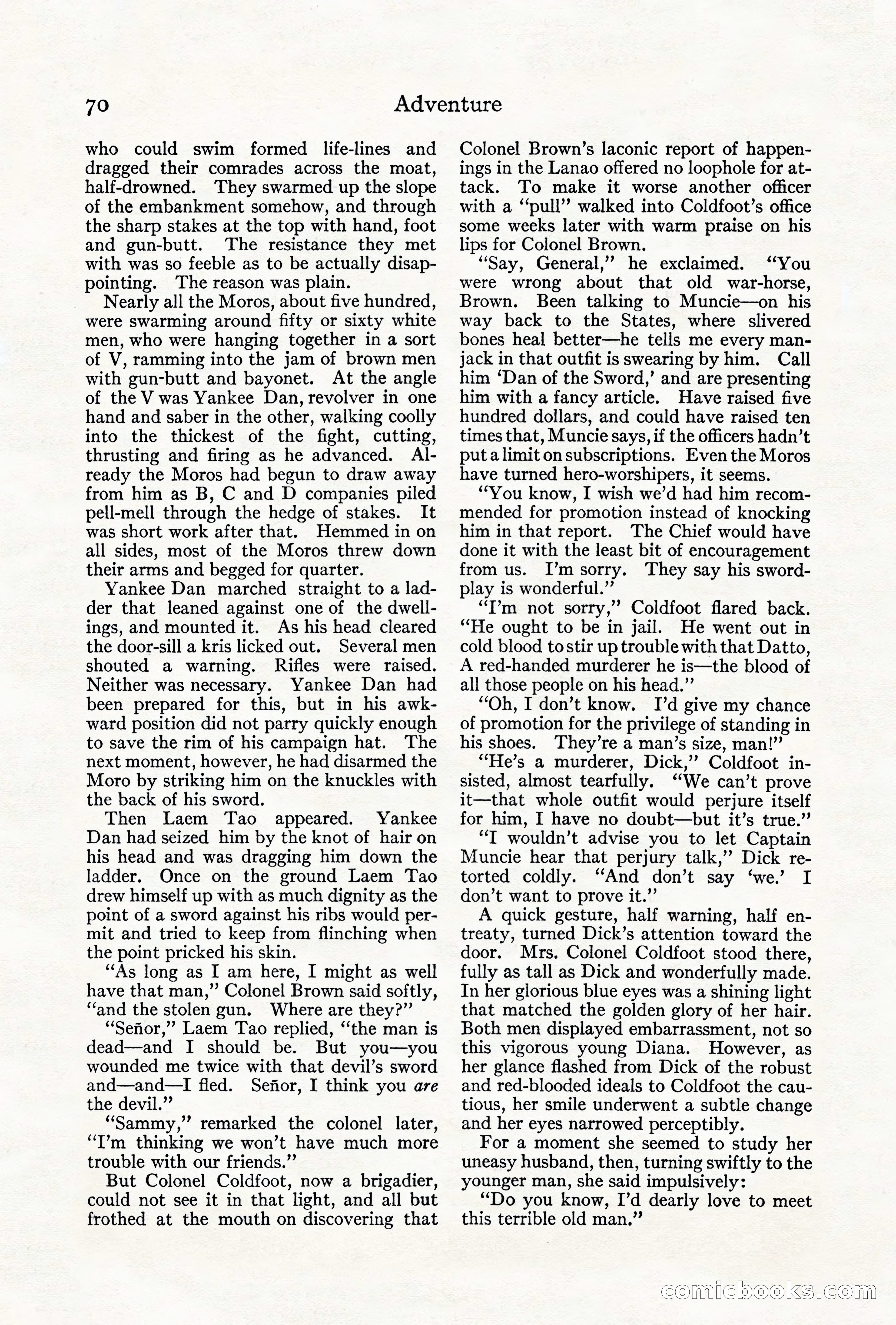
A restored page from Pulp Fiction, 1917. Page through the whole issue in the reader above.
📄 Transcribed text from this page (OCR, searchable)
Machine-transcribed from the original scan — historical spelling and the odd misread are preserved.
70 who could swim formed life-lines and dragged their comrades across the moat, half-drowned. They swarmed up the slope of the embankment somehow, and through the sharp stakes at the top with hand, foot and gun-butt. The resistance they met with was so feeble as to be actually disap- pointing. The reason was plain. Nearly all the Moros, about five hundred, were swarming around fifty or sixty white men, who were hanging together in a sort of V, ramming into the jam of brown men with gun-butt and bayonet. At the angle of the V was Yankee Dan, revolver in one hand and saber in the other, walking coolly into the thickest of the fight, cutting, thrusting and firing as he advanced. Al- ready the Moros had begun to draw away from him as B, C and D companies piled pell-mell through the hedge of stakes. It was short work after that. Hemmed in on all sides, most of the Moros threw down their arms and begged for quarter. Yankee Dan marched straight to a lad- der that leaned against one of the dwell- ings, and mounted it. As his head cleared the door-sill a kris licked out. Several men shouted a warning. Rifles were raised. Neither was necessary. Yankee Dan had been prepared for this, but in his awk- ward position did not parry quickly enough to save the rim of his campaign hat. The next moment, however, he had disarmed the Moro by striking him on the knuckles with the back of his sword. Then Laem Tao appeared. Yankee Dan had seized him by the knot of hair on his head and was dragging him down the ladder. Once on the ground Laem Tao drew himself up with as much dignity as the point of a sword against his ribs would per- mit and tried to keep from flinching when the point pricked his skin. ‘“‘As long as I am here, I might as well have that man,” Colonel Brown said softly, ‘“‘and the stolen gun. Where are they?” ‘‘Senior,’’ Laem Tao replied, “‘the man is dead—and I should be. But you—you wounded me twice with that devil’s sword and—and—I fled. Sefior, I think you are the devil.” “Sammy,” remarked the colonel later, “T’m thinking we won’t have much more trouble with our friends.” But Colonel Coldfoot, now a brigadier, could not see it in that light, and all but frothed at the mouth on discovering that bf Adventure Colonel Brown’s laconic report of happen- ings in the Lanao offered no loophole for at- tack. To make it worse another officer with a “pull” walked into Coldfoot’s office some weeks later with warm praise on his lips for Colonel Brown. ‘Say, General,’”’ he exclaimed. ‘‘You were wrong about that old war-horse, Brown. Been talking to Muncie—on his way back to the States, where slivered bones heal better—he tells me every man- jack in that outfit is swearing by him. Call him ‘Dan of the Sword,’ and are presenting him with a fancy article. Have raised five hundred dollars, and could have raised ten times that, Muncie says, if the officers hadn’t put a limit on subscriptions. Even the Moros have turned hero-worshipers, it seems. ‘You know, I wish we’d had him recom- mended for promotion instead of knocking him in that report. The Chief would have done it with the least bit of encouragement from us. I’m sorry. They say his sword- play is wonderful.” “1’m not sorry,’ Coldfoot flared back. “He ought to be in jail. He went out in cold blood tostir up trouble with that Datto, A red-handed murderer he is—the blood of all those people on his head.” “Oh, I don’t know. I’d give my chance of promotion for the privilege of standing in his shoes. They’re a man’s size, man!” “‘He’s a murderer, Dick,’’ Coldfoot in- sisted, almost tearfully. ‘“‘We can’t prove it—that whole outfit would perjure itself for him, I have no doubt—but it’s true.” “T wouldn’t advise you to let Captain Muncie hear that perjury talk,’’ Dick re- torted coldly. “And don’t say ‘we.’ I don’t want to prove it.”’ A quick gesture, half warning, half en- treaty, turned Dick’s attention toward the door. Mrs. Colonel Coldfoot stood there, fully as tall as Dick and wonderfully made. In her glorious blue eyes was a shining light that matched the golden glory of her hair. Both men displayed embarrassment, not so this vigorous young Diana. However, as her glance flashed from Dick of the robust and red-blooded ideals to Coldfoot the cau- tious, her smile underwent a subtle change and her eyes narrowed perceptibly. For a moment she seemed to study her uneasy husband, then, turning swiftly to the younger man, she said impulsively: “Do you know, I’d dearly love to meet this terrible old man.” cComicdook C© 5}