
Pulp Fiction, 1917 · page 57 of 196
Adventure, August 1917 — page 57: what you’re looking at
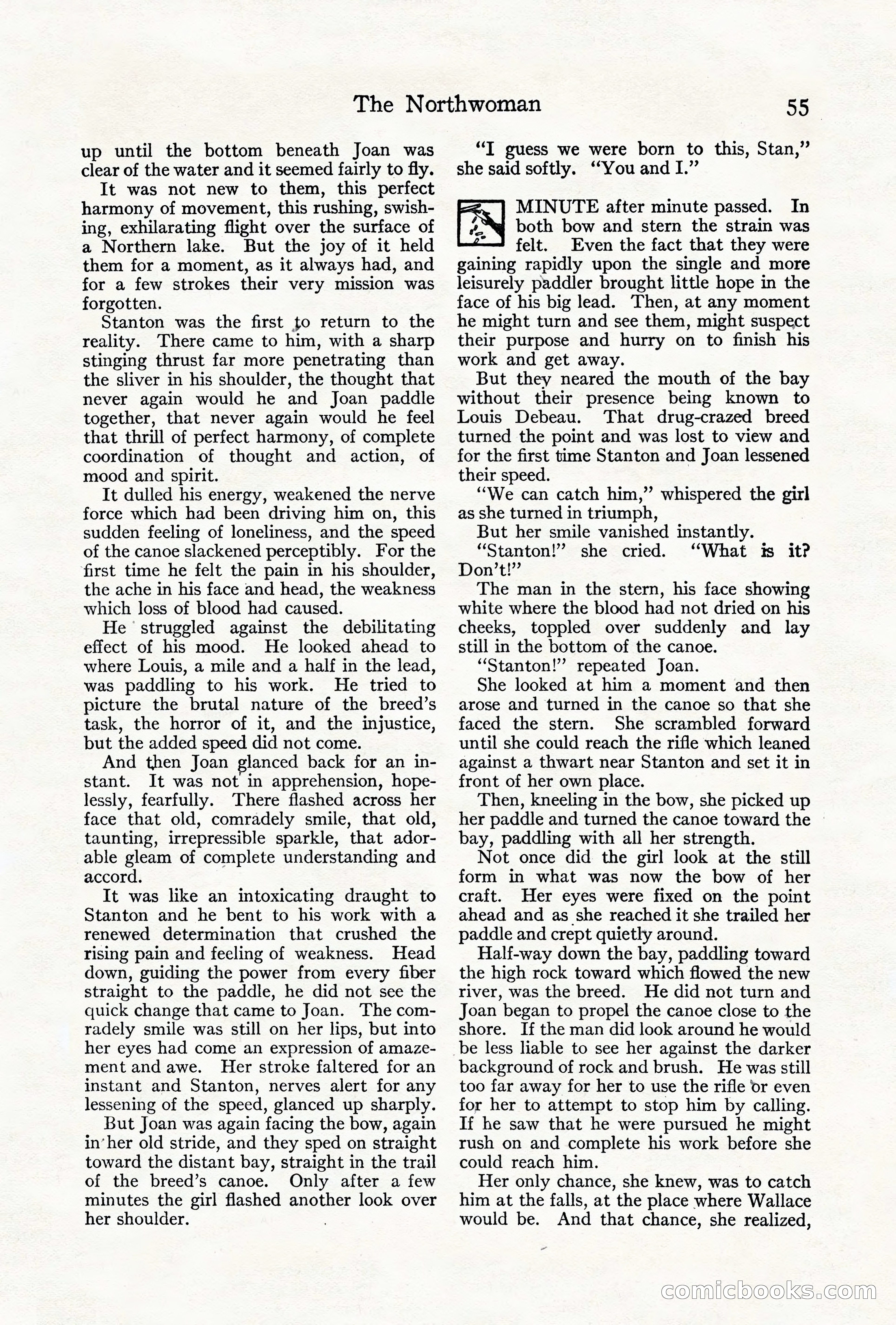
A restored page from Pulp Fiction, 1917. Page through the whole issue in the reader above.
📄 Transcribed text from this page (OCR, searchable)
Machine-transcribed from the original scan — historical spelling and the odd misread are preserved.
The Northwoman up until the bottom beneath Joan was clear of the water and it seemed fairly to fly. It was not new to them, this perfect harmony of movement, this rushing, swish- ing, exhilarating flight over the surface of a Northern lake. But the joy of it held them for a moment, as it always had, and for a few strokes their very mission was forgotten. Stanton was the first to return to the reality. There came to him, with a sharp stinging thrust far more penetrating than the sliver in his shoulder, the thought that never again would he and Joan paddle together, that never again would he feel that thrill of perfect harmony, of complete coordination of thought and action, of mood and spirit. It dulled his energy, weakened the nerve force which had been driving him on, this sudden feeling of loneliness, and the speed of the canoe slackened perceptibly. For the first time he felt the pain in his shoulder, the ache in his face and head, the weakness which loss of blood had caused. He struggled against the debilitating effect of his mood. He looked ahead to where Louis, a mile and a half in the lead, was paddling to his work. He tried to picture the brutal nature of the breed’s task, the horror of it, and the injustice, but the added speed did not come. And then Joan glanced back for an in- stant. It was not in apprehension, hope- lessly, fearfully. There flashed across her face that old, comradely smile, that old, taunting, irrepressible sparkle, that ador- able gleam of complete understanding and accord. It was like an intoxicating draught to Stanton and he bent to his work with a renewed determination that crushed the rising pain and feeling of weakness. Head down, guiding the power from every fiber straight to the paddle, he did not see the quick change that came to Joan. The com- radely smile was still on her lips, but into her eyes had come an expression of amaze- ment and awe. Her stroke faltered for an instant and Stanton, nerves alert for any lessening of the speed, glanced up sharply. But Joan was again facing the bow, again in’her old stride, and they sped on straight toward the distant bay, straight in the trail of the breed’s canoe. Only after a few minutes the girl flashed another look over her shoulder. “TI guess we were born to this, Stan,” she said softly. ‘You and I.” ~ MINUTE after minute passed. In both bow and stern the strain was felt. Even the fact that they were gaining rapidly upon the single and more leisurely paddler brought little hope in the face of his big lead. Then, at any moment he might turn and see them, might suspect their purpose and hurry on to finish his work and get away. But they neared the mouth of the bay without their presence being known to Louis Debeau. That drug-crazed breed turned the point and was lost to view and for the first time Stanton and Joan lessened their speed. ‘We can catch him,” whispered the girl as she turned in triumph, But her smile vanished instantly. “Stanton!” she cried. ‘What is it? Don’t!” The man in the stern, his face showing white where the blood had not dried on his cheeks, toppled over suddenly and lay still in the bottom of the canoe. “Stanton!”’ repeated Joan. She looked at him a moment and then arose and turned in the canoe so that she faced the stern. She scrambled forward until she could reach the rifle which leaned against a thwart near Stanton and set it in front of her own place. Then, kneeling in the bow, she picked up 55 | her paddle and turned the canoe toward the © bay, paddling with all her strength. Not once did the girl look at the still form in what was now the bow of her craft. Her eyes were fixed on the point ahead and as she reached it she trailed her paddle and crept quietly around. Half-way down the bay, paddling toward the high rock toward which flowed the new river, was the breed. He did not turn and Joan began to propel the canoe close to the shore. If the man did look around he would be less liable to see her against the darker background of rock and brush. He was still too far away for her to use the rifle or even for her to attempt to stop him by calling. If he saw that he were pursued he might rush on and complete his work before she could reach him. Her only chance, she knew, was to catch him at the falls, at the place where Wallace would be. And that chance, she realized, - CoOmiclsoo CO S|