
Pulp Fiction, 1917 · page 41 of 196
Adventure, August 1917 — page 41: what you’re looking at
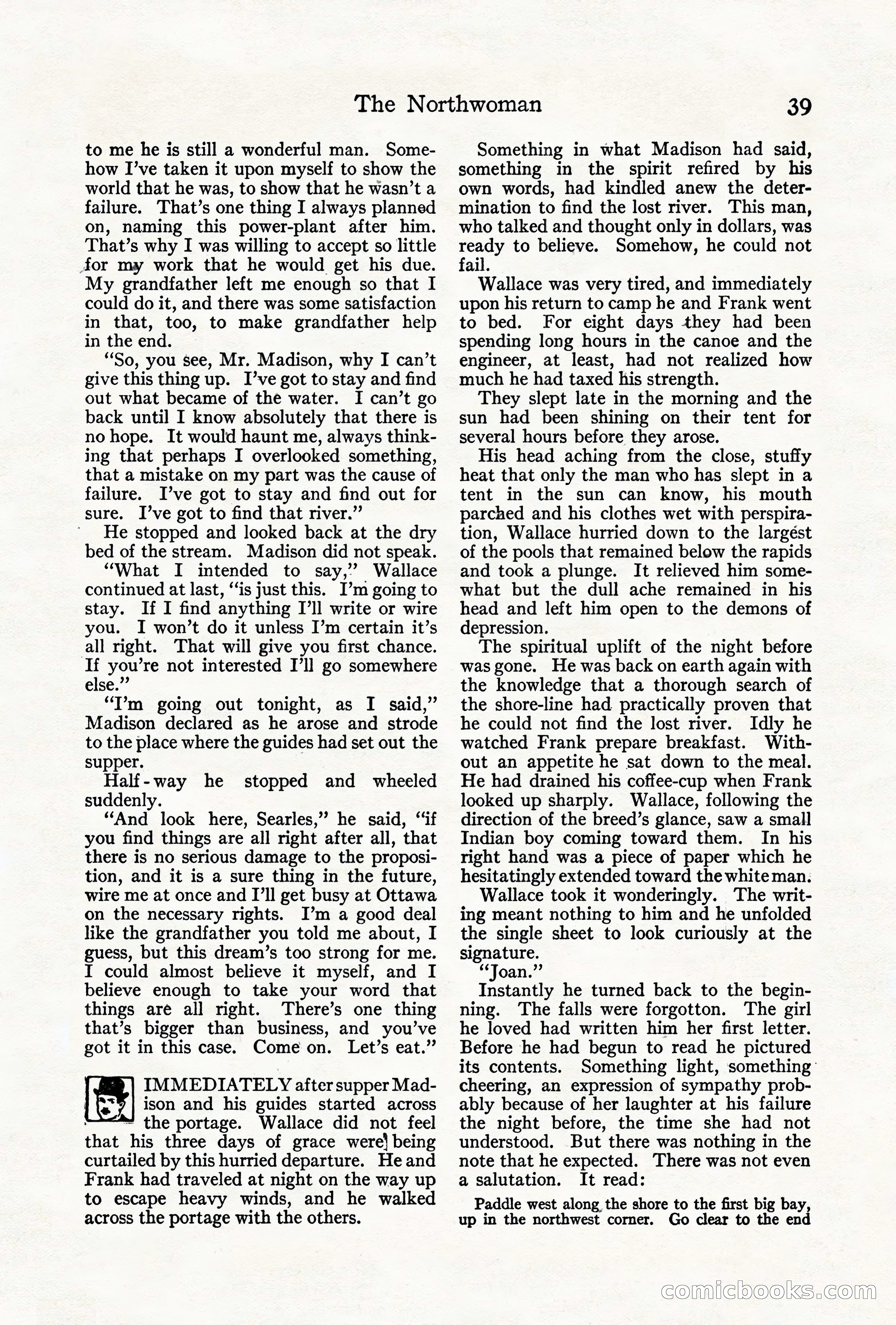
A restored page from Pulp Fiction, 1917. Page through the whole issue in the reader above.
📄 Transcribed text from this page (OCR, searchable)
Machine-transcribed from the original scan — historical spelling and the odd misread are preserved.
The Northwoman to me he is still a wonderful man. Some- how I’ve taken it upon myself to show the world that he was, to show that he wasn’t a failure. That’s one thing I always planned on, naming this power-plant after him. That’s why I was willing to accept so little for my work that he would get his due. My grandfather left me enough so that I could do it, and there was some satisfaction in that, too, to make grandfather help in the end. “So, you see, Mr. Madison, why I can’t give this thing up. I’ve got to stay and find out what became of the water. I can’t go back until I know absolutely that there is no hope. It would haunt me, always think- ing that perhaps I overlooked something, that a mistake on my part was the cause of failure. I’ve got to stay and find out for sure. I’ve got to find that river.” He stopped and looked back at the dry bed of the stream. Madison did not speak. “What I intended to say,’’ Wallace continued at last, ‘‘is just this. I’m going to stay. If I find anything I’ll write or wire you. I won’t do it unless I’m certain it’s all right. That will give you first chance. If you’re not interested I’ll go somewhere else.” “I’m going out tonight, as I said,” Madison declared as he arose and strode to the place where the guides had set out the supper. Half-way he suddenly. ‘‘And look here, Searles,’ he said, “if you find things are all right after all, that there is no serious damage to the proposi- tion, and it is a sure thing in the future, Wire me at once and I’ll get busy at Ottawa on the necessary rights. I’m a good deal like the grandfather you told me about, I guess, but this dream’s too strong for me. I could almost believe it myself, and I believe enough to take your word that things are all right. There’s one thing that’s bigger than business, and you’ve got it in this case. Come on. Let’s eat.” [si e —_ stopped and wheeled IMMEDIATELY after supper Mad- ison and his guides started across the portage. Wallace did not feel that his three days of grace were! being curtailed by this hurried departure. He and Frank had traveled at night on the way up to escape heavy winds, and he walked across the portage with the others. 39 Something in what Madison had said, something in the spirit refired by his own words, had kindled anew the deter- mination to find the lost river. This man, who talked and thought only in dollars, was ready to believe. Somehow, he could not fail. Wallace was very tired, and immediately upon his return to camp he and Frank went to bed. For eight days they had been spending long hours in the canoe and the engineer, at least, had not realized how much he had taxed his strength. They slept late in the morning and the sun had been shining on their tent for several hours before they arose. His head aching from the close, stuffy heat that only the man who has slept in a tent in the sun can know, his mouth parched and his clothes wet with perspira- tion, Wallace hurried down to the largést of the pools that remained below the rapids and took a plunge. It relieved him some- what but the dull ache remained in his head and left him open to the demons of depression. The spiritual uplift of the night before was gone. He was back on earth again with the knowledge that a thorough search of the shore-line had practically proven that he could not find the lost river. Idly he watched Frank prepare breakfast. With- out an appetite he sat down to the meal. He had drained his coffee-cup when Frank looked up sharply. Wallace, following the direction of the breed’s glance, saw a small Indian boy coming toward them. In his right hand was a piece of paper which he hesitatingly extended toward the white man. Wallace took it wonderingly. The writ- ing meant nothing to him and he unfolded the single sheet to look curiously at the signature. “Joan.” Instantly he turned back to the begin- ning. The falls were forgotton. The girl he loved had written him her first letter. Before he had begun to read he pictured its contents. cheering, an expression of sympathy prob- ably because of her laughter at his failure the night before, the time she had not understood. But there was nothing in the note that he expected. There was not even a salutation. It read: Paddle west along the shore to the first big bay, up in the northwest corner. Go clear to the end Comiclsoo Something light, something’ CO 5}