
Pulp Fiction, 1917 · page 22 of 196
Adventure, August 1917 — page 22: what you’re looking at
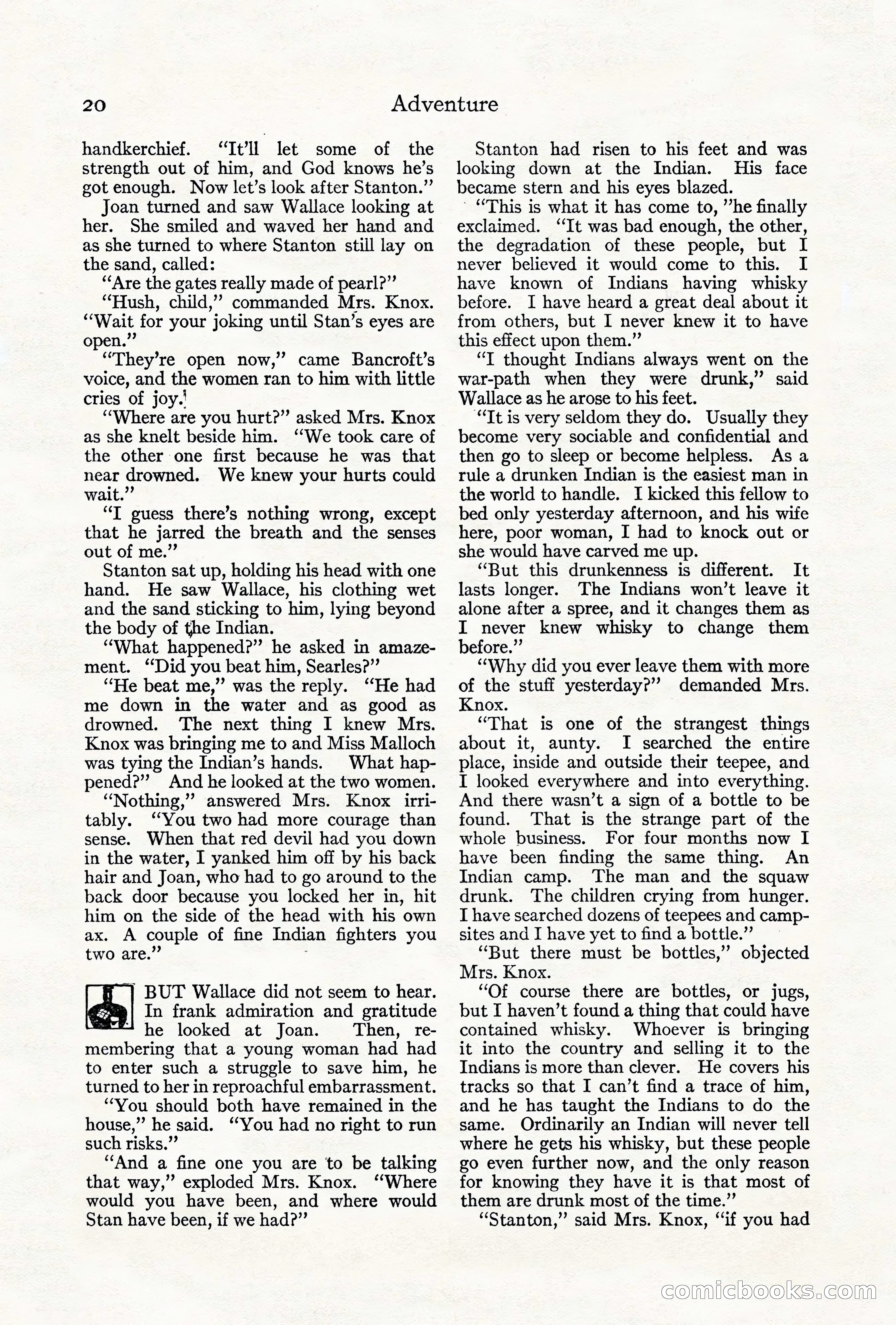
A restored page from Pulp Fiction, 1917. Page through the whole issue in the reader above.
📄 Transcribed text from this page (OCR, searchable)
Machine-transcribed from the original scan — historical spelling and the odd misread are preserved.
20 handkerchief. “It'll let some of the strength out of him, and God knows he’s got enough. Now let’s look after Stanton.” Joan turned and saw Wallace looking at her. She smiled and waved her hand and as she turned to where Stanton still lay on the sand, called: ‘‘Are the gates really made of pearl?” “Hush, child,” commanded Mrs. Knox. ‘Wait for your joking until Stan’s eyes are open.” “They’re open now,’ came Bancroft’s voice, and the women ran to him with little cries of joy.' ‘“‘Where are you hurt?” asked Mrs. Knox as she knelt beside him. ‘‘We took care of the other one first because he was that near drowned. We knew your hurts could wait.” “T guess there’s nothing wrong, except that he jarred the breath and the senses out of me.” Stanton sat up, holding his head with one hand. He saw Wallace, his clothing wet and the sand sticking to him, lying beyond the body of the Indian. “What happenedr” he asked in amaze- ment. “Did you beat him, Searles?” “He beat me,” was the reply. ‘‘He had me down in the water and as good as drowned. The next thing I knew Mrs. Knox was bringing me to and Miss Malloch was tying the Indian’s hands. What hap- pened?” And he looked at the two women. “Nothing,” answered Mrs. Knox irri- tably. ‘You two had more courage than sense. When that red devil had you down in the water, I yanked him off by his back hair and Joan, who had to go around to the back door because you locked her in, hit him on the side of the head with his own ax. A couple of fine Indian fighters you two are.” ida) In frank admiration and gratitude he looked at Joan. Then, re- membering that a young woman had had to enter such a struggle to save him, he turned to her in reproachful embarrassment. ‘You should both have remained in the house,” he said. ‘You had no right to run such risks.” ‘“‘And a fine one you are to be talking that way,” exploded Mrs. Knox. ‘‘Where would you have been, and where would Stan have been, if we hade”’ BUT Wallace did not seem to hear. Adventure Stanton had risen to his feet and was looking down at the Indian. His face became stern and his eyes blazed. “This is what it has come to, ”he finally exclaimed. “It was bad enough, the other, the degradation of these people, but I never believed it would come to this. I have known of Indians having whisky before. I have heard a great deal about it from others, but I never knew it to have this effect upon them.” “T thought Indians always went on the war-path when they were drunk,” said Wallace as he arose to his feet. “Tt is very seldom they do. Usually they become very sociable and confidential and then go to sleep or become helpless. As a rule a drunken Indian is the easiest man in the world to handle. I kicked this fellow to bed only yesterday afternoon, and his wife here, poor woman, I had to knock out or she would have carved me up. “But this drunkenness is different. It lasts longer. The Indians won’t leave it alone after a spree, and it changes them as I never knew whisky to change them before.” “Why did you ever leave them with more of the stuff yesterday?” demanded Mrs. Knox. “That is one of the strangest things about it, aunty. I searched the entire place, inside and outside their teepee, and I looked everywhere and into everything. And there wasn’t a sign of a bottle to be found. That is the strange part of the whole business. For four months now I have been finding the same thing. An Indian camp. The man and the squaw drunk. The children crying from hunger. I have searched dozens of teepees and camp- sites and I have yet to find a bottle.” “But there must be bottles,” objected Mrs. Knox. “Of course there are bottles, or jugs, but I haven’t found a thing that could have contained whisky. Whoever is bringing it into the country and selling it to the Indians is more than clever. He covers his tracks so that I can’t find a trace of him, and he has taught the Indians to do the same. Ordinarily an Indian will never tell where he gets his whisky, but these people go even further now, and the only reason for knowing they have it is that most of them are drunk most of the time.’’ “Stanton,” said Mrs. Knox, “if you had cCoMmicldook CO S|