
Pulp Fiction, 1917 · page 156 of 196
Adventure, August 1917 — page 156: what you’re looking at
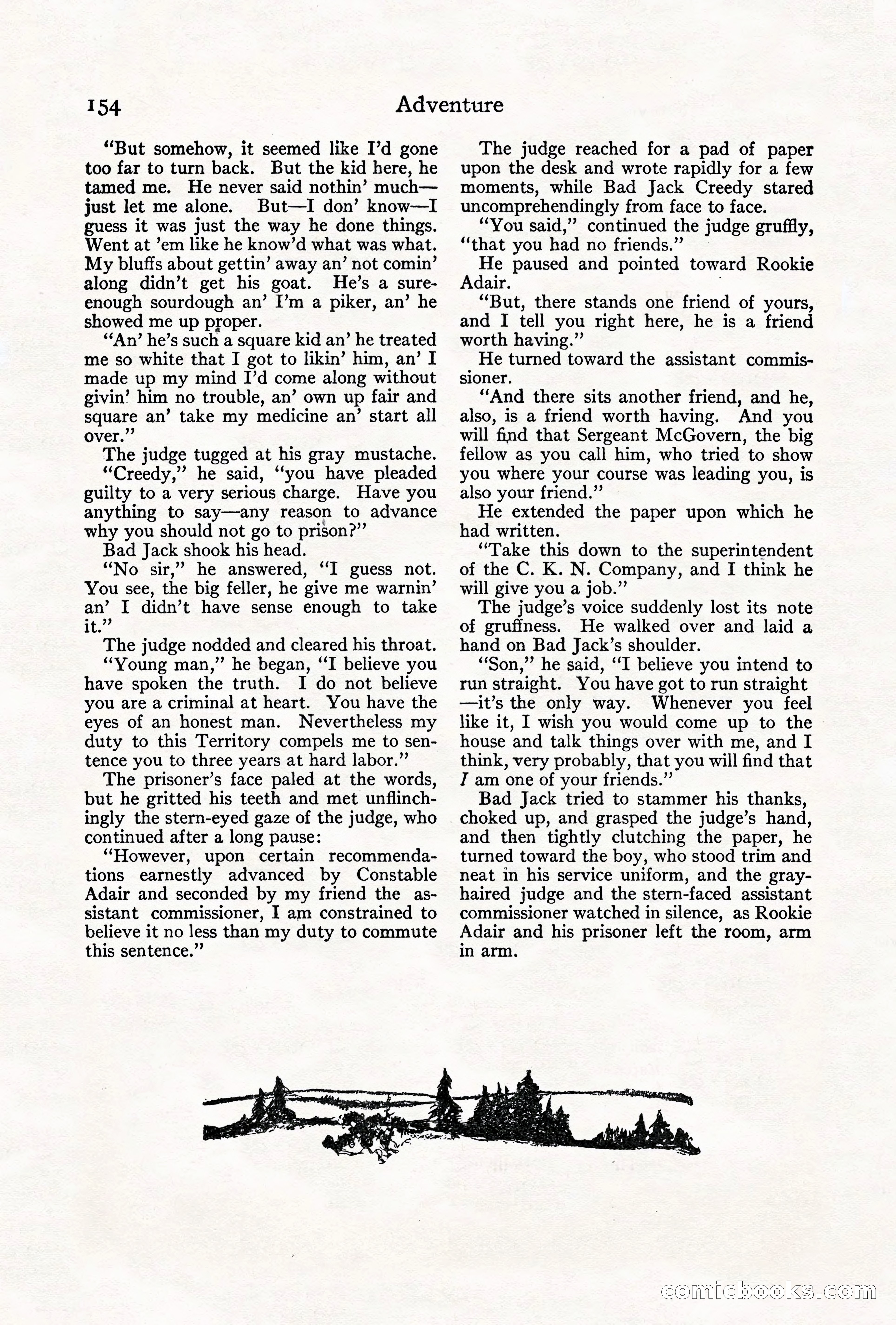
A restored page from Pulp Fiction, 1917. Page through the whole issue in the reader above.
📄 Transcribed text from this page (OCR, searchable)
Machine-transcribed from the original scan — historical spelling and the odd misread are preserved.
154 “But somehow, it seemed like I’d gone too far to turn back. But the kid here, he tamed me. He never said nothin’ much— just let me alone. But—I don’ know—I guess it was just the way he done things. Went at ’em like he know’d what was what. My bluffs about gettin’ away an’ not comin’ along didn’t get his , goat. He’s a sure- enough sourdough an’ I’m a piker, an’ he showed me up proper. ‘‘An’ he’s such a square kid an’ he treated me so white that I got to likin’ him, an’ I made up my mind I’d come along without givin’ him no trouble, an’ own up fair and square an’ take my medicine an’ start all over.” The judge tugged at his gray mustache. “‘Creedy,” he said, “you have pleaded guilty to a very serious charge. Have you anything to say—any reason to advance why you should not go to prison?” Bad Jack shook his head. “No sir,” he answered, “I guess not. You see, the big feller, he give me warnin’ an’ I didn’t have sense enough to take it. 93 The judge nodded and cleared his throat. “Young man,” he began, “I believe you have spoken the truth. I do not believe you are a criminal at heart. You have the eyes of an honest man. Nevertheless my duty to this Territory compels me to sen- tence you to three years at hard labor.”’ The prisoner’s face paled at the words, but he gritted his teeth and met unflinch- ingly the stern-eyed gaze of the judge, who continued after a long pause: “However, upon certain recommenda- tions earnestly advanced by Constable Adair and seconded by my friend the as- sistant commissioner, I am constrained to believe it no less than my duty to commute this sentence.” Adventure The judge reached for a pad of paper upon the desk and wrote rapidly for a few moments, while Bad Jack Creedy stared uncomprehendingly from face to face. “You said,” continued the judge gruffly, “that you had no friends.” | He paused and pointed toward Rookie Adair. “But, there stands one friend of yours, and I tell you right here, he is a friend worth having.”’ He turned toward the assistant commis- sioner. “‘And there sits another friend, and he, also, is a friend worth having. And you will find that Sergeant McGovern, the big fellow as you call him, who tried to show you where your course was leading you, is also your friend.” He extended the paper upon which he had written. “Take this down to the superintendent of the C. K. N. Company, and I think he will give you a job.” The judge’s voice suddenly lost its note of gruffness. He walked over and laid a hand on Bad Jack’s shoulder. “Son,” he said, “‘I believe you intend to run straight. You have got to run straight —it’s the only way. Whenever you feel like it, I wish you would come up to the house and talk things over with me, and I think, very probably, that you will find that I am one of your friends.” Bad Jack tried to stammer his thanks, choked up, and grasped the judge’s hand, and then tightly clutching the paper, he turned toward the boy, who stood trim and neat in his service uniform, and the gray- haired judge and the stern-faced assistant commissioner watched in silence, as Rookie Adair and his prisoner left the room, arm in arm. CoOMmiclsoo © S|