
Pulp Fiction, 1917 · page 15 of 196
Adventure, August 1917 — page 15: what you’re looking at
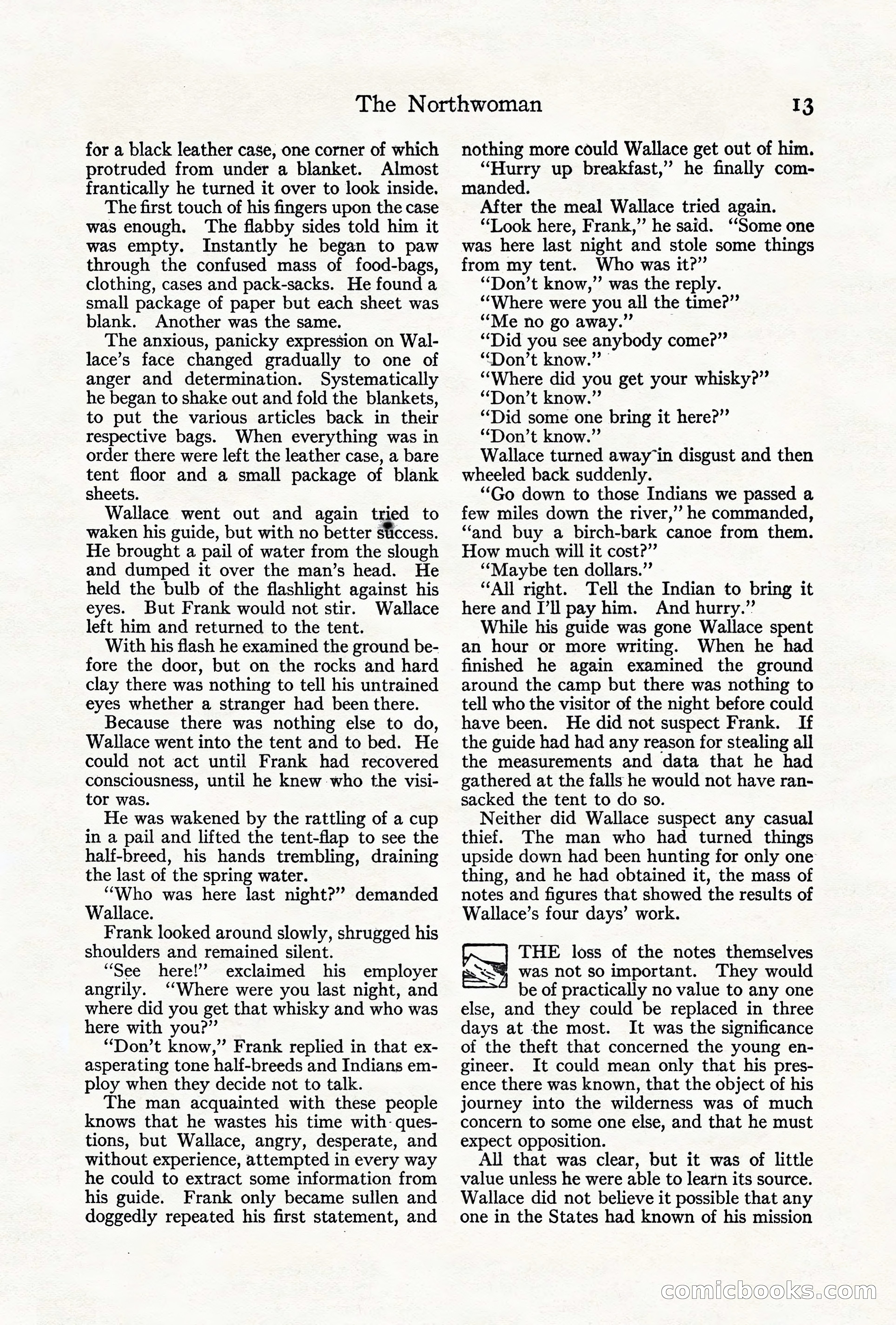
A restored page from Pulp Fiction, 1917. Page through the whole issue in the reader above.
📄 Transcribed text from this page (OCR, searchable)
Machine-transcribed from the original scan — historical spelling and the odd misread are preserved.
The Northwoman for a black leather case, one corner of which protruded from under a blanket. Almost frantically he turned it over to look inside. The first touch of his fingers upon the case was enough. ‘The flabby sides told him it was empty. Instantly he began to paw through the confused mass of food-bags, clothing, cases and pack-sacks. He found a small package of paper but each sheet was blank. Another was the same. The anxious, panicky expression on Wal- lace’s face changed gradually to one of anger and determination. Systematically he began to shake out and fold the blankets, to put the various articles back in their respective bags. When everything was in order there were left the leather case, a bare tent floor and a small package of blank sheets. Wallace went out and again tried to waken his guide, but with no better sficcess. He brought a pail of water from the slough and dumped it over the man’s head. He held the bulb of the flashlight against his eyes. But Frank would not stir. Wallace left him and returned to the tent. With his flash he examined the ground be- fore the door, but on the rocks and hard clay there was nothing to tell his untrained eyes whether a stranger had been there. Because there was nothing else to do, Wallace went into the tent and to bed. He could not act until Frank had recovered consciousness, until he knew who the visi- tor was. He was wakened by the rattling of a cup in a pail and lifted the tent-flap to see the half-breed, his hands trembling, draining the last of the spring water. ‘“‘Who was here last night?” demanded Wallace. Frank looked around slowly, shrugged his shoulders and remained silent. ‘See here!”’ exclaimed his employer angrily. ‘Where were you last night, and where did you get that whisky and who was here with you?” “Don’t know,” Frank replied in that ex- asperating tone half-breeds and Indians em- ploy when they decide not to talk. The man acquainted with these people knows that he wastes his time with-ques- tions, but Wallace, angry, desperate, and without experience, attempted in every way he could to extract some information from his guide. Frank only became sullen and doggedly repeated his first statement, and 13 nothing more could Wallace get out of him. “Hurry up breakfast,” he finally com- manded. : After the meal Wallace tried again. ‘Look here, Frank,’’ he said. ‘‘Some one was here last night and stole some things from my tent. Who was it?” ‘Don’t know,” was the reply. ‘‘Where were you all the time?” “Me no go away.” “Did you see anybody come?” “Don’t know.” ‘“‘Where did you get your whisky?” “Don’t know.” “Did some one bring it here?”’ “Don’t know.” | Wallace turned awayin disgust and then wheeled back suddenly. ‘““Go down to those Indians we passed a few miles down the river,” he commanded, ‘and buy a birch-bark canoe from them. How much will it cost?” “Maybe ten dollars.’’ “All right. Tell the Indian to bring it here and I’ll pay him. And hurry.” While his guide was gone Wallace spent an hour or more writing. When he had finished he again examined the ground around the camp but there was nothing to tell who the visitor of the night before could have been. He did not suspect Frank. If the guide had had any reason for stealing all the measurements and data that he had gathered at the falls he would not have ran- sacked the tent to do so. Neither did Wallace suspect any casual thief. The man who had turned things upside down had been hunting for only one thing, and he had obtained it, the mass of notes and figures that showed the results of Wallace’s four days’ work. THE loss of the notes themselves was not so important. They would be of practically no value to any one else, and they could be replaced in three days at the most. It was the significance of the theft that concerned the young en- gineer. It could mean only that his pres- ence there was known, that the object of his journey into the wilderness was of much concern to some one else, and that he must expect opposition. All that was clear, but it was of little value unless he were able to learn its source. Wallace did not believe it possible that any one in the States had known of his mission \. SSS CoMmiclsoo (© S}