
Pulp Fiction, 1917 · page 134 of 196
Adventure, August 1917 — page 134: what you’re looking at
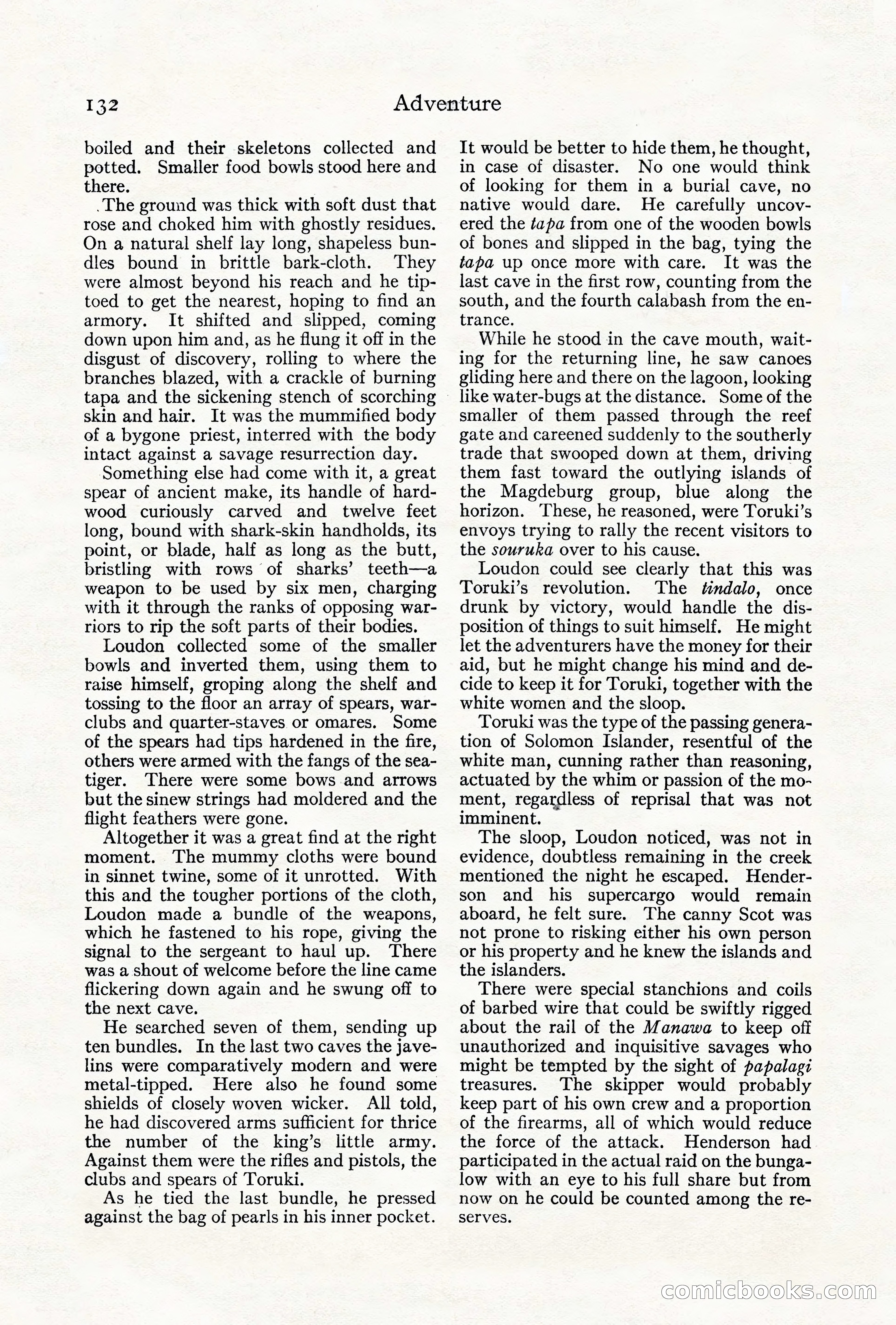
A restored page from Pulp Fiction, 1917. Page through the whole issue in the reader above.
📄 Transcribed text from this page (OCR, searchable)
Machine-transcribed from the original scan — historical spelling and the odd misread are preserved.
132 boiled and their skeletons collected and potted. Smaller food bowls stood here and there. 7 .The ground was thick with soft dust that rose and choked him with ghostly residues. On a natural shelf lay long, shapeless bun- dles bound in brittle bark-cloth. They were almost beyond his reach and he tip- toed to get the nearest, hoping to find an armory. It shifted and slipped, coming down upon him and, as he flung it off in the disgust of discovery, rolling to where the branches blazed, with a crackle of burning tapa and the sickening stench of scorching © skin and hair. It was the mummified body of a bygone priest, interred with the body intact against a savage resurrection day. Something else had come with it, a great spear of ancient make, its handle of hard- wood curiously carved and twelve feet long, bound with shark-skin handholds, its point, or blade, half as long as the butt, bristling with rows of sharks’ teeth—a weapon to be used by six men, charging with it through the ranks of opposing war- riors to rip the soft parts of their bodies. Loudon collected some of the smaller bowls and inverted them, using them to raise himself, groping along the shelf and tossing to the floor an array of spears, war- clubs and quarter-staves or omares. Some of the spears had tips hardened in the fire, others were armed with the fangs of the sea- tiger. There were some bows and arrows but the sinew strings had moldered and the flight feathers were gone. Altogether it was a great find at the right moment. The mummy cloths were bound in sinnet twine, some of it unrotted. With this and the tougher portions of the cloth, Loudon made a bundle of the weapons, which he fastened to his rope, giving the signal to the sergeant to haul up. There was a shout of welcome before the line came flickering down again and he swung off to the next cave. He searched seven of them, sending up ten bundles. In the last two caves the jave- lins were comparatively modern and were metal-tipped. Here also he found some shields of closely woven wicker. All told, he had discovered arms sufficient for thrice the number of the king’s little army. Against them were the rifles and pistols, the clubs and spears of Toruki. As he tied the last bundle, he pressed against the bag of pearls in his inner pocket. Adventure It would be better to hide them, he thought, in case of disaster. No one would think of looking for them in a burial cave, no native would dare. He carefully uncov- ered the ‘apa from one of the wooden bowls of bones and slipped in the bag, tying the tapa up once more with care. It was the last cave in the first row, counting from the south, and the fourth calabash from the en- trance. While he stood in the cave mouth, wait- ing for the returning line, he saw canoes gliding here and there on the lagoon, looking like water-bugs at the distance. Some of the smaller of them passed through the reef gate and careened suddenly to the southerly trade that swooped down at them, driving them fast toward the outlying islands of the Magdeburg group, blue along the horizon. These, he reasoned, were Toruki’s envoys trying to rally the recent visitors to the souruka over to his cause. Loudon could see clearly that this was Toruki’s revolution. The ¢indalo, once drunk by victory, would handle the dis- position of things to suit himself. He might let the adventurers have the money for their aid, but he might change his mind and de- cide to keep it for Toruki, together with the white women and the sloop. Toruki was the type of the passing genera- tion of Solomon Islander, resentful of the white man, cunning rather than reasoning, actuated by the whim or passion of the mo- ment, regardless of reprisal that was not imminent. The sloop, Loudon noticed, was not in evidence, doubtless remaining in the creek mentioned the night he escaped. Hender- son and his supercargo would remain aboard, he felt sure. The canny Scot was not prone to risking either his own person or his property and he knew the islands and the islanders. There were special stanchions and coils of barbed wire that could be swiftly rigged about the rail of the Manawa to keep off unauthorized and inquisitive savages who might be tempted by the sight of papalagi treasures. The skipper would probably keep part of his own crew and a proportion of the firearms, all of which would reduce the force of the attack. Henderson had participated in the actual raid on the bunga- low with an eye to his full share but from now on he could be counted among the re- serves. cComicaook CO S}