
Pulp Fiction, 1917 · page 13 of 196
Adventure, August 1917 — page 13: what you’re looking at
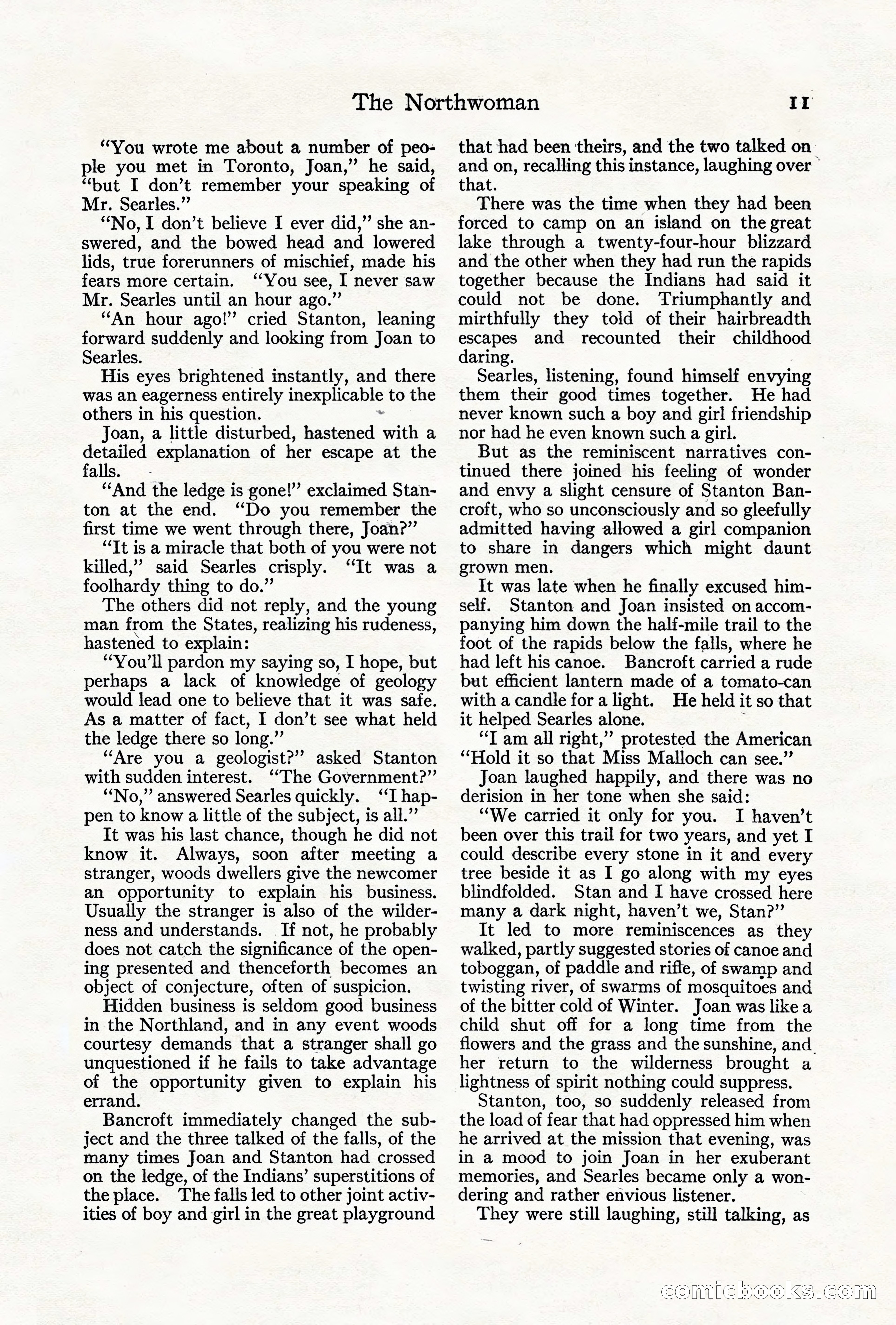
A restored page from Pulp Fiction, 1917. Page through the whole issue in the reader above.
📄 Transcribed text from this page (OCR, searchable)
Machine-transcribed from the original scan — historical spelling and the odd misread are preserved.
The Northwoman ‘You wrote me about a number of peo- ple you met in Toronto, Joan,” he said, “but I don’t remember your speaking of Mr. Searles.” “No, I don’t believe I ever did,” she an- swered, and the bowed head and lowered lids, true forerunners of mischief, made his fears more certain. ‘‘You see, I never saw Mr. Searles until an hour ago.” “An hour ago!’’ cried Stanton, leaning forward suddenly and looking from Joan to Searles. His eyes brightened instantly, and there was an eagerness entirely inexplicable to the others in his question. Joan, a little disturbed, hastened with a detailed explanation of her escape at the falls. - ‘“‘And the ledge is gone!”’ exclaimed Stan- ton at the end. “Do you remember the first time we went through there, Joan?” “It is a miracle that both of you were not killed,” said Searles crisply. “It was a foolhardy thing to do.” The others did not reply, and the young man from the States, realizing his rudeness, hastened to explain: ‘““You’ll pardon my saying so, I hope, but perhaps a lack of knowledge of geology would lead one to believe that it was safe. As a matter of fact, I don’t see what held the ledge there so long.” ‘“‘Are you a geologist?” asked Stanton with sudden interest. ‘The Government?” ‘““No,” answered Searles quickly. ‘I hap- pen to know a little of the subject, is all.” It was his last chance, though he did not know it. Always, soon after meeting a stranger, woods dwellers give the newcomer an opportunity to explain his business. Usually the stranger is also of the wilder- ness and understands. If not, he probably does not catch the significance of the open- ing presented and thenceforth becomes an object of conjecture, often of suspicion. Hidden business is seldom good business in the Northland, and in any event woods courtesy demands that a stranger shall go unquestioned if he fails to take advantage of the opportunity given to explain his errand. Bancroft immediately changed the sub- ject and the three talked of the falls, of the many times Joan and Stanton had crossed on the ledge, of the Indians’ superstitions of the place. The falls led to other joint activ- ities of boy and girl in the great playground IL that had been theirs, and the two talked on- and on, recalling this instance, laughing over that. There was the time when they had been forced to camp on an island on the great lake through a twenty-four-hour blizzard and the other when they had run the rapids together because the Indians had said it could not be done. Triumphantly and mirthfully they told of their hairbreadth escapes and recounted their childhood daring. Searles, listening, found himself envying them their good times together. He had never known such a boy and girl friendship nor had he even known such a girl. But as the reminiscent narratives con- tinued there joined his feeling of wonder and envy a slight censure of Stanton Ban- croft, who so unconsciously and so gleefully admitted having allowed a girl companion to share in dangers which might daunt grown men. It was late when he finally excused him- self. Stanton and Joan insisted on accom- panying him down the half-mile trail to the foot of the rapids below the falls, where he had left his canoe. Bancroft carried a rude but efficient lantern made of a tomato-can with a candle for a light. He held it so that it helped Searles alone. : “T am all right,” protested the American ‘Hold it so that Miss Malloch can see.” Joan laughed happily, and there was no derision in her tone when she said: “We carried it only for you. I haven’t been over this trail for two years, and yet I could describe every stone in it and every tree beside it as I go along with my eyes blindfolded. Stan and I have crossed here many a dark night, haven’t we, Stan?” It led to more reminiscences as they © walked, partly suggested stories of canoe and toboggan, of paddle and rifle, of swamp and twisting river, of swarms of mosquitoes and of the bitter cold of Winter. Joan was likea child shut off for a long time from the flowers and the grass and the sunshine, and her return to the wilderness brought a lightness of spirit nothing could suppress. Stanton, too, so suddenly released from the load of fear that had oppressed him when he arrived at the mission that evening, was in a mood to join Joan in her exuberant memories, and Searles became only a won- dering and rather envious listener. They were still laughing, still talking, as Comiclsoo CO S|