
Pulp Fiction, 1917 · page 127 of 196
Adventure, August 1917 — page 127: what you’re looking at
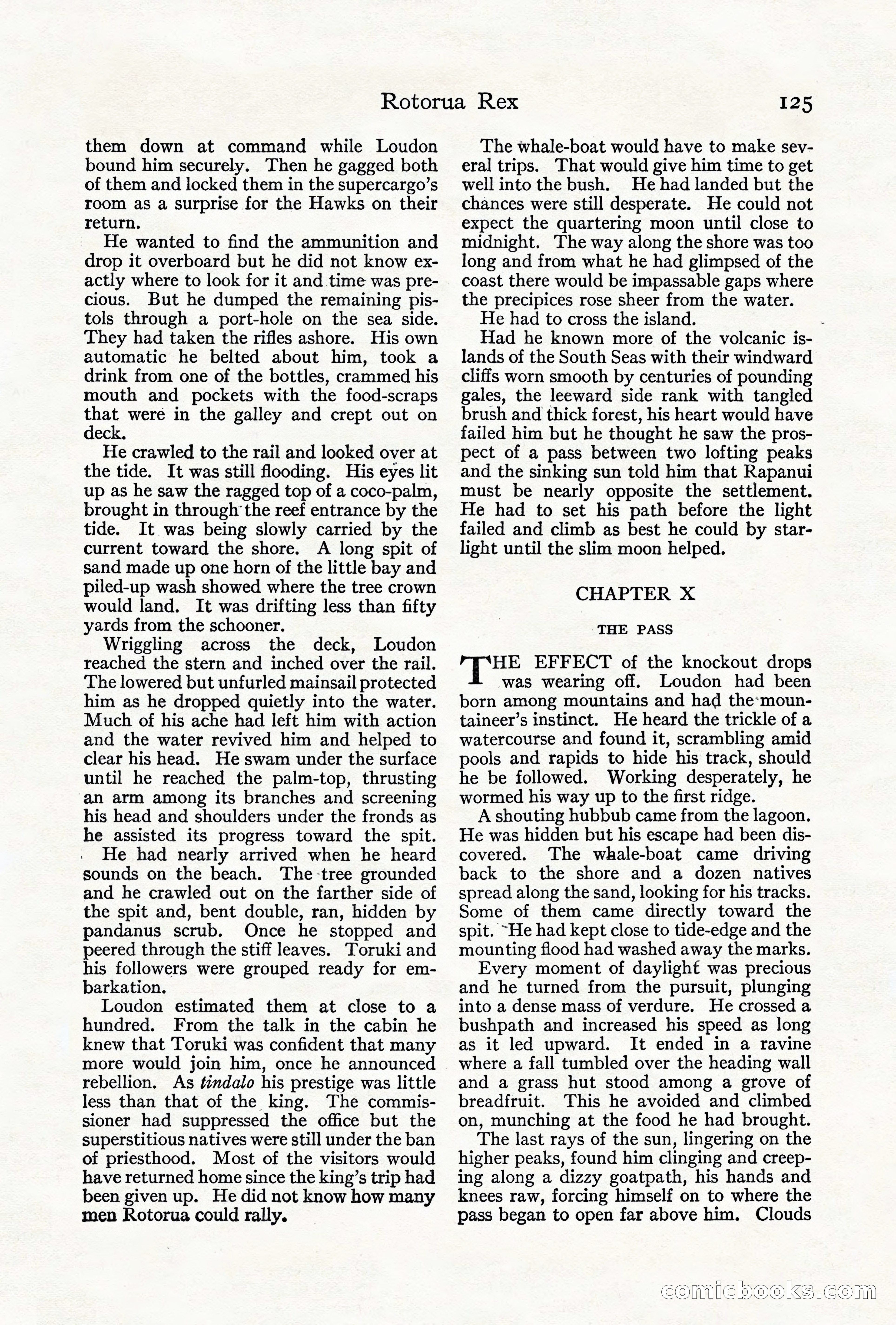
A restored page from Pulp Fiction, 1917. Page through the whole issue in the reader above.
📄 Transcribed text from this page (OCR, searchable)
Machine-transcribed from the original scan — historical spelling and the odd misread are preserved.
Rotorua Rex them down at command while Loudon bound him securely. Then he gagged both of them and locked them in the supercargo’s room as a surprise for the Hawks on their return. He wanted to find the ammunition and drop it overboard but he did not know ex- actly where to look for it and time was pre- cious. But he dumped the remaining pis- tols through a port-hole on the sea side. They had taken the rifles ashore. His own automatic he belted about him, took a drink from one of the bottles, crammed his mouth and pockets with the food-scraps that were in the galley and crept out on deck. He crawled to the rail and looked over at the tide. It was still flooding. His eyes lit up as he saw the ragged top of a coco-palm, brought in through the reef entrance by the tide. It was being slowly carried by the current toward the shore. A long spit of sand made up one horn of the little bay and piled-up wash showed where the tree crown would land. It was drifting less than fifty yards from the schooner. Wriggling across the deck, Loudon reached the stern and inched over the rail. The lowered but unfurled mainsail protected him as he dropped quietly into the water. Much of his ache had left him with action and the water revived him and helped to clear his head. He swam under the surface until he reached the palm-top, thrusting an arm among its branches and screening his head and shoulders under the fronds as he assisted its progress toward the spit. He had nearly arrived when he heard sounds on the beach. The-tree grounded and he crawled out on the farther side of the spit and, bent double, ran, hidden by pandanus scrub. Once he stopped and peered through the stiff leaves. Toruki and his followers were grouped ready for em- barkation. Loudon estimated them at close to a hundred. From the talk in the cabin he knew that Toruki was confident that many more would join him, once he announced rebellion. As tindalo his prestige was little less than that of the king. The commis- sioner had suppressed the office but the superstitious natives were still under the ban of priesthood. Most of the visitors would have returned home since the king’s trip had been given up. He did not know how many men Rotorua could rally. 125 The whale-boat would have to make sev- eral trips. That would give him time to get well into the bush. He had landed but the chances were still desperate. He could not expect the quartering moon until close to midnight. The way along the shore was too long and from what he had glimpsed of the coast there would be impassable gaps where the precipices rose sheer from the water. He had to cross the island. Had he known more of the volcanic is- lands of the South Seas with their windward cliffs worn smooth by centuries of pounding gales, the leeward side rank with tangled brush and thick forest, his heart would have failed him but he thought he saw the pros- pect of a pass between two lofting peaks and the sinking sun told him that Rapanui must be nearly opposite the settlement. He had to set his path before the light failed and climb as best he could by star- light until the slim moon helped. CHAPTER X THE PASS 4 Bes EFFECT of the knockout drops was wearing off. Loudon had been born among mountains and had the-moun- taineer’s instinct. He heard the trickle of a watercourse and found it, scrambling amid pools and rapids to hide his track, should he be followed. Working desperately, he wormed his way up to the first ridge. A shouting hubbub came from the lagoon. He was hidden but his escape had been dis- covered. The whale-boat came driving back to the shore and a dozen natives spread along the sand, looking for his tracks. Some of them came directly toward the spit. “He had kept close to tide-edge and the mounting flood had washed away the marks. Every moment of daylight was precious and he turned from the pursuit, plunging into a dense mass of verdure. He crossed a bushpath and increased his speed as long as it led upward. It ended in a ravine where a fall tumbled over the heading wall and a grass hut stood among a grove of breadfruit. This he avoided and climbed on, munching at the food he had brought. The last rays of the sun, lingering on the higher peaks, found him clinging and creep- ing along a dizzy goatpath, his hands and knees raw, forcing himself on to where the pass began to open far above him. Clouds Comiclsoo (© 5}