
Pulp Fiction, 1917 · page 114 of 196
Adventure, August 1917 — page 114: what you’re looking at
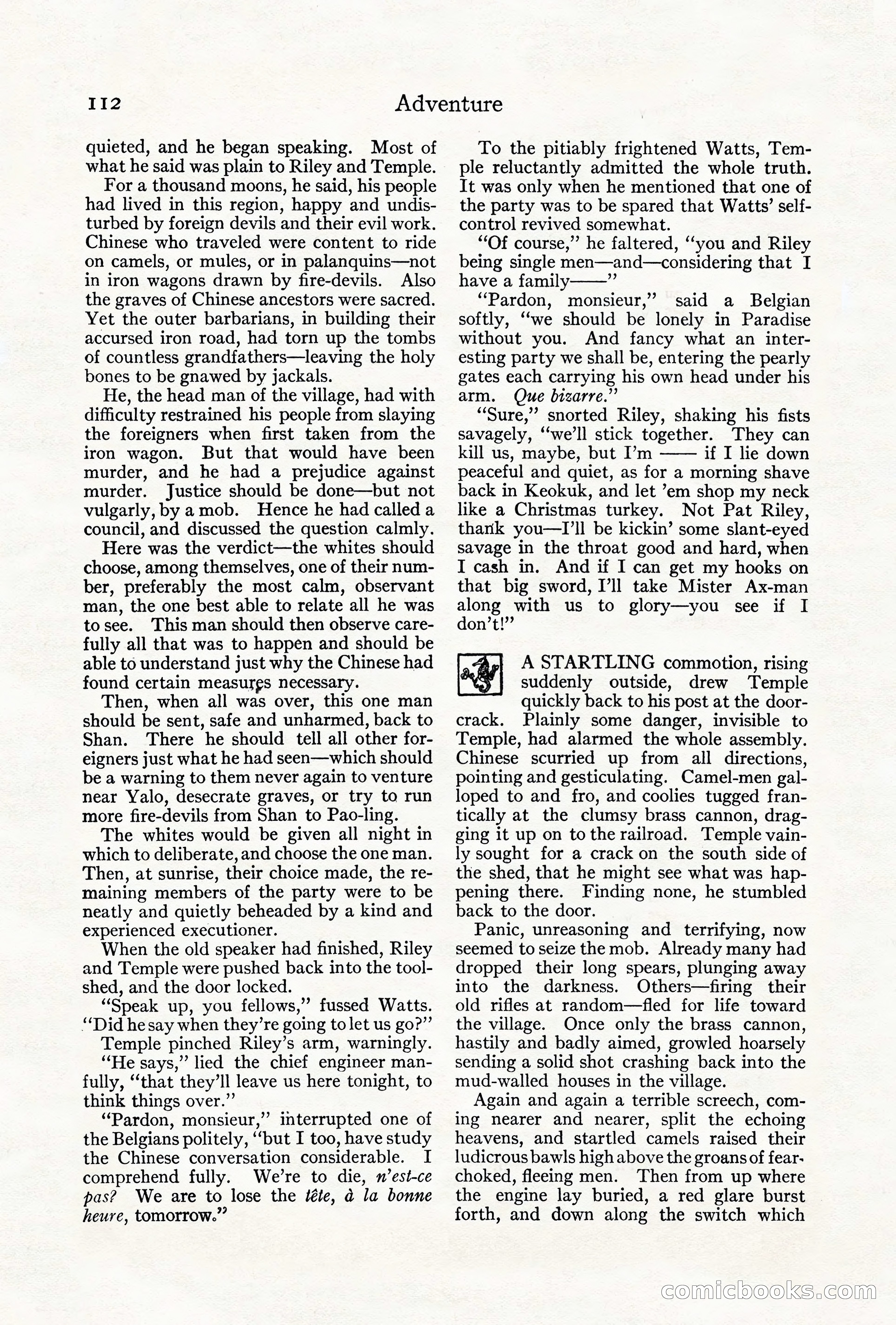
A restored page from Pulp Fiction, 1917. Page through the whole issue in the reader above.
📄 Transcribed text from this page (OCR, searchable)
Machine-transcribed from the original scan — historical spelling and the odd misread are preserved.
112 quieted, and he began speaking. Most of what he said was plain to Riley and Temple. For a thousand moons, he said, his people had lived in this region, happy and undis- turbed by foreign devils and their evil work. Chinese who traveled were content to ride on camels, or mules, or in palanquins—not in iron wagons drawn by fire-devils. Also the graves of Chinese ancestors were sacred. Yet the outer barbarians, in building their accursed iron road, had torn up the tombs of countless grandfathers—leaving the holy bones to be gnawed by Jackals. He, the head man of the village, had with difficulty restrained his people from slaying the foreigners when first taken from the iron wagon. But that would have been murder, and he had a prejudice against murder. Justice should be done—but not vulgarly, bya mob. Hence he had called a council, and discussed the question calmly. Here was the verdict—the whites should choose, among themselves, one of their num- ber, preferably the most calm, observant man, the one best able to relate all he was tosee. ‘This man should then observe care- fully all that was to happen and should be able to understand just why the Chinese had found certain measurgs necessary. Then, when all was over, this one man should be sent, safe and unharmed, back to Shan. There he should tell all other for- eigners just what he had seen—which should be a warning to them never again to venture near Yalo, desecrate graves, or try to run more fire-devils from Shan to Pao-ling. The whites would be given all night in which to deliberate, and choose the one man. Then, at sunrise, their choice made, the re- maining members of the party were to be neatly and quietly beheaded by a kind and experienced executioner. When the old speaker had finished, Riley and Temple were pushed back into the tool- shed, and the door locked. “Speak up, you fellows,” fussed Watts. “Did he say when they’re going tolet us go?” Temple pinched Riley’s arm, warningly. “He says,” lied the chief engineer man- fully, “‘that they’ll leave us here tonight, to think things over.”’ “Pardon, monsieur,” interrupted one of the Belgians politely, ‘but I too, have study the Chinese conversation considerable. I comprehend fully. We're to die, n’est-ce pas? We are to lose the /éte, d la bonne heure, tomorrow.” Adventure To the pitiably frightened Watts, Tem- ple reluctantly admitted the whole truth. It was only when he mentioned that one of the party was to be spared that Watts’ self- control revived somewhat. “Of course,” he faltered, ‘‘you and Riley being single men—and—considering that I have a family bs “Pardon, monsieur,” said a Belgian softly, “we should be lonely in Paradise without you. And fancy what an inter- esting party we shall be, entering the pearly gates each carrying his own head under his arm. Que bizarre.” “Sure,” snorted Riley, shaking his fists savagely, “we'll stick together. They can kill us, maybe, but I’m if I lie down peaceful and quiet, as for a morning shave back in Keokuk, and let ’em shop my neck like a Christmas turkey. Not Pat Riley, thank you—I’ll be kickin’ some slant-eyed savage in the throat good and hard, when I cash in. And if I can get my hooks on that big sword, I’ll take Mister Ax-man along with us to glory—you see if I don’t!” A STARTLING commotion, rising suddenly outside, drew Temple quickly back to his post at the door- crack. Plainly some danger, invisible to Temple, had alarmed the whole assembly. Chinese scurried up from all directions, pointing and gesticulating. Camel-men gal- loped to and fro, and coolies tugged fran- tically at the clumsy brass cannon, drag- ging it up on tothe railroad. Temple vain- ly sought for a crack on the south side of the shed, that he might see what was hap- pening there. Finding none, he stumbled back to the door. Panic, unreasoning and terrifying, now seemed to seize the mob. Already many had dropped their long spears, plunging away into the darkness. Others—firing their old rifles at random—fled for life toward the village. Once only the brass cannon, hastily and badly aimed, growled hoarsely sending a solid shot crashing back into the mud-walled houses in the village. Again and again a terrible screech, com- ing nearer and nearer, split the echoing heavens, and startled camels raised their ludicrous bawls high above the groans of fear. choked, fleeing men. Then from up where the engine lay buried, a red glare burst forth, and down along the switch which COmiclbook (© 5}