
Pulp Fiction, 1916 · page 79 of 228
Adventure Magazine Cover, April 1916 — page 79: what you’re looking at
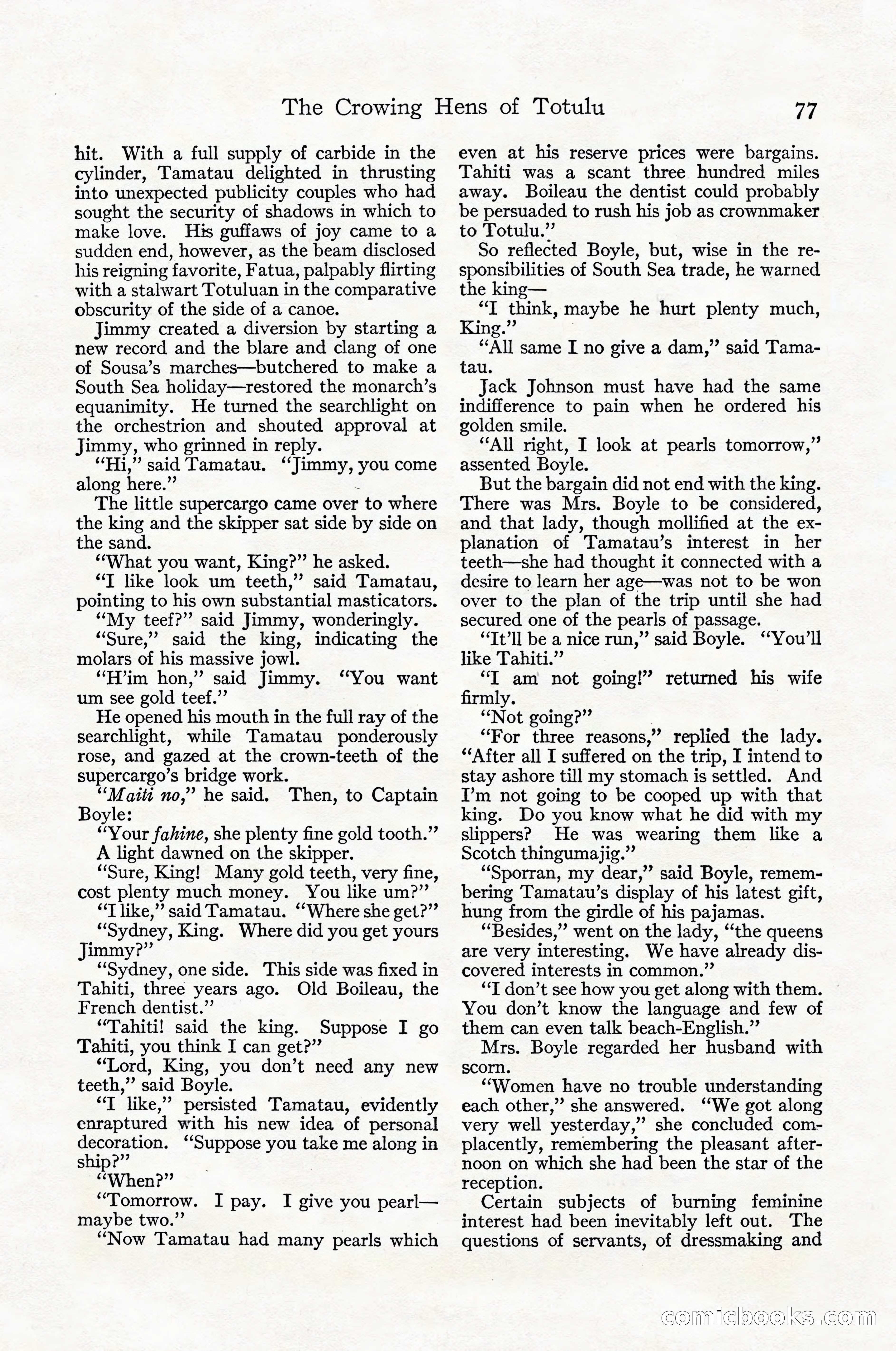
A restored page from Pulp Fiction, 1916. Page through the whole issue in the reader above.
📄 Transcribed text from this page (OCR, searchable)
Machine-transcribed from the original scan — historical spelling and the odd misread are preserved.
The Crowing Hens of Totulu hit. With a full supply of carbide in the cylinder, Tamatau delighted in thrusting into unexpected publicity couples who had sought the security of shadows in which to make love. His guffaws of joy came to a sudden end, however, as the beam disclosed his reigning favorite, Fatua, palpably flirting with a stalwart Totuluan in the comparative obscurity of the side of a canoe. Jimmy created a diversion by starting a new record and the blare and clang of one of Sousa’s marches—butchered to make a South Sea holiday—restored the monarch’s equanimity. He turned the searchlight on the orchestrion and shouted approval at Jimmy, who grinned in reply. wees Ms said Tamatau. “Jimmy, you come along here.” The little supercargo came over to where the king and the skipper sat side by side on the sand. ‘‘What you want, King?” he asked. “T like look um teeth,” said Tamatau, pointing to his own substantial masticators. ‘““My teef?” said Jimmy, wonderingly. ‘‘Sure,” said the king, indicating the molars of his massive jowl. *‘H’im hon,” said Jimmy. um see gold teef.”’ He opened his mouth in the full ray of the searchlight, while Tamatau ponderously rose, and gazed at the crown-teeth of the supercargo’s bridge work. “Maiti no,” he said. Then, to Captain Boyle: “Your fahine, she plenty fine gold tooth.” A light dawned on the skipper. “Sure, King! Many gold teeth, very fine, cost plenty much money. You like um?” “T like,” said Tamatau. “‘Where she get?” ‘“‘Sydney, King. Where did you get yours Jimmy?” ‘Sydney, one side. This side was fixed in Tahiti, three years ago. Old Boileau, the French dentist.” “Tahiti! said the king. Suppose I go Tahiti, you think I can get?” “Lord, King, you don’t need any new teeth,”’ said Boyle. “T like,” persisted Tamatau, evidently enraptured with his new idea of personal decoration. “Suppose you take me along in ship?” (4 “When?” “Tomorrow. I pay. I give you pearl— maybe two.” ‘“‘Now Tamatau had many pearls which “Vou want 77 even at his reserve prices were bargains. Tahiti was a scant three hundred miles away. Boileau the dentist could probably be persuaded to rush his job as crownmaker to Totulu.” So reflected Boyle, but, wise in the re- sponsibilities of South Sea trade, he warned the king— ge | think, maybe he hurt plenty much, King.” ‘“‘All same I no give a dam,” tau. Jack Johnson must have had the same indifference to pain when he ordered his golden smile. “All right, I look at pearls tomorrow,” assented Boyle. But the bargain did not end with the king. There was Mrs. Boyle to be considered, and that lady, though mollified at the ex- planation of Tamatau’s interest in her teeth—she had thought it connected with a desire to learn her age—was not to be won over to the plan of the trip until she had secured one of the pearls of passage. “Tt’ll be a nice run,” said Boyle. like Tahiti.” “T am not going!” returned his wife firmly. “Not going?” “For three reasons,” replied the lady. ‘‘After all I suffered on the trip, I intend to stay ashore till my stomach is settled. And I’m not going to be cooped up with that king. Do you know what he did with my slippers? He was wearing them like a Scotch thingumajig.”’ ‘“Sporran, my dear,” said Boyle, remem- bering Tamatau’s display of his latest gift, hung from the girdle of his pajamas. ‘‘Besides,”’ went on the lady, “‘the queens are very interesting. We have already dis- covered interests in common.” ‘I don’t see how you get along with them. You don’t know the language and few of them can even talk beach-English.” Mrs. Boyle regarded her husband with scorn. ‘“Women have no trouble understanding each other,” she answered. ‘‘We got along very well yesterday,” she concluded com- placently, remembering the pleasant after- noon on which she had been the star of the reception. Certain subjects of burning feminine interest had been inevitably left out. The questions of servants, of dressmaking and said Tama- “Vou ll CoMmicboooks CO