
Pulp Fiction, 1916 · page 75 of 228
Adventure Magazine Cover, April 1916 — page 75: what you’re looking at
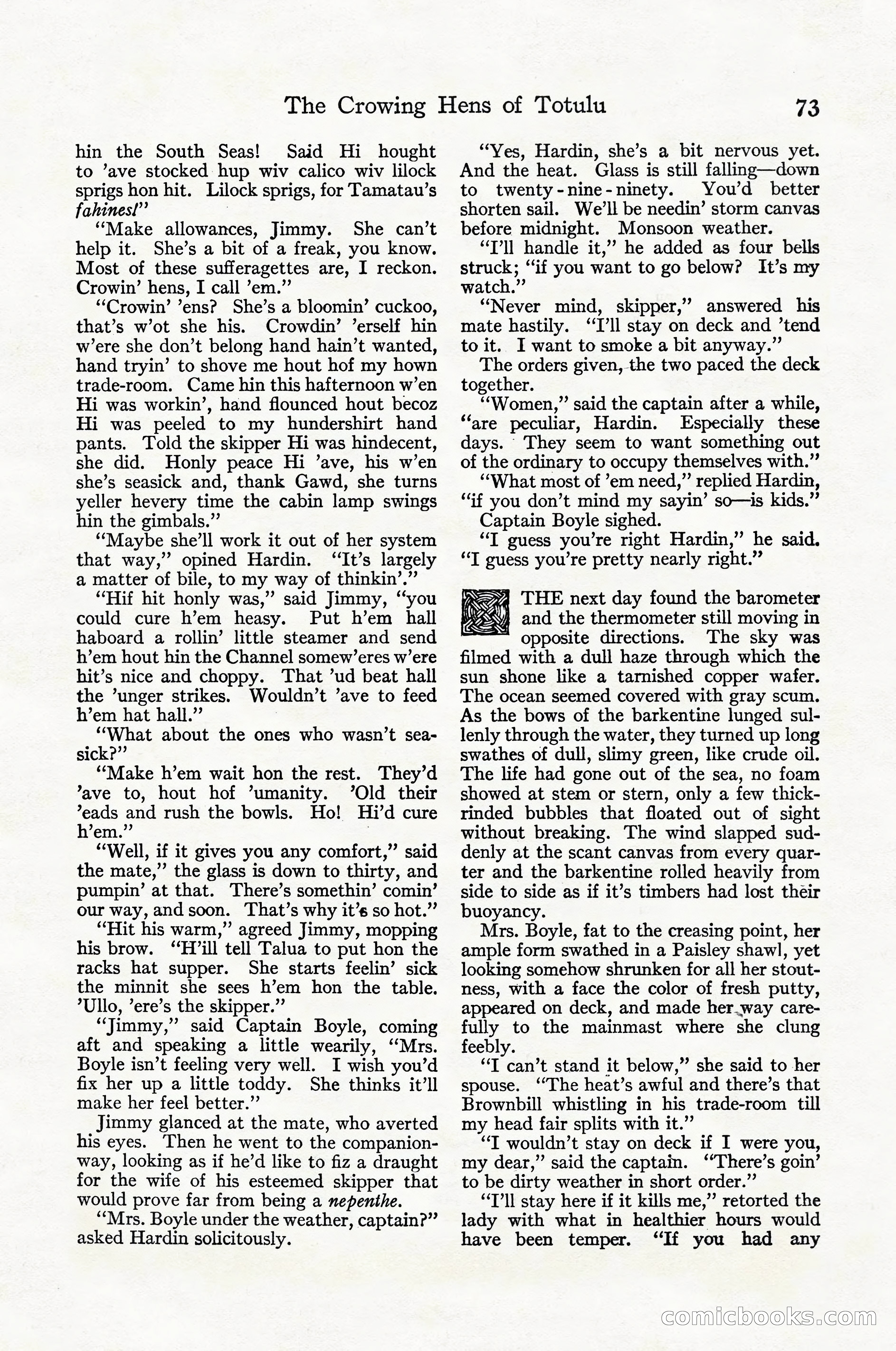
A restored page from Pulp Fiction, 1916. Page through the whole issue in the reader above.
📄 Transcribed text from this page (OCR, searchable)
Machine-transcribed from the original scan — historical spelling and the odd misread are preserved.
The Crowing Hens of Totulu hin the South Seas! Said Hi hought to ’ave stocked hup wiv calico wiv lilock sprigs hon hit. Lilock sprigs, for Tamatau’s fahinesl’’ 7 “Make allowances, Jimmy. She can’t help it. She’s a bit of a freak, you know. Most of these sufferagettes are, I reckon. Crowin’ hens, I call ’em.”’ ““Crowin’ ’ens? She’s a bloomin’ cuckoo, that’s w’ot she his. Crowdin’ ’erself hin w’ere she don’t belong hand hain’t wanted, hand tryin’ to shove me hout hof my hown trade-room. Came hin this hafternoon w’en Hi was workin’, hand flounced hout becoz Hi was peeled to my hundershirt hand pants. Told the skipper Hi was hindecent, she did. Honly peace Hi ’ave, his w’en she’s seasick and, thank Gawd, she turns yeller hevery time the cabin lamp swings hin the gimbals.” “Maybe she’ll work it out of her system that way,” opined Hardin. “It’s largely a matter of bile, to my way of thinkin’.” “Hif hit honly was,” said Jimmy, “‘you could cure h’em heasy. Put h’em hall haboard a rollin’ little steamer and send h’em hout hin the Channel somew’eres w’ere hit’s nice and choppy. That ’ud beat hall the ’unger strikes. Wouldn’t ’ave to feed h’em hat hall.” : “‘What about the ones who wasn’t sea- sick?” “Make h’em wait hon the rest. They’d ’ave to, hout hof ’umanity. ’Old their ’eads and rush the bowls. Ho! Hi’d cure h’em.” : “‘Well, if it gives you any comfort,” said the mate,” the glass is down to thirty, and pumpin’ at that. There’s somethin’ comin’ our way, and soon. That’s why it’s so hot.” “Hit his warm,” agreed Jimmy, mopping his brow. “Hill tell Talua to put hon the racks hat supper. She starts feelin’ sick the minnit she sees h’em hon the table. *Ullo, ’ere’s the skipper.” “Jimmy,” said Captain Boyle, coming aft and speaking a little wearily, “Mrs. Boyle isn’t feeling very well. I wish you’d fix her up a little toddy. She thinks it’ll make her feel better.”’ Jimmy glanced at the mate, who averted his eyes. Then he went to the companion- way, looking as if he’d like to fiz a draught for the wife of his esteemed skipper that would prove far from being a nepenthe. “Mrs. Boyle under the weather, captain?” asked Hardin solicitously. 73 “Yes, Hardin, she’s a bit nervous yet. And the heat. Glass is still falling—down to twenty-nine-ninety. You'd better shorten sail. We'll be needin’ storm canvas before midnight. Monsoon weather. “T’ll handle it,’’ he added as four bells struck; “if you want to go below? It’s my watch.” “Never mind, skipper,’ answered his mate hastily. ‘‘I’ll stay on deck and ’tend to it. I want to smoke a bit anyway.” The orders given, the two paced the deck together. ‘“‘Women,” said the captain after a while, “fare peculiar, Hardin. Especially these days. They seem to want something out of the ordinary to occupy themselves with.” ‘‘What most of ’em need,” replied Hardin, ‘Gf you don’t mind my sayin’ so—is kids.” Captain Boyle sighed. “T guess you’re right Hardin,” he said. “T guess you’re pretty nearly right.” Ome THE next day found the barometer WAN: ‘ eis WN and the thermometer still moving in opposite directions. The sky was filmed with a dull haze through which the sun shone like a tarnished copper wafer. The ocean seemed covered with gray scum. As the bows of the barkentine lunged sul- lenly through the water, they turned up long swathes of dull, slimy green, like crude oil. The life had gone out of the sea, no foam showed at stem or stern, only a few thick- rinded bubbles that floated out of sight without breaking. The wind slapped sud- denly at the scant canvas from every quar- ter and the barkentine rolled heavily from side to side as if it’s timbers had lost their buoyancy. Mrs. Boyle, fat to the creasing point, her ample form swathed in a Paisley shawl, yet looking somehow shrunken for all her stout- ness, with a face the color of fresh putty, appeared on deck, and made her way care- fully to the mainmast where she clung feebly. “T can’t stand it below,” she said to her spouse. ‘The heat’s awful and there’s that Brownbill whistling in his trade-room till my head fair splits with it.” “T wouldn’t stay on deck if I were you, my dear,” said the captain. ‘“There’s goin’ to be dirty weather in short order.”’ “T’ll stay here if it kills me,” retorted the lady with what in healthier hours would have been temper. “If you had any CoOMmichoooks CO