
Pulp Fiction, 1916 · page 6 of 228
Adventure Magazine Cover, April 1916 — page 6: what you’re looking at
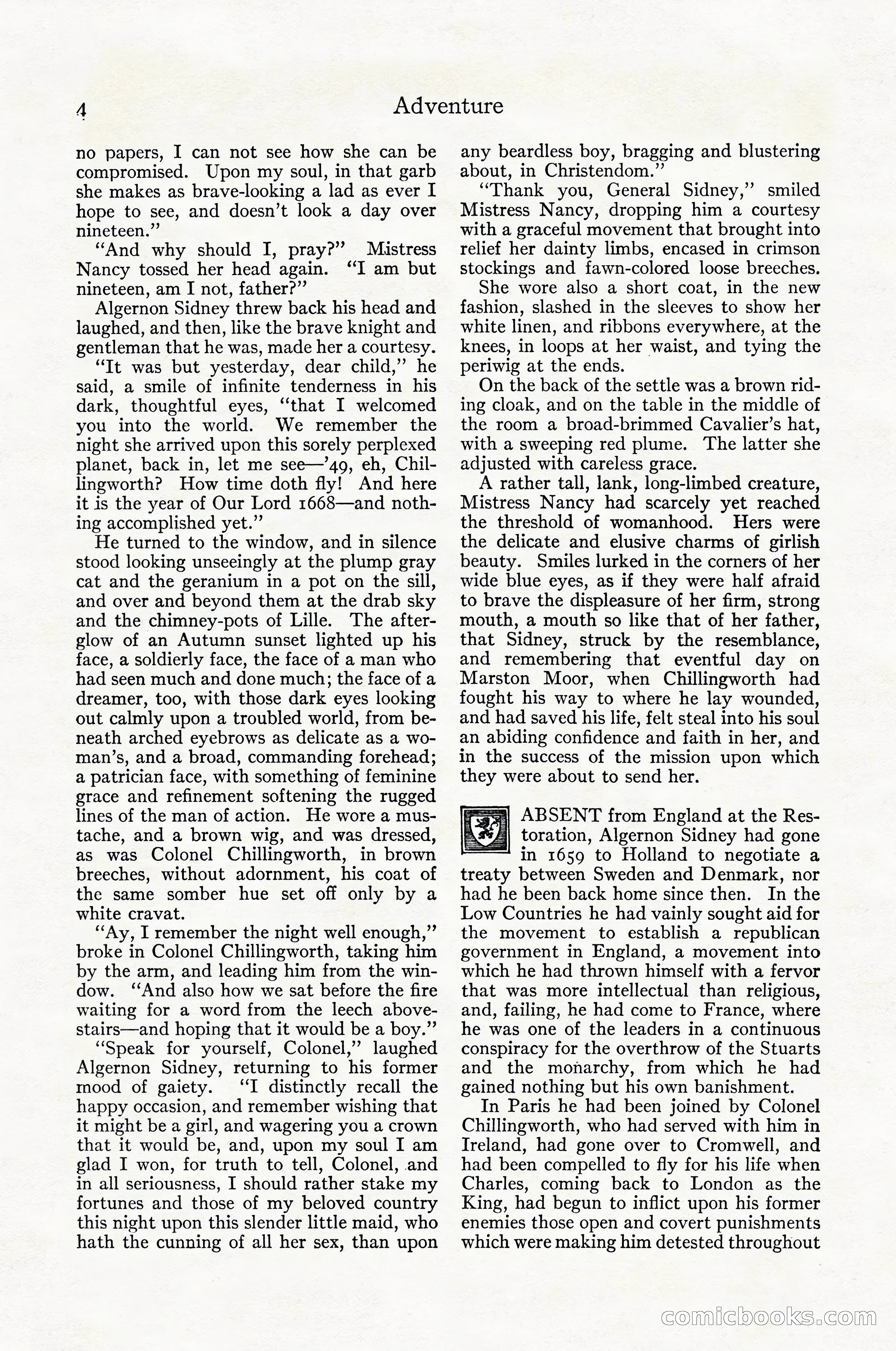
A restored page from Pulp Fiction, 1916. Page through the whole issue in the reader above.
📄 Transcribed text from this page (OCR, searchable)
Machine-transcribed from the original scan — historical spelling and the odd misread are preserved.
A no papers, I can not see how she can be compromised. Upon my soul, in that garb she makes as brave-looking a lad as ever I hope to see, and doesn’t look a day over nineteen.” “And why should I, pray?” Nancy tossed her head again. nineteen, am I not, father?” Algernon Sidney threw back his head and laughed, and then, like the brave knight and gentleman that he was, made her a courtesy. “Tt was but yesterday, dear child,” he said, a smile of infinite tenderness in his dark, thoughtful eyes, “‘that I welcomed you into the world. We remember the night she arrived upon this sorely perplexed planet, back in, let me see—’4g, eh, Chil- lingworthe How time doth fly! And here it is the year of Our Lord 1668—and noth- ing accomplished yet.” He turned to the window, and in silence stood looking unseeingly at the plump gray cat and the geranium in a pot on the sill, and over and beyond them at the drab sky and the chimney-pots of Lille. The after- glow of an Autumn sunset lighted up his face, a soldierly face, the face of a man who had seen much and done much; the face of a dreamer, too, with those dark eyes looking out calmly upon a troubled world, from be- neath arched eyebrows as delicate as a wo- man’s, and a broad, commanding forehead; a patrician face, with something of feminine grace and refinement softening the rugged lines of the man of action. He wore a mus- tache, and a brown wig, and was dressed, as was Colonel Chillingworth, in brown breeches, without adornment, his coat of the same somber hue set off only by a white cravat. ‘‘Ay, I remember the night well enough,”’ broke in Colonel Chillingworth, taking him by the arm, and leading him from the win- dow. ‘And also how we sat before the fire waiting for a word from the leech above- stairs—and hoping that it would be a boy.” ‘Speak for yourself, Colonel,’ laughed Algernon Sidney, returning to his former mood of gaiety. ‘I distinctly recall the happy occasion, and remember wishing that it might be a girl, and wagering you a crown that it would be, and, upon my soul I am glad I won, for truth to tell, Colonel, and in all seriousness, I should rather stake my fortunes and those of my beloved country this night upon this slender little maid, who hath the cunning of all her sex, than upon Mistress “T am but Adventure any beardless boy, bragging and blustering about, in Christendom.”’ “Thank you, General Sidney,” smiled Mistress Nancy, dropping him a courtesy with a graceful movement that brought into relief her dainty limbs, encased in crimson stockings and fawn-colored loose breeches. She wore also a short coat, in the new fashion, slashed in the sleeves to show her white linen, and ribbons everywhere, at the knees, in loops at her waist, and tying the periwig at the ends. On the back of the settle was a brown rid- ing cloak, and on the table in the middle of the room a broad-brimmed Cavalier’s hat, with a sweeping red plume. The latter she adjusted with careless grace. A rather tall, lank, long-limbed creature, Mistress Nancy had scarcely yet reached the threshold of womanhood. Hers were the delicate and elusive charms of girlish beauty. Smiles lurked in the corners of her wide blue eyes, as if they were half afraid to brave the displeasure of her firm, strong mouth, a mouth so like that of her father, that Sidney, struck by the resemblance, and remembering that eventful day on Marston Moor, when Chillingworth had fought his way to where he lay wounded, and had saved his life, felt steal into his soul an abiding confidence and faith in her, and in the success of the mission upon which they were about to send her. faa) ABSENT from England at the Res- Ag##Z4) toration, Algernon Sidney had gone in 1659 to Holland to negotiate a treaty between Sweden and Denmark, nor had he been back home since then. In the Low Countries he had vainly sought aid for the movement to establish a republican government in England, a movement into which he had thrown himself with a fervor that was more intellectual than religious, and, failing, he had come to France, where he was one of the leaders in a continuous conspiracy for the overthrow of the Stuarts and the monarchy, from which he had gained nothing but his own banishment. In Paris he had been joined by Colonel Chillingworth, who had served with him in Ireland, had gone over to Cromwell, and had been compelled to fly for his life when Charles, coming back to London as the King, had begun to inflict upon his former enemies those open and covert punishments which were making him detested throughout COMmichoooks CO