
Pulp Fiction, 1916 · page 223 of 228
Adventure Magazine Cover, April 1916 — page 223: what you’re looking at
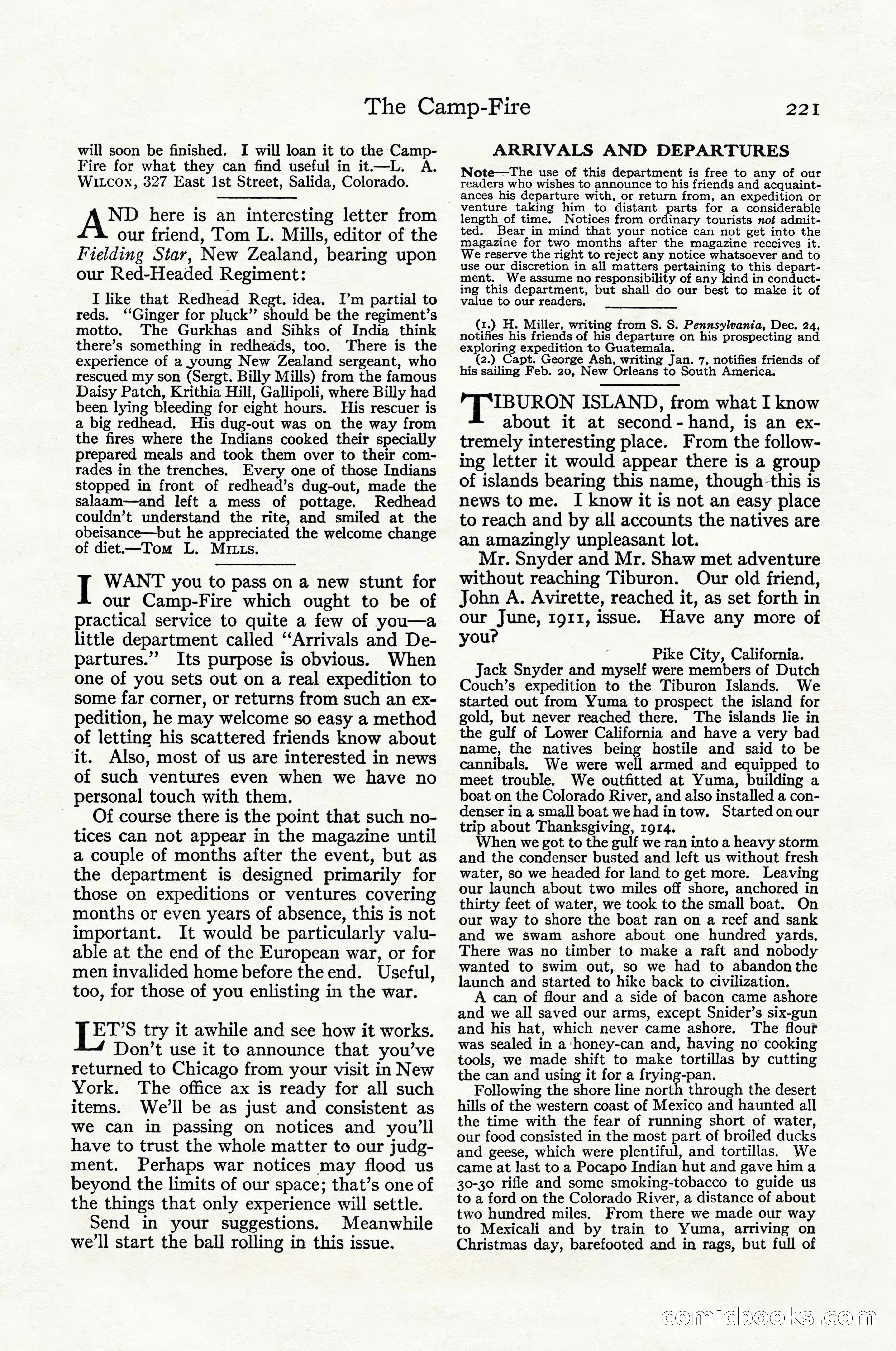
A restored page from Pulp Fiction, 1916. Page through the whole issue in the reader above.
📄 Transcribed text from this page (OCR, searchable)
Machine-transcribed from the original scan — historical spelling and the odd misread are preserved.
The Camp-Fire will soon be finished. I will loan it to the Camp- Fire for what they can find useful in it—L. A. WILcox, 327 East Ist Street, Salida, Colorado. AS” here is an interesting letter from our friend, Tom L. Mills, editor of the Fielding Star, New Zealand, bearing upon our Red-Headed Regiment: I like that Redhead Regt. idea. I’m partial to reds. ‘‘Ginger for pluck” should be the regiment’s motto. The Gurkhas and Sihks of India think there’s something in redheads, too. There is the experience of a young New Zealand sergeant, who rescued my son (Sergt. Billy Mills) from the famous Daisy Patch, Krithia Hill, Gallipoli, where Billy had been lying bleeding for eight hours. His rescuer is a big redhead. His dug-out was on the way from the fires where the Indians cooked their specially prepared meals and took them over to their com- rades in the trenches. Every one of those Indians stopped in front of redhead’s dug-out, made the salaam—and left a mess of pottage. Redhead couldn’t understand the rite, and smiled at the obeisance—but he appreciated the welcome change of diet—Tom L. Mrrts. I WANT you to pass on a new stunt for our Camp-Fire which ought to be of practical service to quite a few of you—a little department called ‘‘Arrivals and De- partures.” Its purpose is obvious. When one of you sets out on a real expedition to some far corner, or returns from such an ex- pedition, he may welcome so easy a method of letting his scattered friends know about it. Also, most of us are interested in news of such ventures even when we have no personal touch with them. Of course there is the point that such no- tices can not appear in the magazine until a couple of months after the event, but as the department is designed primarily for those on expeditions or ventures covering months or even years of absence, this is not important. It would be particularly valu- able at the end of the European war, or for men invalided home before theend. Useful, too, for those of you enlisting in the war. (Bes try it awhile and see how it works. Don’t use it to announce that you’ve returned to Chicago from your visit in New York. The office ax is ready for all such items. We'll be as just and consistent as we can in passing on notices and you’ll have to trust the whole matter to our judg- ment. Perhaps war notices may flood us beyond the limits of our space; that’s one of the things that only experience will settle. Send in your suggestions. Meanwhile we'll start the ball rolling in this issue. 221 ARRIVALS AND DEPARTURES Note—The use of this department is free to any of our readers who wishes to announce to his friends and acquaint- ances his departure with, or return from, an expedition or venture taking him to distant parts for a considerable length of time. Notices from ordinary tourists not admit- ted. Bear in mind that your notice can not get into the magazine for two months after the magazine receives it. We reserve the right to reject any notice whatsoever and to use our discretion in all matters pertaining to this depart- ment. We assume no responsibility of any kind in conduct- ing this department, but shall do our best to make it of value to our readers. (1.) H. Miller, writing from S. S. Pennsylvania, Dec. 24 notifies his friends of his departure on his prospecting and exploring expedition to Guatemala. (2.) Capt. George Ash, writing Jan. 7, notifies friends of his sailing Feb. 20, New Orleans to South America. IBURON ISLAND, from what I know about it at second - hand, is an ex- tremely interesting place. From the follow- ing letter it would appear there is a group of islands bearing this name, though this is news to me. I know it is not an easy place to reach and by all accounts the natives are an amazingly unpleasant lot. Mr. Snyder and Mr. Shaw met adventure without reaching Tiburon. Our old friend, John A. Avirette, reached it, as set forth in our June, 1911, issue. Have any more of youre Pike City, California. Jack Snyder and myself were members of Dutch Couch’s expedition to the Tiburon Islands. We started out from Yuma to prospect the island for gold, but never reached there. The islands lie in the gulf of Lower California and have a very bad name, the natives being hostile and said to be cannibals. We were well armed and equipped to meet trouble. We outfitted at Yuma, building a boat on the Colorado River, and also installed a con- denser in a small boat we had in tow. Started on our trip about Thanksgiving, 1914. When we got to the gulf we ran into a heavy storm and the condenser busted and left us without fresh water, so we headed for land to get more. Leaving our launch about two miles off shore, anchored in thirty feet of water, we took to the small boat. On our way to shore the boat ran on a reef and sank and we swam ashore about one hundred yards. There was no timber to make a raft and nobody wanted to swim out, so we had to abandon the launch and started to hike back to civilization. A can of flour and a side of bacon came ashore and we all saved our arms, except Snider’s six-gun and his hat, which never came ashore. The flour was sealed in a‘honey-can and, having no cooking tools, we made shift to make tortillas by cutting the can and using it for a frying-pan. Following the shore line north through the desert hills of the western coast of Mexico and haunted all the time with the fear of running short of water, our food consisted in the most part of broiled ducks and geese, which were plentiful, and tortillas. We came at last to a Pocapo Indian hut and gave him a 30-30 rifle and some smoking-tobacco to guide us to a ford on the Colorado River, a distance of about two hundred miles. From there we made our way to Mexicali and by train to Yuma, arriving on Christmas day, barefooted and in rags, but full of CoOMmicboooks CO