
Pulp Fiction, 1916 · page 169 of 228
Adventure Magazine Cover, April 1916 — page 169: what you’re looking at
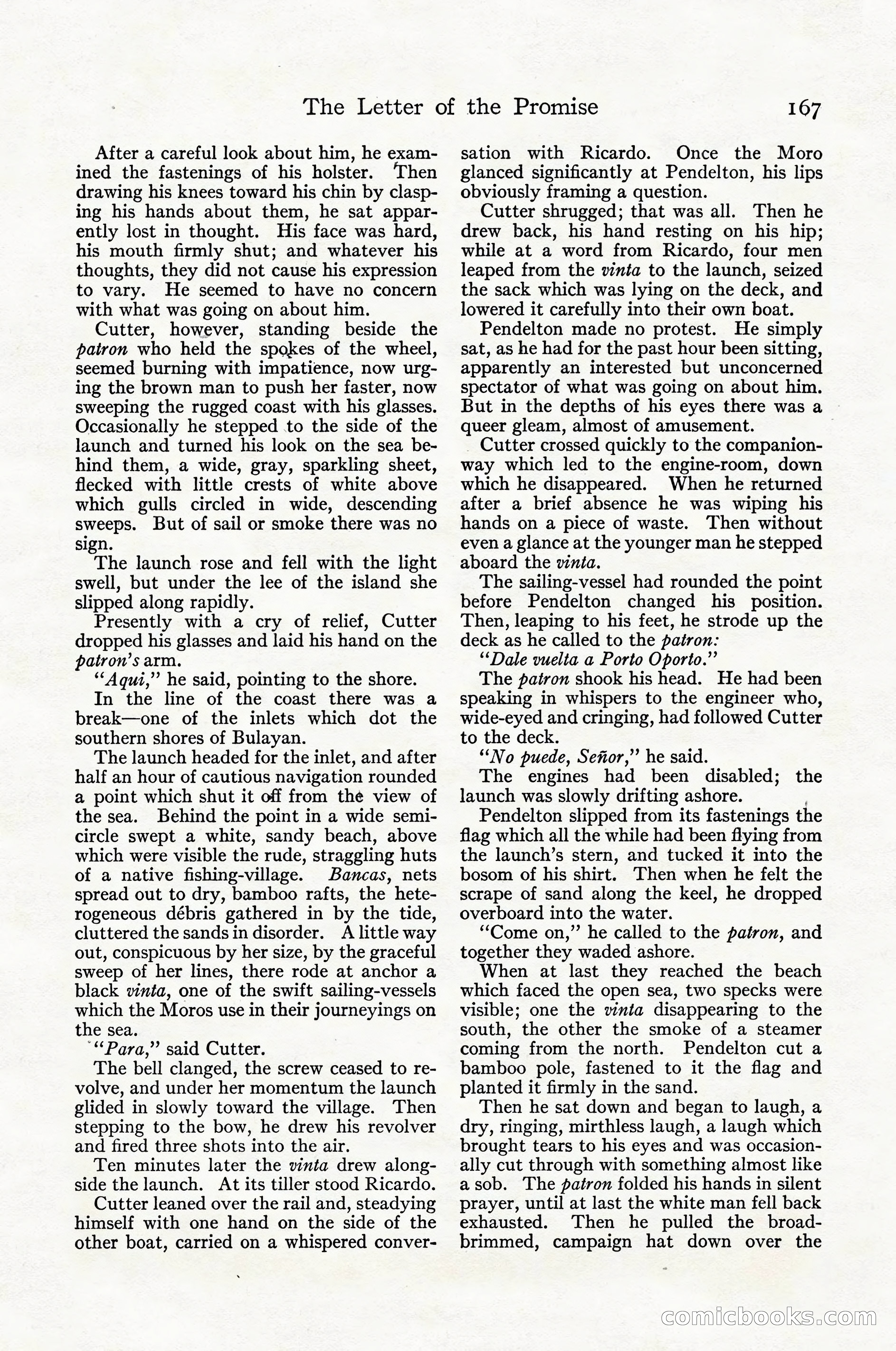
A restored page from Pulp Fiction, 1916. Page through the whole issue in the reader above.
📄 Transcribed text from this page (OCR, searchable)
Machine-transcribed from the original scan — historical spelling and the odd misread are preserved.
The Letter of the Promise After a careful look about him, he exam- ined the fastenings of his holster. Then drawing his knees toward his chin by clasp- ing his hands about them, he sat appar- ently lost in thought. His face was hard, his mouth firmly shut; and whatever his thoughts, they did not cause his expression to vary. He seemed to have no concern with what was going on about him. Cutter, however, standing beside the patron who held the spokes of the wheel, seemed burning with impatience, now urg- ing the brown man to push her faster, now sweeping the rugged coast with his glasses. Occasionally he stepped to the side of the launch and turned his look on the sea be- hind them, a wide, gray, sparkling sheet, flecked with little crests of white above which gulls circled in wide, descending sweeps. But of sail or smoke there was no sign. The launch rose and fell with the light swell, but under the lee of the island she slipped along rapidly. Presently with a cry of relief, Cutter dropped his glasses and laid his hand on the patron’s arm. ‘‘Aqui,” he said, pointing to the shore. In the line of the coast there was a break—one of the inlets which dot the southern shores of Bulayan. The launch headed for the inlet, and after half an hour of cautious navigation rounded a point which shut it off from the view of the sea. Behind the point in a wide semi- circle swept a white, sandy beach, above which were visible the rude, straggling huts of a native fishing-village. Bancas, nets spread out to dry, bamboo rafts, the hete- rogeneous débris gathered in by the tide, cluttered the sands in disorder. A little way out, conspicuous by her size, by the graceful sweep of her lines, there rode at anchor a black vinta, one of the swift sailing-vessels which the Moros use in their journeyings on the sea. “Para,” said Cutter. The bell clanged, the screw ceased to re- volve, and under her momentum the launch glided in slowly toward the village. Then stepping to the bow, he drew his revolver and fired three shots into the air. Ten minutes later the vinta drew along- side the launch. At its tiller stood Ricardo. Cutter leaned over the rail and, steadying himself with one hand on the side of the other boat, carried on a whispered conver- 167 sation with Ricardo. Once the Moro glanced significantly at Pendelton, his lips obviously framing a question. Cutter shrugged; that was all. Then he drew back, his hand resting on his hip; while at a word from Ricardo, four men leaped from the vinta to the launch, seized the sack which was lying on the deck, and lowered it carefully into their own boat. Pendelton made no protest. He simply sat, as he had for the past hour been sitting, apparently an interested but unconcerned spectator of what was going on about him. But in the depths of his eyes there was a queer gleam, almost of amusement. _ Cutter crossed quickly to the companion- way which led to the engine-room, down which he disappeared. When he returned after a brief absence he was wiping his hands on a piece of waste. Then without even a glance at the younger man he stepped aboard the vinta. The sailing-vessel had rounded the point before Pendelton changed his position. Then, leaping to his feet, he strode up the deck as he called to the patron: ‘Dale vuelta a Porto Oporto.” The patron shook his head. He had been speaking in whispers to the engineer who, wide-eyed and cringing, had followed Cutter to the deck. ‘No puede, Senor,” he said. The engines had been disabled; launch was slowly drifting ashore. Pendelton slipped from its fastenings the flag which all the while had been flying from the launch’s stern, and tucked it into the bosom of his shirt. Then when he felt the scrape of sand along the keel, he dropped overboard into the water. ‘““Come on,” he called to the patron, and together they waded ashore. When at last they reached the beach the which faced the open sea, two specks were visible; one the vinta disappearing to the south, the other the smoke of a steamer coming from the north. fPendelton cut a bamboo pole, fastened to it the flag and planted it firmly in the sand. Then he sat down and began to laugh, a dry, ringing, mirthless laugh, a laugh which brought tears to his eyes and was occasion- ally cut through with something almost like asob. The patron folded his hands in silent prayer, until at last the white man fell back exhausted. Then he pulled the broad- brimmed, campaign hat down over the CoMmicboooks (CO