
Pulp Fiction, 1916 · page 139 of 228
Adventure Magazine Cover, April 1916 — page 139: what you’re looking at
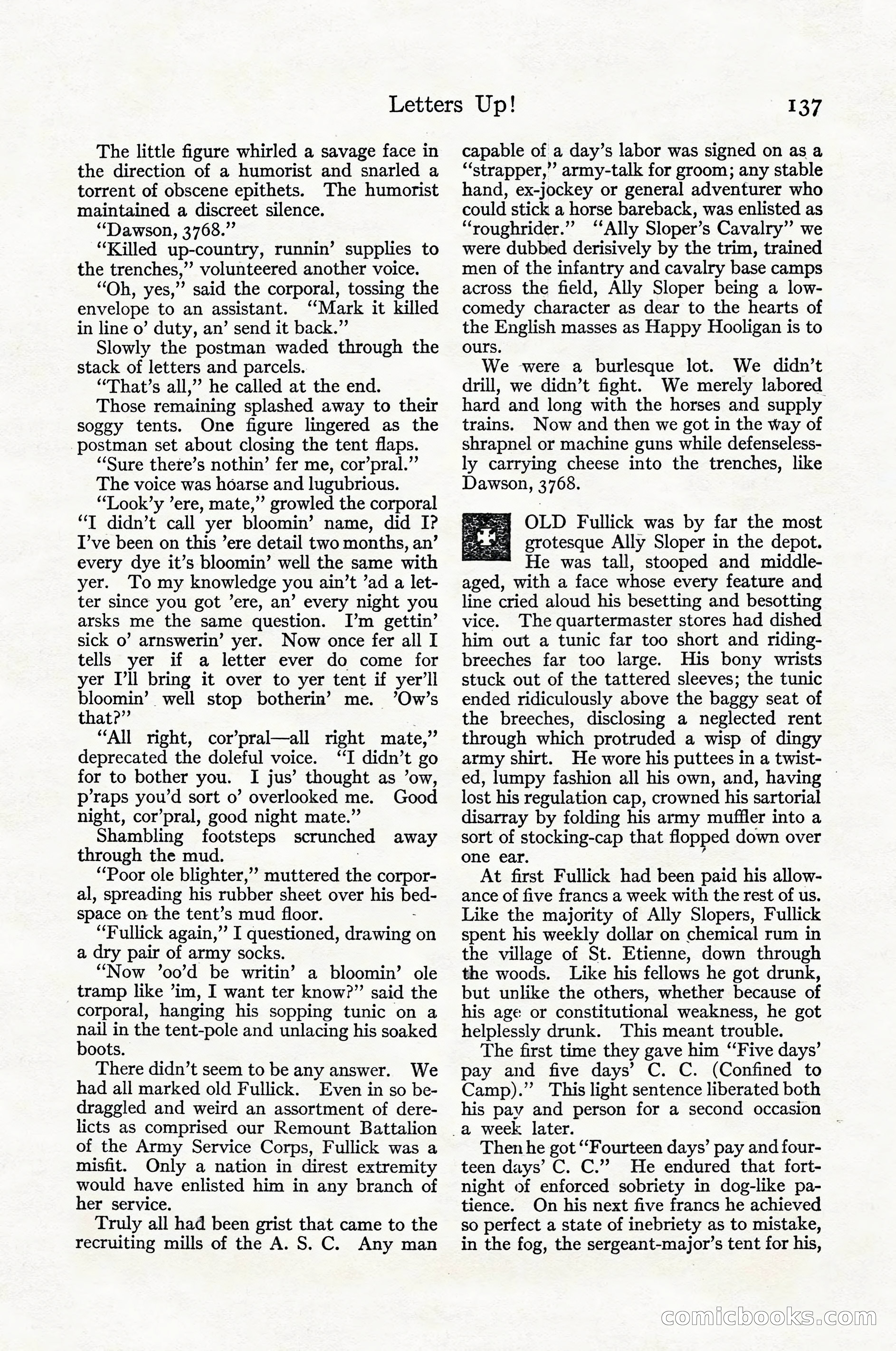
A restored page from Pulp Fiction, 1916. Page through the whole issue in the reader above.
📄 Transcribed text from this page (OCR, searchable)
Machine-transcribed from the original scan — historical spelling and the odd misread are preserved.
Letters Up! The little figure whirled a savage face in the direction of a humorist and snarled a torrent of obscene epithets. The humorist maintained a discreet silence. “Dawson, 3768.” “Killed up-country, runnin’ supplies to the trenches,” volunteered another voice. “Oh, yes,” said the corporal, tossing the envelope to an assistant. ‘Mark it killed in line o’ duty, an’ send it back.” Slowly the postman waded through the stack of letters and parcels. “That’s all,” he called at the end. Those remaining splashed away to their soggy tents. One figure lingered as the postman set about closing the tent flaps. ‘Sure there’s nothin’ fer me, cor’pral.” The voice was hoarse and lugubrious. “‘Look’y ’ere, mate,” growled the corporal “T didn’t call yer bloomin’ name, did I? I’ve been on this ’ere detail two months, an every dye it’s bloomin’ well the same with yer. To my knowledge you ain’t ’ad a let- ter since you got ’ere, an’ every night you arsks me the same question. I’m gettin’ sick o’ arnswerin’ yer. Now once fer all I tells yer if a letter ever do come for yer [’ll bring it over to yer tent if yer’ll bloomin’ well stop botherin’ me. ’Ow’s that?” “All right, cor’pral—all right mate,” deprecated the doleful voice. ‘I didn’t go for to bother you. I jus’ thought as ’ow, p’raps you’d sort o’ overlooked me. Good night, cor’pral, good night mate.” Shambling footsteps scrunched away through the mud. ‘Poor ole blighter,” muttered the corpor- al, spreading his rubber sheet over his bed- space on the tent’s mud floor. “Fullick again,’’ I questioned, eects on a dry pair of army socks. “Now ’oo’d be writin’ a bloomin’ ole tramp like ’im, I want ter know?” said the corporal, hanging his sopping tunic on a nail in the tent-pole and unlacing his soaked boots. There didn’t seem to be any answer. We had all marked old Fullick. Even in so be- draggled and weird an assortment of dere- licts as comprised our Remount Battalion of the Army Service Corps, Fullick was a misfit. Only a nation in direst extremity would have enlisted him in any branch of her service. Truly all had been grist that came to the recruiting mills of the A. S. C. Any man 137 capable of a day’s labor was signed on as a “‘strapper,” army-talk for groom; any stable hand, ex-jockey or general adventurer who could stick a horse bareback, was enlisted as “roughrider.” “Ally Sloper’s Cavalry” we were dubbed derisively by the trim, trained men of the infantry and cavalry base camps across the field, Ally Sloper being a low- comedy character as dear to the hearts of the English masses as Happy Hooligan is to ours. We were a burlesque lot. We didn’t drill, we didn’t fight. hard and long with the horses and supply trains. Now and then we got in the way of shrapnel or machine guns while defenseless- ly carrying cheese into the trenches, like Dawson, 3768. OLD Fullick was by far the most grotesque Ally Sloper in the depot. He was tall, stooped and middle- aged, with a face whose every feature and line cried aloud his besetting and besotting vice. The quartermaster stores had dished him out a tunic far too short and riding- breeches far too large. His bony wrists stuck out of the tattered sleeves; the tunic ended ridiculously above the baggy seat of the breeches, disclosing a neglected rent through which protruded a wisp of dingy army shirt. He wore his puttees in a twist- We merely labored ed, lumpy fashion all his own, and, having ~ lost his regulation cap, crowned his sartorial disarray by folding his army muffler into a sort of stocking-cap that flopped down over one ear. At first Fullick had been paid his allow- ance of five francs a week with the rest of us. Like the majority of Ally Slopers, Fullick spent his weekly dollar on chemical rum in the village of St. Etienne, down through the woods. Like his fellows he got drunk, but unlike the others, whether because of his age or constitutional weakness, he got helplessly drunk. This meant trouble. The first time they gave him “Five days’ pay and five days’ C. C. (Confined to Camp).” This light sentence liberated both his pay and person for a second occasion a week later. Then he got “Fourteen days’ pay and four- teen days’ C. C.”” He endured that fort- night of enforced sobriety in dog-like pa- tience. On his next five francs he achieved so perfect a state of inebriety as to mistake, in the fog, the sergeant-major’s tent for his, CoMmicboooks CO