
Pulp Fiction, 1916 · page 13 of 228
Adventure Magazine Cover, April 1916 — page 13: what you’re looking at
A restored page from Pulp Fiction, 1916. Page through the whole issue in the reader above.
📄 Transcribed text from this page (OCR, searchable)
Machine-transcribed from the original scan — historical spelling and the odd misread are preserved.
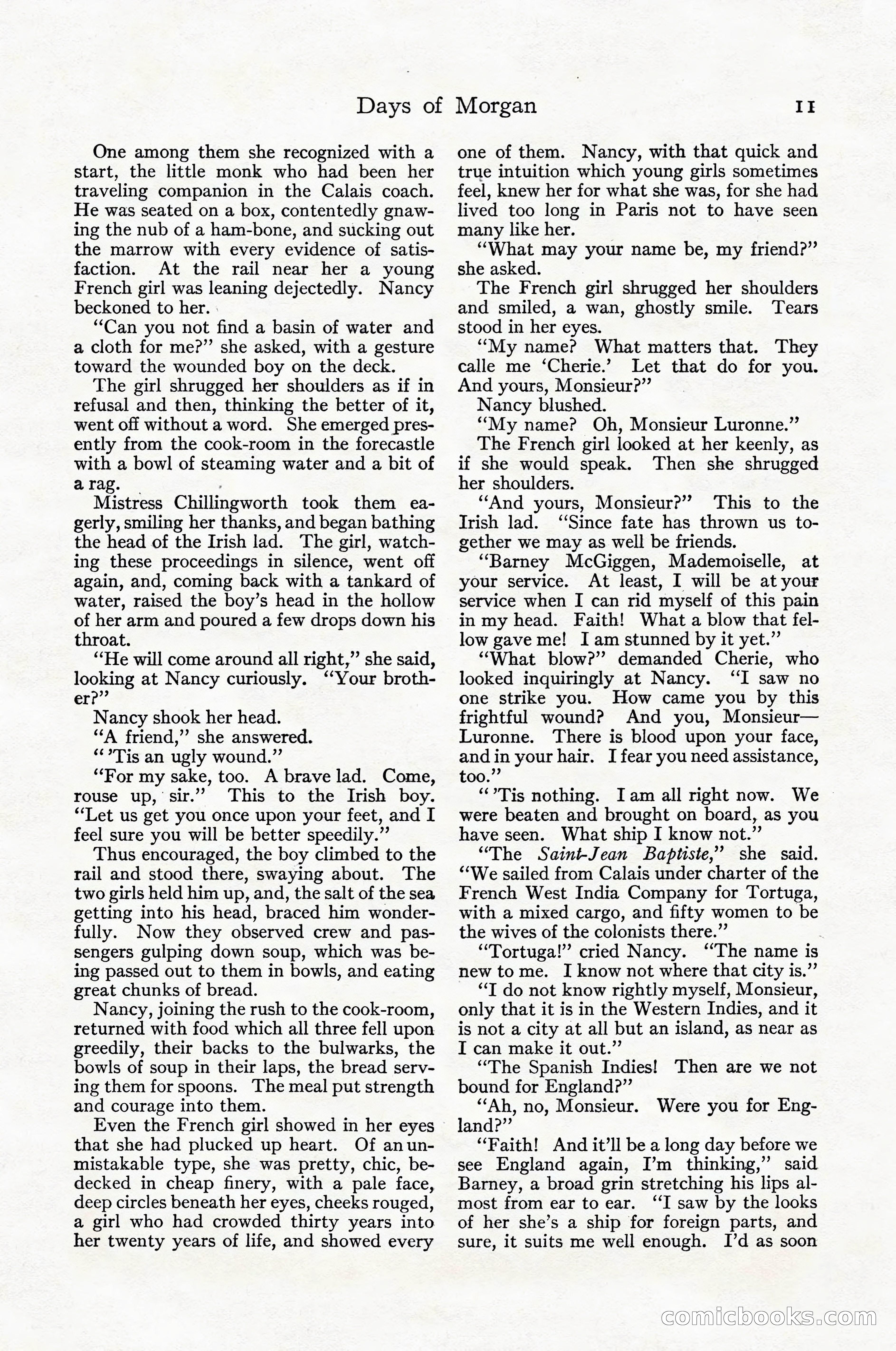
Days of One among them she recognized with a start, the little monk who had been her traveling companion in the Calais coach. He was seated on a box, contentedly gnaw- ing the nub of a ham-bone, and sucking out the marrow with every evidence of satis- faction. At the rail near her a young French girl was leaning dejectedly. Nancy beckoned to her. : “Can you not find a basin of water and a cloth for me?”’ she asked, with a gesture toward the wounded boy on the deck. The girl shrugged her shoulders as if in refusal and then, thinking the better of it, went off without a word. She emerged pres- ently from the cook-room in the forecastle with a bowl of steaming water and a bit of arag. — : Mistress Chillingworth took them ea- gerly, smiling her thanks, and began bathing the head of the Irish lad. The girl, watch- ing these proceedings in silence, went off again, and, coming back with a tankard of water, raised the boy’s head in the hollow of her arm and poured a few drops down his throat. ‘“‘He will come around all right,” she said, looking at Nancy curiously. ‘Your broth- err” Nancy shook her head. ‘“‘A friend,”’ she answered. “Tis an ugly wound.” ‘“‘For my sake, too. A brave lad. Come, rouse up, sir.”’ This to the Irish boy. *“‘Let us get you once upon your feet, and I feel sure you will be better speedily.” Thus encouraged, the boy climbed to the rail and stood there, swaying about. The two girls held him up, and, the salt of the sea getting into his head, braced him wonder- fully. Now they observed crew and pas- sengers gulping down soup, which was be- ing passed out to them in bowls, and eating great chunks of bread. Nancy, joining the rush to the cook-room, returned with food which all three fell upon greedily, their backs to the bulwarks, the bowls of soup in their laps, the bread serv- ing them for spoons. The meal put strength and courage into them. Even the French girl showed in her eyes that she had plucked up heart. Of anun- mistakable type, she was pretty, chic, be- decked in cheap finery, with a pale face, deep circles beneath her eyes, cheeks rouged, a girl who had crowded thirty years into her twenty years of life, and showed every Morgan It one of them. Nancy, with that quick and true intuition which young girls sometimes feel, knew her for what she was, for she had lived too long in Paris not to have seen many like her. ‘“‘What may your name be, my friend?” she asked. The French girl shrugged her shoulders and smiled, a wan, ghostly smile. Tears stood in her eyes. “My name? What matters that. They calle me ‘Cherie.’ Let that do for you. And yours, Monsieur?” Nancy blushed. “My name? Oh, Monsieur Luronne.” The French girl looked at her keenly, as if she would speak. Then she shrugged her shoulders. ‘‘And yours, Monsieur?” This to the Irish lad. ‘Since fate has thrown us to- gether we may as well be friends. “Barney McGiggen, Mademoiselle, at your service. At least, I will be at your service when I can rid myself of this pain in my head. Faith! What a blow that fel- low gave me! I am stunned by it yet.” “What blow?” demanded Cherie, who looked inquiringly at Nancy. “I saw no one strike you. How came you by this frightful wound? And you, Monsieur— Luronne. There is blood upon your face, and in your hair. J fear you need assistance, too.” “Tis nothing. Iam all right now. We — were beaten and brought on board, as you have seen. What ship I know not.” “The Saint-Jean Baptiste,’ she said. ‘“We sailed from Calais under charter of the French West India Company for Tortuga, with a mixed cargo, and fifty women to be the wives of the colonists there.” “Tortuga!” cried Nancy. new tome. I know not where that city is.”’ “T do not know rightly myself, Monsieur, only that it is in the Western Indies, and it is not a city at all but an island, as near as I can make it out.” “The Spanish Indies! Then are we not bound for England?” ‘“‘Ah, no, Monsieur. Were you for Eng- land?” “Faith! And it’ll be a long day before we see England again, I’m thinking,” said Barney, a broad grin stretching his lips al- most from ear to ear. “I saw by the looks of her she’s a ship for foreign parts, and sure, it suits me well enough. I’d as soon CoOMmMichoooks “The name is CO