
Pulp Fiction, 1916 · page 129 of 228
Adventure Magazine Cover, April 1916 — page 129: what you’re looking at
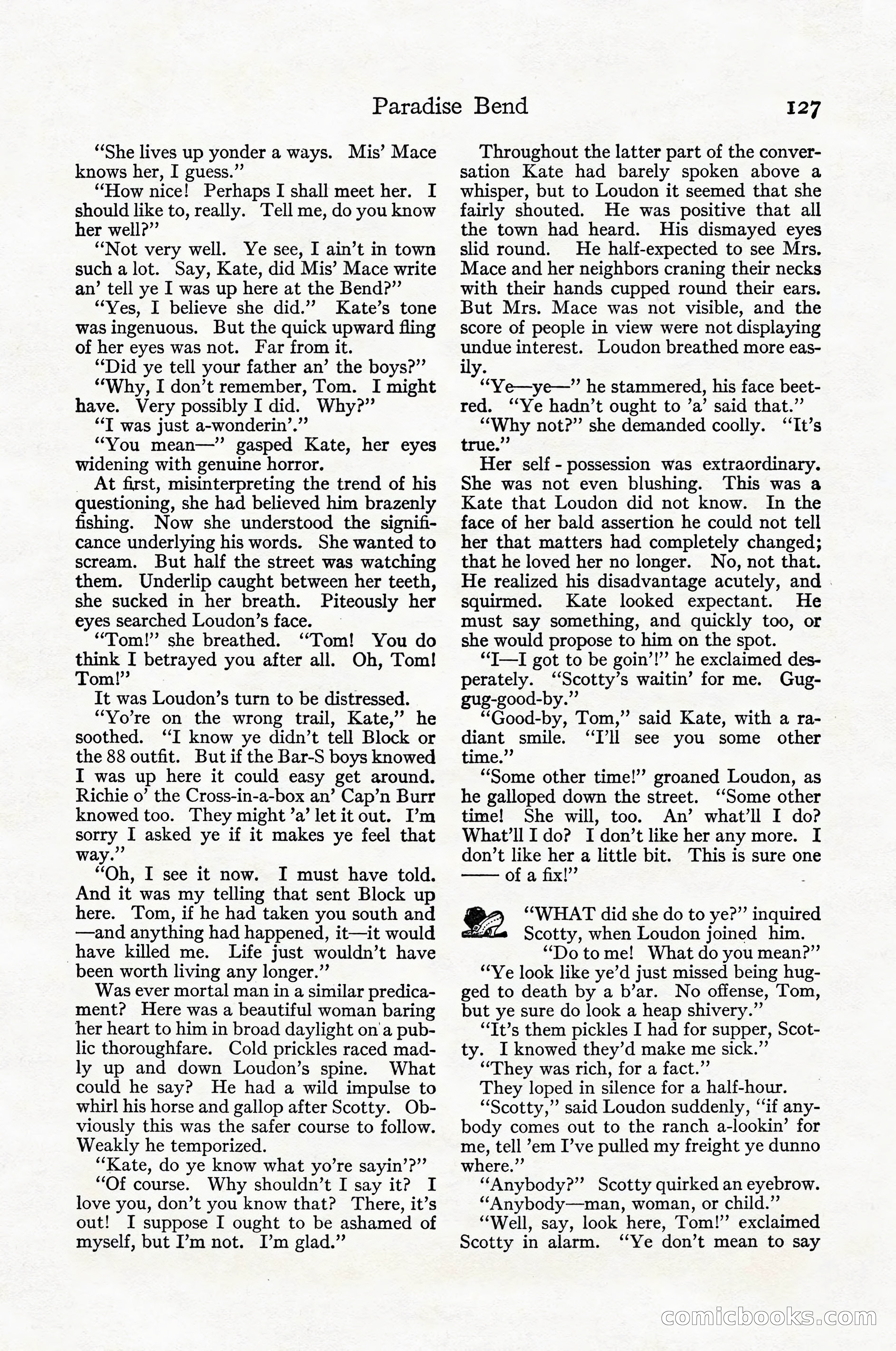
A restored page from Pulp Fiction, 1916. Page through the whole issue in the reader above.
📄 Transcribed text from this page (OCR, searchable)
Machine-transcribed from the original scan — historical spelling and the odd misread are preserved.
Paradise Bend ‘She lives up yonder a ways. Mis’ Mace knows her, I guess.” “How nice! Perhaps I shall meet her. I should like to, really. Tell me, do you know her well?” ‘“‘Not very well. Ye see, I ain’t in town such alot. Say, Kate, did Mis’ Mace write an’ tell ye I was up here at the Bend?” “Yes, I believe she did.’”? Kate’s tone was ingenuous. But the quick upward fling of her eyes was not. Far from it. “Did ye tell your father an’ the boys?” “Why, I don’t remember, Tom. I might have. Very possibly I did. Why?” “IT was just a-wonderin’. e “You mean—” gasped Kate, her eyes widening with genuine horror. _ At first, misinterpreting the trend of his questioning, she had believed him brazenly fishing. Now she understood the signifi- cance underlying his words. She wanted to scream. But half the street was watching them. Underlip caught between her teeth, she sucked in her breath. Piteously her eyes searched Loudon’s face. “Tom!” she breathed. ‘‘Tom! You do think I betrayed you after all. Oh, Tom! Tom. It was Loudon’s turn to be distressed. “Yo’re on the wrong trail, Kate,’ he soothed. “I know ye didn’t tell Block or the 88 outfit. But if the Bar-S boys knowed I was up here it could easy get around. Richie o’ the Cross-in-a-box an’ Cap’n Burr knowed too. They might ’a’ let it out. I’m sorry I asked ye if it makes ye feel that way.” “Oh, I see it now. I must have told. And it was my telling that sent Block up here. Tom, if he had taken you south and —and anything had happened, it—it would have killed me. Life just wouldn’t have been worth living any longer.”’ Was ever mortal man in a similar predica- ment? Here was a beautiful woman baring her heart to him in broad daylight on'a pub- lic thoroughfare. Cold prickles raced mad- ly up and down Loudon’s spine. What could he say? He had a wild impulse to whirl his horse and gallop after Scotty. Ob- viously this was the safer course to follow. Weakly he temporized. “Kate, do ye know what yo’re sayin’?”’ “Of course. Why shouldn’t I say it? I love you, don’t you know that? There, it’s out! I suppose I ought to be ashamed of myself, but I’m not. I’m glad.” 127 Throughout the latter part of the conver- sation Kate had barely spoken above a whisper, but to Loudon it seemed that she fairly shouted. He was positive that all the town had heard. His dismayed eyes slid round. He half-expected to see Mrs. Mace and her neighbors craning their necks with their hands cupped round their ears. But Mrs. Mace was not visible, and the score of people in view were not displaying undue interest. Loudon breathed more eas- ily. ‘“Ye—ye—”’ he stammered, his face beet- red. ‘Ye hadn’t ought to ’a’ said that.” ‘“‘Why not?” she demanded coolly. ‘It’s true.” Her self - possession was extraordinary. She was not even blushing. This was a Kate that Loudon did not know. In the face of her bald assertion he could not tell her that matters had completely changed; that he loved her no longer. No, not that. He realized his disadvantage acutely, and . squirmed. Kate looked expectant. He must say something, and quickly too, or she would propose to him on the spot. ‘“‘I—I got to be goin’! he exclaimed des- perately. ‘“‘Scotty’s waitin’ for me. Gug- gug-good-by.”’ ‘“‘Good-by, Tom,” diant smile. time. 9) ‘Some other time!”’ groaned Loudon, as he galloped down the street. ‘‘Some other time! She will, too. An’ what’ll I do? What’ll Ido? I don’t like her any more. I don’t like her a little bit. This is sure one —— of 9 fix!” said Kate, with a ra- “Tl see you some other ‘“WHAT did she do to ye?” inquired Scotty, when Loudon joined him. “Dotome! What do you mean?” “Ve look like ye’d just missed being hug- ged to death by a b’ar. No offense, Tom, but ye sure do look a heap shivery.”’ “It’s them pickles I had for supper, Scot- ty. I knowed they’d make me sick.” “‘They was rich, for a fact.” They loped in silence for a half-hour. “Scotty,” said Loudon suddenly, “if any- body comes out to the ranch a-lookin’ for me, tell ’em I’ve pulled my freight ye dunno where.”’ “Anybody?” Scotty quirked an eyebrow. ““Anybody—man, woman, or child.” “Well, say, look here, Tom!’’ exclaimed Scotty in alarm. ‘Ye don’t mean to say CoMmichoooks CO