
Pulp Fiction, 1916 · page 116 of 228
Adventure Magazine Cover, April 1916 — page 116: what you’re looking at
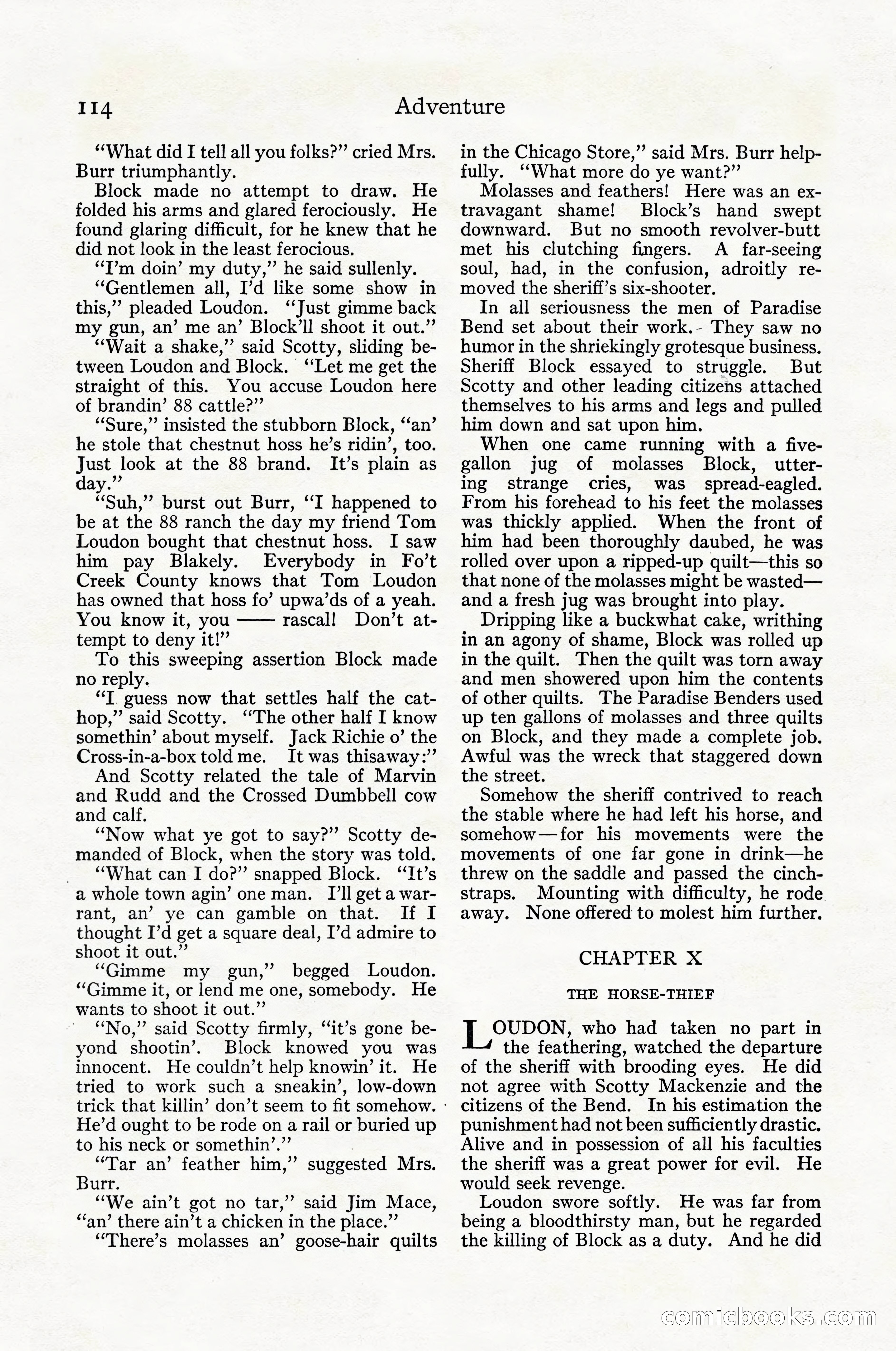
A restored page from Pulp Fiction, 1916. Page through the whole issue in the reader above.
📄 Transcribed text from this page (OCR, searchable)
Machine-transcribed from the original scan — historical spelling and the odd misread are preserved.
114 ‘‘What did I tell all you folks?” cried Mrs. Burr triumphantly. Block made no attempt to draw. He folded his arms and glared ferociously. He found glaring difficult, for he knew that he did not look in the least ferocious. “I’m doin’ my duty,” he said sullenly. “Gentlemen all, I’d like some show in this,’’ pleaded Loudon. “Just gimme back my gun, an’ me an’ Block’ll shoot it out.” ‘Wait a shake,” said Scotty, sliding be- tween Loudon and Block. ‘‘Let me get the straight of this. You accuse Loudon here of brandin’ 88 cattle?”’ ‘‘Sure,”’ insisted the stubborn Block, ‘‘an’ he stole that chestnut hoss he’s ridin’, too. Just look at the 88 brand. It’s plain as day.” “Suh,” burst out Burr, “I happened to be at the 88 ranch the day my friend Tom Loudon bought that chestnut hoss. I saw him pay Blakely. Everybody in Fo’t Creek County knows that Tom Loudon has owned that hoss fo’ upwa’ds of a yeah. You know it, you rascal! Don’t at- tempt to deny it!” To this sweeping assertion Block made no reply. “T, guess now that settles half the cat- hop,” said Scotty. ‘The other half I know somethin’ about myself. Jack Richie o’ the Cross-in-a-box toldme. It was thisaway:” And Scotty related the tale of Marvin and Rudd and the Crossed Dumbbell cow and calf. ‘“‘Now what ye got to say?” Scotty de- manded of Block, when the story was told. ‘“‘What can I do?” snapped Block. ‘“‘It’s a whole town agin’ one man. I'll get a war- rant, an’ ye can gamble on that. If I thought I’d get a square deal, I’d admire to shoot it out.” “Gimme my gun,” begged Loudon. ‘“‘Gimme it, or lend me one, somebody. He wants to shoot it out.” “No,” said Scotty firmly, “‘it’s gone be- yond shootin’. Block knowed you was innocent. He couldn’t help knowin’ it. He tried to work such a sneakin’, low-down trick that killin’ don’t seem to fit somehow. - He’d ought to be rode on a rail or buried up to his neck or somethin’.’’ “Tar an’ feather him,’ Burr. ‘‘We ain’t got no tar,” said Jim Mace, ‘fan’ there ain’t a chicken in the place.” ‘“‘There’s molasses an’ goose-hair quilts ) suggested Mrs. ) Adventure in the Chicago Store,”’ said Mrs. Burr help- fully. ‘“‘What more do ye want?” Molasses and feathers! Here was an ex- travagant shame! Block’s hand swept downward. But no smooth revolver-butt met his clutching fingers. A _ far-seeing soul, had, in the confusion, adroitly re- moved the sheriff’s six-shooter. In all seriousness the men of Paradise Bend set about their work.- They saw no humor in the shriekingly grotesque business. Sheriff Block essayed to struggle. But Scotty and other leading citizens attached themselves to his arms and legs and pulled him down and sat upon him. When one came running with a five- gallon jug of molasses Block, utter- ing strange cries, was spread-eagled. From his forehead to his feet the molasses was thickly applied. When the front of him had been thoroughly daubed, he was rolled over upon a ripped-up quilt—this so that none of the molasses might be wasted— and a fresh jug was brought into play. Dripping like a buckwhat cake, writhing in an agony of shame, Block was rolled up in the quilt. Then the quilt was torn away and men showered upon him the contents of other quilts. The Paradise Benders used up ten gallons of molasses and three quilts on Block, and they made a complete job. Awful was the wreck that staggered down the street. Somehow the sheriff contrived to reach the stable where he had left his horse, and somehow—for his movements were the movements of one far gone in drink—he threw on the saddle and passed the cinch- straps. away. None offered to molest him further. CHAPTER X THE HORSE-THIEF Lee eee who had taken no part in the feathering, watched the departure of the sheriff with brooding eyes. He did not agree with Scotty Mackenzie and the citizens of the Bend. In his estimation the punishment had not been sufficiently drastic. Alive and in possession of all his faculties the sheriff was a great power for evil. He would seek revenge. Loudon swore softly. He was far from being a bloodthirsty man, but he regarded the killing of Block as a duty. And he did CoOMmicboooks Mounting with difficulty, he rode (©