
Pulp Fiction, 1916 · page 102 of 228
Adventure Magazine Cover, April 1916 — page 102: what you’re looking at
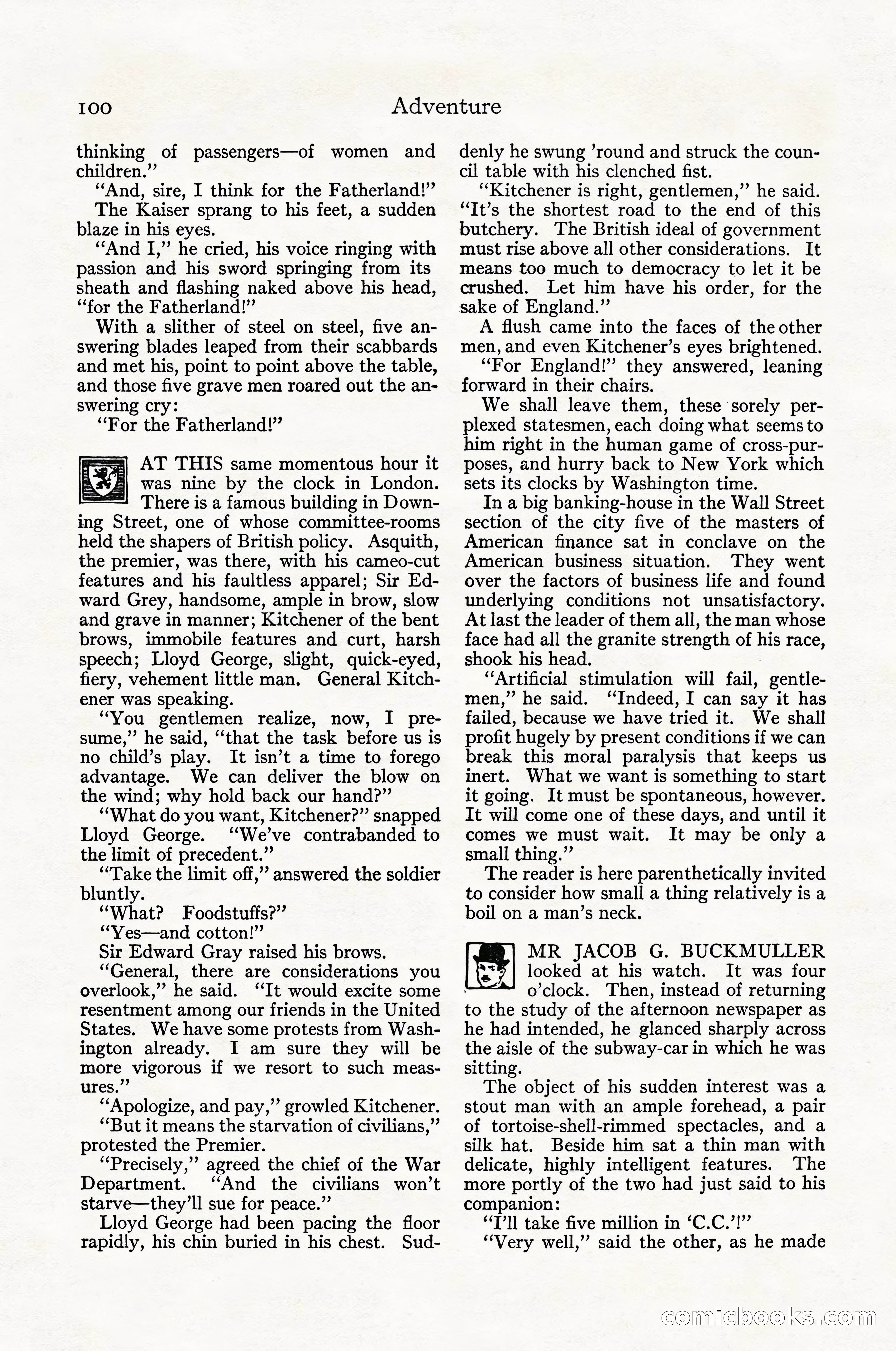
A restored page from Pulp Fiction, 1916. Page through the whole issue in the reader above.
📄 Transcribed text from this page (OCR, searchable)
Machine-transcribed from the original scan — historical spelling and the odd misread are preserved.
I0O thinking of passengers—of women and children.” ‘“‘And, sire, I think for the Fatherland!” The Kaiser sprang to his feet, a sudden blaze in his eyes. ‘And I,” he cried, his voice ringing with passion and his sword springing from its sheath and flashing naked above his head, ‘for the Fatherland!” With a slither of steel on steel, five an- swering blades leaped from their scabbards and met his, point to point above the table, and those five grave men roared out the an- swering cry: “For the Fatherland!” AT THIS same momentous hour it was nine by the clock in London. There is a famous building in Down- ing Street, one of whose committee-rooms held the shapers of British policy. Asquith, the premier, was there, with his cameo-cut features and his faultless apparel; Sir Ed- ward Grey, handsome, ample in brow, slow and grave in manner; Kitchener of the bent brows, immobile features and curt, harsh speech; Lloyd George, slight, quick-eyed, fiery, vehement little man. General Kitch- ener was speaking. “You gentlemen realize, now, I pre- sume,” he said, ‘‘that the task before us is no child’s play. It isn’t a time to forego advantage. We can deliver the blow on the wind; why hold back our hand?” “What do you want, Kitchener?” snapped Lloyd George. ‘‘We’ve contrabanded to the limit of precedent.” “Take the limit off,”’ answered the soldier bluntly. “What? Foodstuffs?” ‘“Yes—and cotton!” Sir Edward Gray raised his brows. “General, there are considerations you overlook,”’ he said. “It would excite some resentment among our friends in the United States. We have some protests from Wash- ington already. I am sure they will be more vigorous if we resort to such meas- ures.” ‘‘Apologize, and pay,” growled Kitchener. ‘But it means the starvation of civilians,” protested the Premier. “Precisely,” agreed the chief of the War Department. “And the civilians won’t starve—they’ll sue for peace.” Lloyd George had been pacing the floor rapidly, his chin buried in his chest. Sud- Adventure denly he swung ’round and struck the coun- cil table with his clenched fist. ‘Kitchener is right, gentlemen,” he said. “It’s the shortest road to the end of this butchery. The British ideal of government must rise above all other considerations. It means too much to democracy to let it be crushed. Let him have his order, for the sake of England.” A flush came into the faces of the other men, and even Kitchener’s eyes brightened. “For England!” they answered, leaning forward in their chairs. We shall leave them, these sorely per- plexed statesmen, each doing what seems to him right in the human game of cross-pur- poses, and hurry back to New York which sets its clocks by Washington time. In a big banking-house in the Wall Street section of the city five of the masters of American finance sat in conclave on the American business situation. They went over the factors of business life and found underlying conditions not unsatisfactory. At last the leader of them all, the man whose face had all the granite strength of his race, shook his head. “Artificial stimulation will fail, gentle- men,” he said. ‘Indeed, I can say it has failed, because we have tried it. We shall profit hugely by present conditions if we can break this moral paralysis that keeps us inert. What we want is something to start it going. It must be spontaneous, however. It will come one of these days, and until it comes we must wait. It may be only a small thing.” The reader is here parenthetically invited to consider how small a thing relatively is a boil on a man’s neck. MR JACOB G. BUCKMULLER looked at his watch. It was four o’clock. Then, instead of returning to the study of the afternoon newspaper as he had intended, he glanced sharply across the aisle of the subway-car in which he was sitting. The object of his sudden interest was a stout man with an ample forehead, a pair of tortoise-shell-rimmed spectacles, and a silk hat. Beside him sat a thin man with delicate, highly intelligent features. The more portly of the two had just said to his companion: “T’ll take five million in ‘C.C.’!”’ ‘Very well,”’ said the other, as he made CoOMmicooOoks.Ec©