
Pulp Fiction, 1914 · page 57 of 228
Adventure, December 1914 — page 57: what you’re looking at
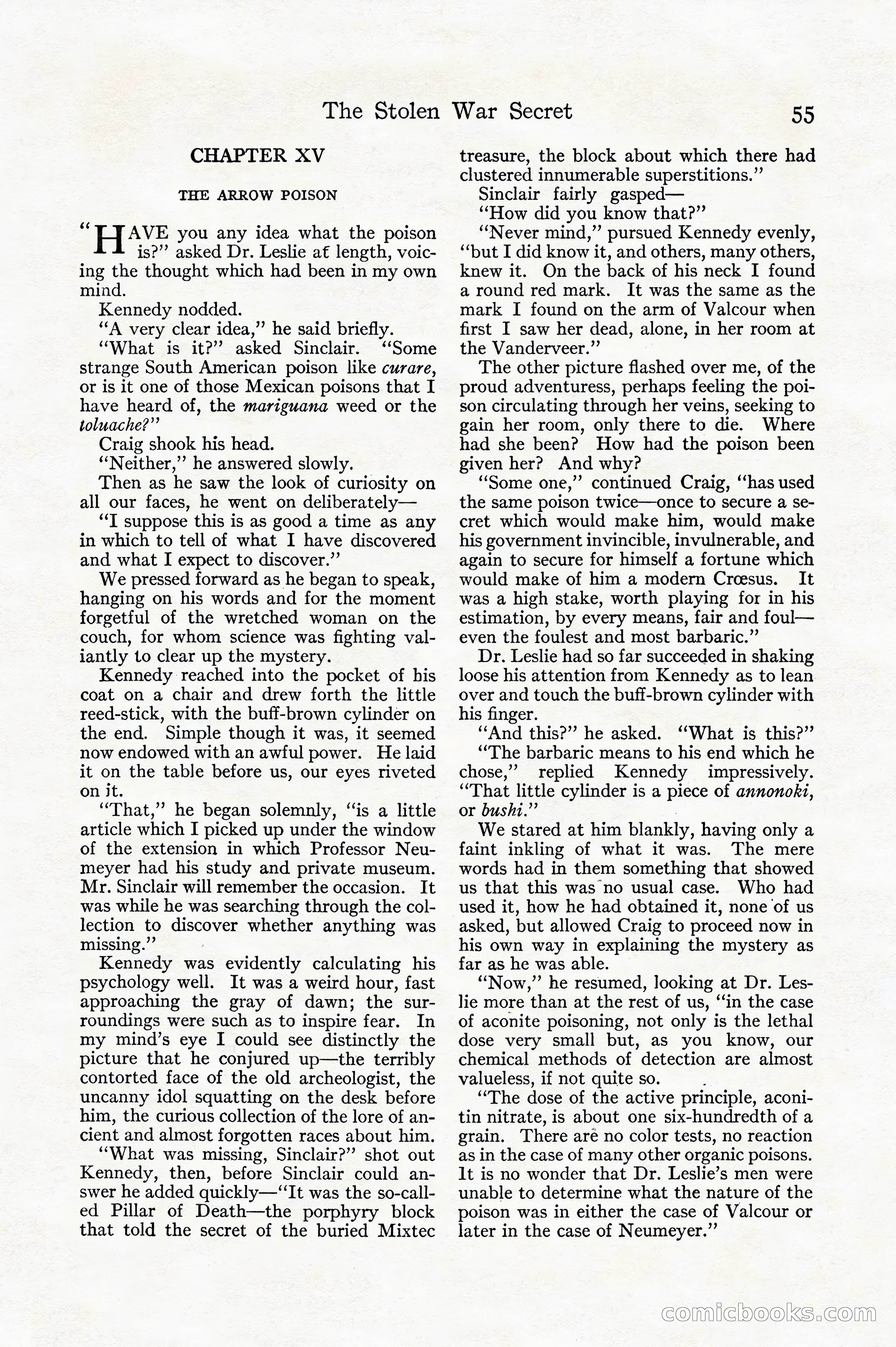
A restored page from Pulp Fiction, 1914. Page through the whole issue in the reader above.
📄 Transcribed text from this page (OCR, searchable)
Machine-transcribed from the original scan — historical spelling and the odd misread are preserved.
The Stolen War Secret CHAPTER XV THE ARROW POISON “HAVE you any idea what the poison is?’”’ asked Dr. Leslie af length, voic- ing the thought which had been in my own mind. Kennedy nodded. ‘‘A very clear idea,” he said briefly. “What is it?” asked Sinclair. ‘Some strange South American poison like curare, or is it one of those Mexican poisons that I have heard of, the mariguana weed or the toluache?”’ Craig shook his head. “Neither,” he answered slowly. Then as he saw the look of curiosity on all our faces, he went on deliberately— “I suppose this is as good a time as any in which to tell of what I have discovered and what I expect to discover.’’ We pressed forward as he began to speak, hanging on his words and for the moment forgetful of the wretched woman on the couch, for whom science was fighting val- iantly to clear up the mystery. Kennedy reached into the pocket of bis coat on a chair and drew forth the little reed-stick, with the buff-brown cylinder on the end. Simple though it was, it seemed now endowed with an awful power. He laid it on the table before us, our eyes riveted on Jt. “That,” he began solemnly, “is a little article which I picked up under the window of the extension in which Professor Neu- meyer had his study and private museum. Mr. Sinclair will remember the occasion. It was while he was searching through the col- lection to discover whether anything was missing.” } Kennedy was evidently calculating his psychology well. It was a weird hour, fast approaching the gray of dawn; the sur- roundings were such as to inspire fear. In my mind’s eye I could see distinctly the picture that he conjured up—the terribly contorted face of the old archeologist, the uncanny idol squatting on the desk before him, the curious collection of the lore of an- cient and almost forgotten races about him. ‘What was missing, Sinclair?” shot out Kennedy, then, before Sinclair could an- swer he added quickly—‘‘It was the so-call- ed Pillar of Death—the porphyry block that told the secret of the buried Mixtec 99 treasure, the block about which there had clustered innumerable superstitions.” Sinclair fairly gasped— “How did you know that?” ‘Never mind,” pursued Kennedy evenly, ‘‘but I did know it, and others, many others, knew it. On the back of his neck I found a round red mark. It was the same as the mark I found on the arm of Valcour when first I saw her dead, alone, in her room at the Vanderveer.”’ The other picture flashed over me, of the proud adventuress, perhaps feeling the poi- son circulating through her veins, seeking to gain her room, only there to die. Where had she been? How had the poison been given her? And why? ‘“‘Some one,” continued Craig, “has used the same poison twice—once to secure a se- cret which would make him, would make his government invincible, invulnerable, and again to secure for himself a fortune which would make of him a modern Creesus. It was a high stake, worth playing for in his estimation, by every means, fair and foul— even the foulest and most barbaric.” Dr. Leslie had so far succeeded in shaking loose his attention from Kennedy as to lean over and touch the buff-brown cylinder with his finger. ‘And this?” he asked. ‘‘What is this?” “The barbaric means to his end which he chose,” replied Kennedy impressively. “That little cylinder is a piece of annonoki, or bushi.”’ ) We stared at him blankly, having only a faint inkling of what it was. The mere words had in them something that showed us that this was no usual case. Who had used it, how he had obtained it, none of us asked, but allowed Craig to proceed now in his own way in explaining the mystery as far as he was able. “Now,” he resumed, looking at Dr. Les- lie more than at the rest of us, “in the case of aconite poisoning, not only is the lethal dose very small but, as you know, our chemical methods of detection are almost valueless, if not quite so. ‘“‘The dose of the active principle, aconi- tin nitrate, is about one six-hundredth of a grain. There are no color tests, no reaction as in the case of many other organic poisons. It is no wonder that Dr. Leslie’s men were unable to determine what the nature of the poison was in either the case of Valcour or later in the case of Neumeyer.”’ MICLOOOLK C©