
Pulp Fiction, 1914 · page 51 of 228
Adventure, December 1914 — page 51: what you’re looking at
A restored page from Pulp Fiction, 1914. Page through the whole issue in the reader above.
📄 Transcribed text from this page (OCR, searchable)
Machine-transcribed from the original scan — historical spelling and the odd misread are preserved.
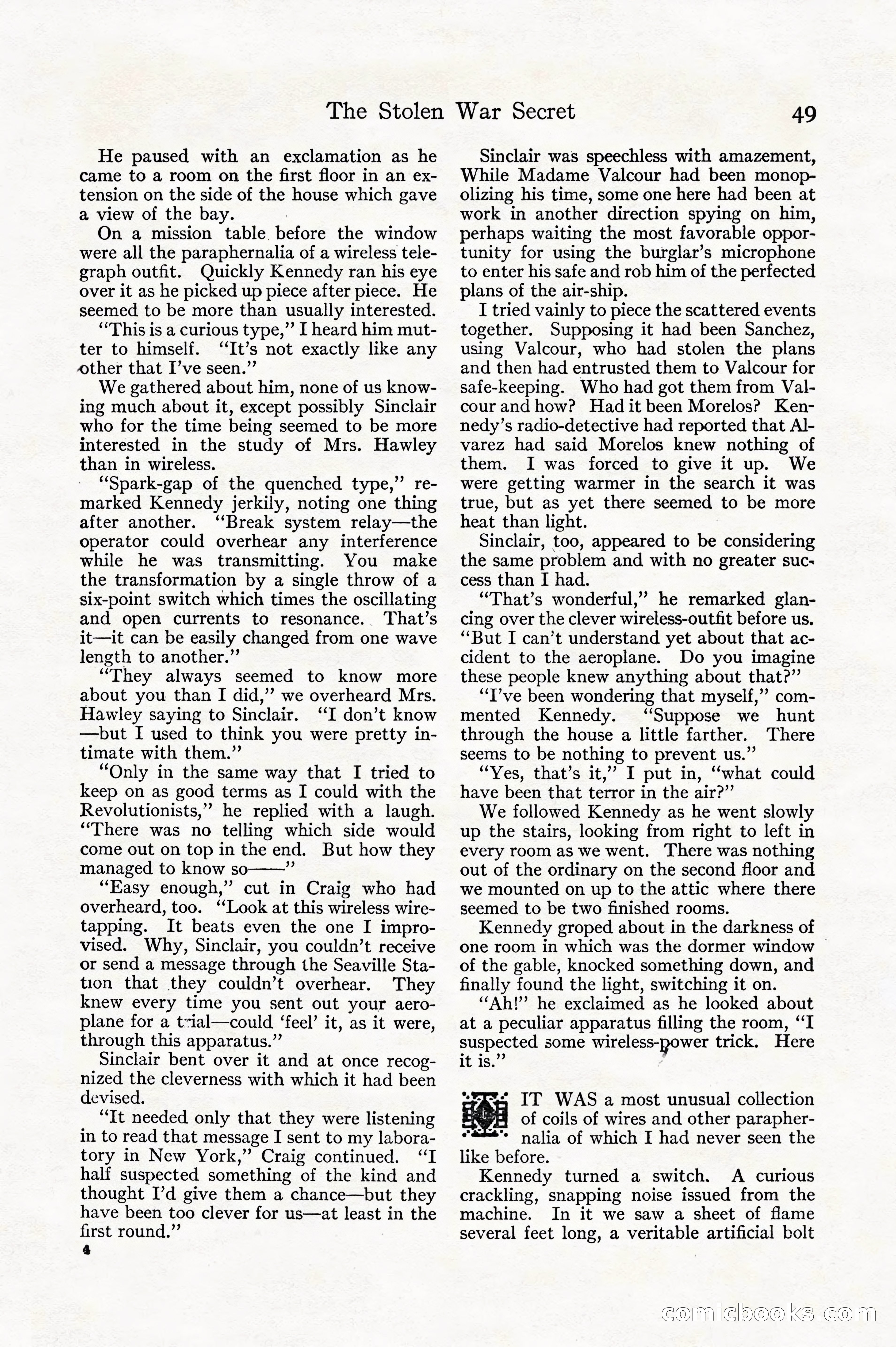
The Stolen War Secret He paused with an exclamation as he came to a room on the first floor in an ex- tension on the side of the house which gave a view of the bay. On a mission table. before the window were all the paraphernalia of a wireless tele- graph outfit. Quickly Kennedy ran his eye over it as he picked up piece after piece. He seemed to be more than usually interested. ‘*This is a curious type,’”’ I heard him mut- ter to himself. “It’s not exactly like any other that I’ve seen.” We gathered about him, none of us know- ing much about it, except possibly Sinclair who for the time being seemed to be more interested in the study of Mrs. Hawley than in wireless. ‘“Spark-gap of the quenched type,’ re- marked Kennedy jerkily, noting one thing after another. “Break system relay—the operator could overhear any interference while he was transmitting. You make the transformation by a single throw of a six-point switch which times the oscillating and open currents to resonance. That’s it—it can be easily changed from one wave length to another.”’ “They always seemed to know more about you than I did,” we overheard Mrs. Hawley saying to Sinclair. “I don’t know —but I used to think you were pretty in- timate with them.” “Only in the same way that I tried to keep on as good terms as I could with the Revolutionists,” he replied with a laugh. “There was no telling which side would come out on top in the end. But how they managed to know so——”’ “Easy enough,” cut in Craig who had overheard, too. ‘Look at this wireless wire- tapping. It beats even the one I impro- vised. Why, Sinclair, you couldn’t receive or send a message through the Seaville Sta- tion that they couldn’t overhear. They knew every time you sent out your aero- plane for a t7ial—could ‘feel’ it, as it were, through this apparatus.” Sinclair bent over it and at once recog- nized the cleverness with which it had been devised. “It needed only that they were listening in to read that message I sent to my labora- tory in New York,” Craig continued. “I half suspected something of the kind and thought I’d give them a chance—but they have been too clever for us—at least in the first round.”’ a 49 Sinclair was speechless with amazement, While Madame Valcour had been monop- olizing his time, some one here had been at work in another direction spying on him, perhaps waiting the most favorable oppor- tunity for using the burglar’s microphone to enter his safe and rob him of the perfected plans of the air-ship. I tried vainly to piece the scattered events together. Supposing it had been Sanchez, using Valcour, who had stolen the plans and then had entrusted them to Valcour for safe-keeping. Who had got them from Val- cour and how? Hadit been Morelos? Ken- nedy’s radio-detective had reported that Al- varez had said Morelos knew nothing of them. I was forced to give it up. We were getting warmer in the search it was true, but as yet there seemed to be more heat than light. Sinclair, too, appeared to be considering the same problem and with no greater suc cess than I had. “That’s wonderful,’ he remarked glan- cing over the clever wireless-outfit before us. “But I can’t understand yet about that ac- cident to the aeroplane. Do you imagine these people knew anything about that?” ‘“T’ve been wondering that myself,’’ com- mented Kennedy. ‘Suppose we hunt through the house a little farther. There seems to be nothing to prevent us.” “Yes, that’s it,’ I put in, “what could have been that terror in the air?”’ We followed Kennedy as he went slowly up the stairs, looking from night to left in every room as we went. There was nothing out of the ordinary on the second floor and we mounted on up to the attic where there seemed to be two finished rooms. Kennedy groped about in the darkness of one room in which was the dormer window of the gable, knocked something down, and finally found the light, switching it on. ‘“‘Ah!” he exclaimed as he looked about at a peculiar apparatus filling the room, “I suspected some wireless-power trick. Here it is.” ; %- IT WAS a most unusual collection of coils of wires and other parapher- * nalia of which I had never seen the like before. Kennedy turned a switch. A curious crackling, snapping noise issued from the machine. In it we saw a sheet of flame several feet long, a veritable artificial bolt MICLOOOLK C©@