
Pulp Fiction, 1914 · page 33 of 228
Adventure, December 1914 — page 33: what you’re looking at
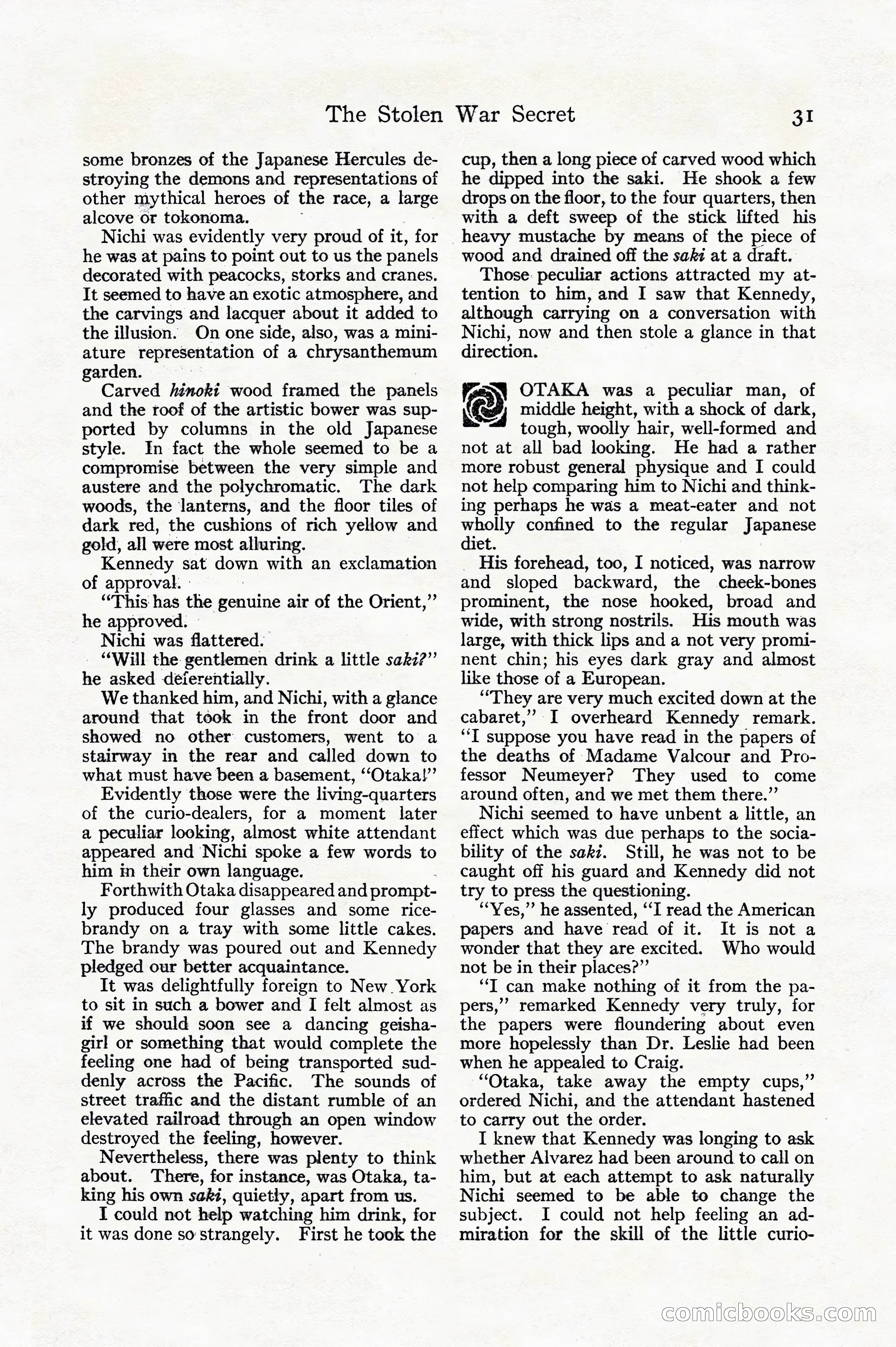
A restored page from Pulp Fiction, 1914. Page through the whole issue in the reader above.
📄 Transcribed text from this page (OCR, searchable)
Machine-transcribed from the original scan — historical spelling and the odd misread are preserved.
The Stolen War Secret some bronzes of the Japanese Hercules de- stroying the demons and representations of other mythical heroes of the race, a large alcove or tokonoma. Nichi was evidently very proud of it, for he was at pains to point out to us the panels decorated with peacocks, storks and cranes. It seemed to have an exotic atmosphere, and the carvings and lacquer about it added to the illusion. On one side, also, was a mini- ature representation of a chrysanthemum garden. Carved hinokt wood framed the panels and the roof of the artistic bower was sup- ported by columns in the old Japanese style. In fact the whole seemed to be a compromise between the very simple and austere and the polychromatic. The dark woods, the lanterns, and the floor tiles of dark red, the cushions of rich yellow and gold, all were most alluring. Kennedy sat down with an exclamation of approval. “This has the genuine air of the Orient,”’ he approved. — Nichi was flattered. _ “Will the gentlemen drink a little saki?”’ he asked deferentially. We thanked him, and Nichi, with a glance around that took in the front door and showed no other customers, went to a stairway in the rear and called down to what must have been a basement, “‘Otaka!”’ Evidently those were the living-quarters of the curio-dealers, for a moment later a peculiar looking, almost white attendant appeared and Nichi spoke a few words to him m their own language. Forthwith Otaka disappeared and prompt- ly produced four glasses and some rice- brandy on a tray with some little cakes. The brandy was poured out and Kennedy pledged our better acquaintance. It was delightfully foreign to New York to sit in such a bower and I felt almost as if we should soon see a dancing geisha- girl or something that would complete the feeling one had of being transported sud- denly across the Pacific. The sounds of street traffic and the distant rumble of an elevated railroad through an open window destroyed the feeling, however. Nevertheless, there was plenty to think about. ‘There, for instance, was Otaka, ta- king his own saki, quietly, apart from us. I could not help watching him drink, for it was done sostrangely. First he took the 31 cup, then a long piece of carved wood which he dipped into the saki. He shook a few drops on the floor, to the four quarters, then with a deft sweep of the stick lifted his heavy mustache by means of the piece of wood and drained off the sak: at a draft. Those: peculiar actions attracted my at- tention to him, and I saw that Kennedy, although carrying on a conversation with Nichi, now and then stole a glance in that direction. (a) OTAKA was a peculiar man, of > middle height, with a shock of dark, tough, woolly hair, well-formed and not at all bad looking. He had a rather more robust general physique and I could not help comparing him to Nichi and think- ing perhaps he was a meat-eater and not wholly confined to the regular Japanese diet. His forehead, too, I noticed, was narrow and sloped backward, the cheek-bones prominent, the nose hooked, broad and wide, with strong nostrils. His mouth was large, with thick lips and a not very promi- nent chin; his eyes dark gray and almost like those of a European. “They are very much excited down at the cabaret,” I overheard Kennedy remark. “I suppose you have read in the papers of the deaths of Madame Valcour and Pro- fessor Neumeyer? They used to come around often, and we met them there.”’ Nichi seemed to have unbent a little, an effect which was due perhaps to the socia- bility of the sakz. Still, he was not to be caught off his guard and Kennedy did not try to press the questioning. “Yes,” he assented, ‘‘I read the American papers and have read of it. It is not a wonder that they are excited. Who would not be in their places?”’ “T can make nothing of it from the pa- pers,’ remarked Kennedy very truly, for the papers were floundering about even more hopelessly than Dr. Leslie had been when he appealed to Craig. “Otaka, take away the empty cups,” ordered Nichi, and the attendant hastened to carry out the order. I knew that Kennedy was longing to ask whether Alvarez had been around to call on him, but at each attempt to ask naturally Nichi seemed to be able to change the subject. I could not help feeling an ad- miration for the skill of the little curio- DOOK C©