
Pulp Fiction, 1914 · page 209 of 228
Adventure, December 1914 — page 209: what you’re looking at
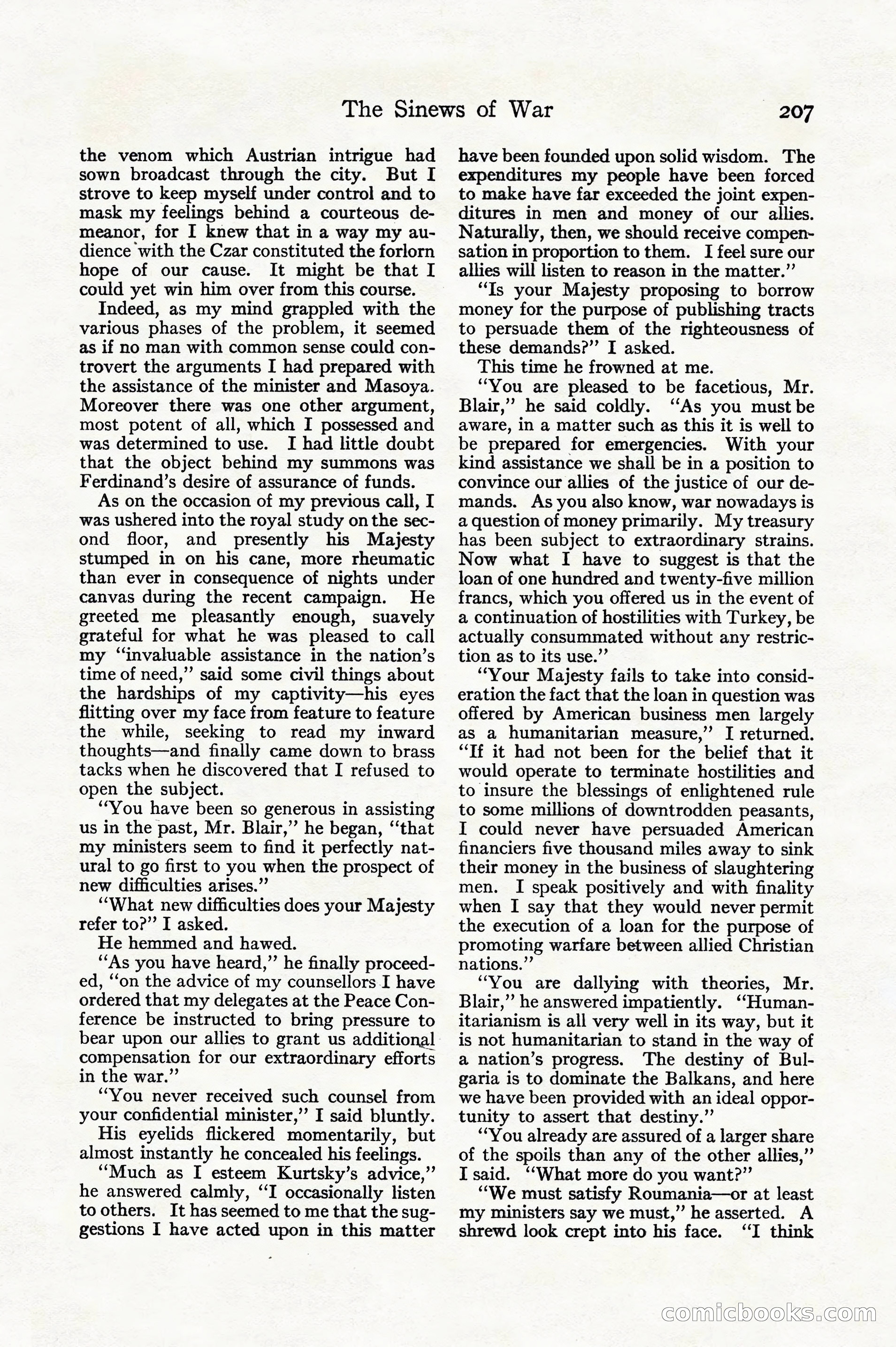
A restored page from Pulp Fiction, 1914. Page through the whole issue in the reader above.
📄 Transcribed text from this page (OCR, searchable)
Machine-transcribed from the original scan — historical spelling and the odd misread are preserved.
The Sinews of War the venom which Austrian intrigue had sown broadcast through the city. But I strove to keep myself under control and to mask my feelings behind a courteous de- meanor, for I knew that in a way my au- dience with the Czar constituted the forlorn hope of our cause. It might be that I could yet win him over from this course. Indeed, as my mind grappled with the various phases of the problem, it seemed as if no man with common sense could con- trovert the arguments I had prepared with the assistance of the minister and Masoya. Moreover there was one other argument, most potent of all, which I possessed and was determined to use. I had little doubt that the object behind my summons was Ferdinand’s desire of assurance of funds. As on the occasion of my previous call, I was ushered into the royal study on the sec- ond floor, and presently his Majesty stumped in on his cane, more rheumatic than ever in consequence of nights under canvas during the recent campaign. He greeted me pleasantly enough, suavely grateful for what he was pleased to call my “invaluable assistance in the nation’s time of need,”’ said some civil things about the hardships of my captivity—his eyes flitting over my face from feature to feature the while, seeking to read my inward thoughts—and finally came down to brass tacks when he discovered that I refused to open the subject. ‘You have been so generous in assisting us in the past, Mr. Blair,” he began, ‘‘that my ministers seem to find it perfectly nat- ural to go first to you when the prospect of new difficulties arises.” “What new difficulties does your Majesty refer to?” I asked. He hemmed and hawed. ‘‘As you have heard,” he finally proceed- ed, ‘fon the advice of my counsellors I have ordered that my delegates at the Peace Con- ference be instructed to bring pressure to bear upon our allies to grant us additional compensation for our extraordinary efforts in the war.” ‘You never received such counsel from your confidential minister,”’ I said bluntly. His eyelids flickered momentarily, but almost instantly he concealed his feelings. ‘““Much as I esteem Kurtsky’s advice,” he answered calmly, “I occasionally listen to others. It has seemed to me that the sug- gestions I have acted upon in this matter 207 have been founded upon solid wisdom. The expenditures my people have been forced to make have far exceeded the joint expen- ditures in men and money of our allies. Naturally, then, we should receive compen- sation in proportion to them. I feel sure our allies will listen to reason in the matter.” “Is your Majesty proposing to borrow money for the purpose of publishing tracts to persuade them of the righteousness of these demands?” I asked. This time he frowned at me. “You are pleased to be facetious, Mr. Blair,” he said coldly. ‘‘As you must be aware, in a matter such as this it is well to be prepared for emergencies. With your kind assistance we shall be in a position to convince our allies of the justice of our de- mands. As you also know, war nowadays is a question of money primarily. My treasury has been subject to extraordinary strains. Now what I have to suggest is that the loan of one hundred and twenty-five million francs, which you offered us in the event of a continuation of hostilities with Turkey, be actually consummated without any restric- tion as to its use.” “Your Majesty fails to take into consid- eration the fact that the loan in question was offered by American business men largely as a humanitarian measure,’”’ I returned. “If it had not been for the belief that it would operate to terminate hostilities and to insure the blessings of enlightened rule to some millions of downtrodden peasants, I could never have persuaded American financiers five thousand miles away to sink their money in the business of slaughtering men. I speak positively and with finality when I say that they would never permit the execution of a loan for the purpose of promoting warfare between allied Christian nations.” “You are dallying with theories, Mr. Blair,”’ he answered impatiently. ‘‘Human- itarianism is all very well in its way, but it is not humanitarian to stand in the way of a nation’s progress. The destiny of Bul- garia is to dominate the Balkans, and here we have been provided with an ideal oppor- tunity to assert that destiny.”’ ‘You already are assured of a larger share of the spoils than any of the other allies,” I said. ‘‘What more do you want?” ‘“‘We must satisfy Roumania—or at least my ministers say we must,” he asserted. A shrewd look crept into his face. ‘I think MICLOOOK C@