
Pulp Fiction, 1914 · page 201 of 228
Adventure, December 1914 — page 201: what you’re looking at
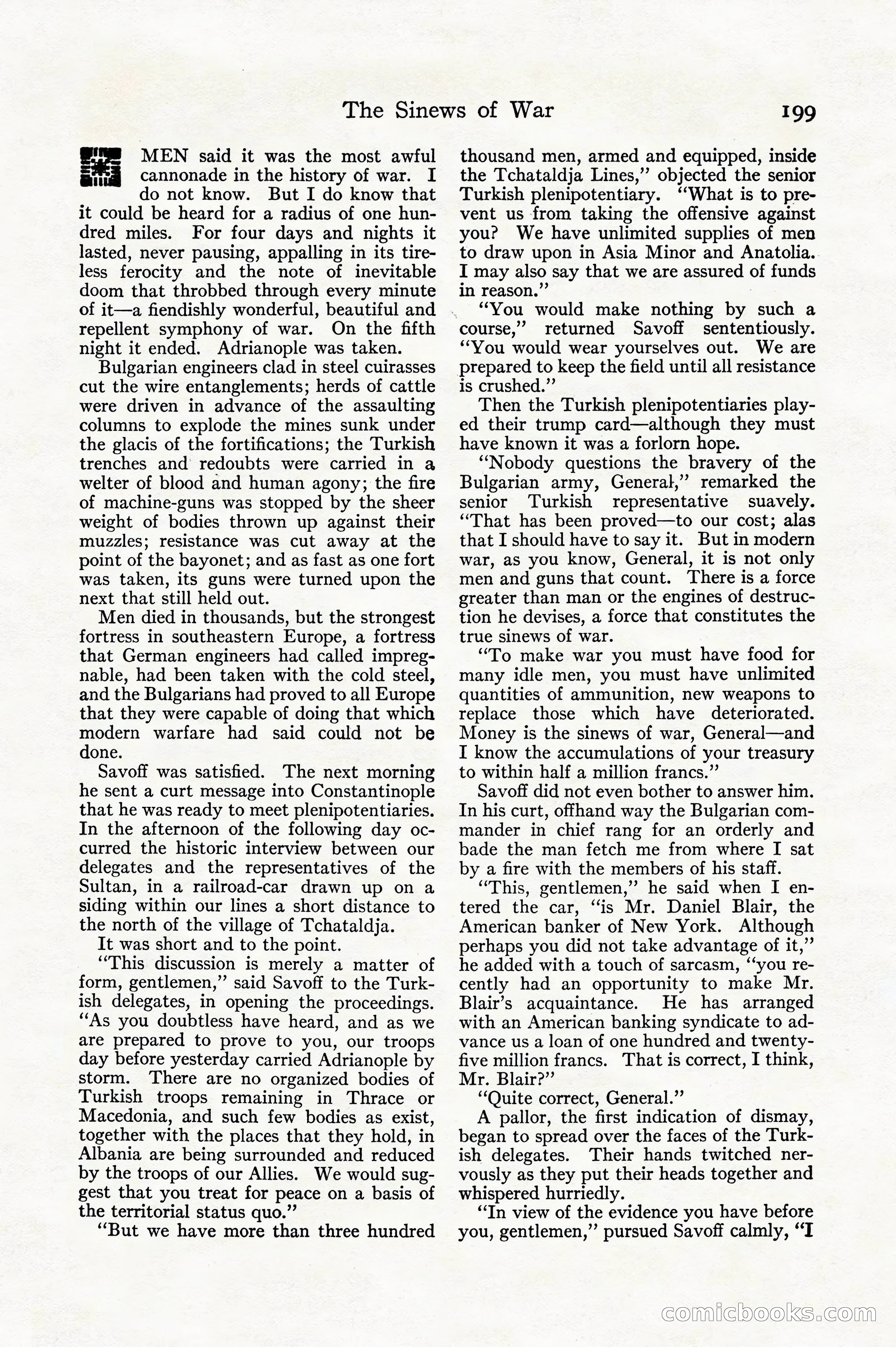
A restored page from Pulp Fiction, 1914. Page through the whole issue in the reader above.
📄 Transcribed text from this page (OCR, searchable)
Machine-transcribed from the original scan — historical spelling and the odd misread are preserved.
The Sinews of War MEN said it was the most awful cannonade in the history of war. I do not know. But I do know that it could be heard for a radius of one hun- dred miles. For four days and nights it lasted, never pausing, appalling in its tire- less ferocity and the note of inevitable doom that throbbed through every minute of it—a fiendishly wonderful, beautiful and repellent symphony of war. On the fifth night it ended. Adrianople was taken. Bulgarian engineers clad in steel cuirasses cut the wire entanglements; herds of cattle were driven in advance of the assaulting columns to explode the mines sunk under the glacis of the fortifications; the Turkish trenches and redoubts were carried in a welter of blood and human agony; the fire of machine-guns was stopped by the sheer weight of bodies thrown up against their muzzles; resistance was cut away at the point of the bayonet; and as fast as one fort was taken, its guns were turned upon the next that still held out. Men died in thousands, but the strongest fortress in southeastern Europe, a fortress that German engineers had called impreg- nable, had been taken with the cold steel, and the Bulgarians had proved to all Europe that they were capable of doing that which modern warfare had said could not be done. Savoff was satisfied. The next morning he sent a curt message into Constantinople that he was ready to meet plenipotentiaries. In the afternoon of the following day oc- curred the historic interview between our delegates and the representatives of the Sultan, in a railroad-car drawn up on a siding within our lines a short distance to the north of the village of Tchataldja. It was short and to the point. “This discussion is merely a matter of form, gentlemen,” said Savoff to the Turk- ish delegates, in opening the proceedings. “As you doubtless have heard, and as we are prepared to prove to you, our troops day before yesterday carried Adrianople by storm. There are no organized bodies of Turkish troops remaining in Thrace or Macedonia, and such few bodies as exist, together with the places that they hold, in Albania are being surrounded and reduced by the troops of our Allies. We would sug- gest that you treat for peace on a basis of the territorial status quo.”’ “But we have more than three hundred 199 thousand men, armed and equipped, inside the Tchataldja Lines,’”’ objected the senior Turkish plenipotentiary. ‘What is to pre- vent us from taking the offensive against you? We have unlimited supplies of men to draw upon in Asia Minor and Anatolia. I may also say that we are assured of funds in reason.”’ : “You would make nothing by such a course,” returned Savoff sententiously. ‘‘You would wear yourselves out. We are prepared to keep the field until all resistance is crushed.” Then the Turkish plenipotentiaries play- ed their trump card—although they must have known it was a forlorn hope. ‘“‘Nobody questions the bravery of the Bulgarian army, General,’ remarked the senior ‘Turkish representative suavely. “That has been proved—to our cost; alas that I should have to say it. But in modern war, as you know, General, it is not only men and guns that count. There is a force greater than man or the engines of destruc- tion he devises, a force that constitutes the true sinews of war. “To make war you must have food for many idle men, you must have unlimited quantities of ammunition, new weapons to replace those which have deteriorated. Money is the sinews of war, General—and I know the accumulations of your treasury to within half a million francs.” Savoff did not even bother to answer him. In his curt, offhand way the Bulgarian com- mander in chief rang for an orderly and bade the man fetch me from where I sat by a fire with the members of his staff. “This, gentlemen,” he said when I en- tered the car, “is Mr. Daniel Blair, the American banker of New York. Although perhaps you did not take advantage of it,”’ he added with a touch of sarcasm, “‘you re- cently had an opportunity to make Mr. Blair’s acquaintance. He has arranged with an American banking syndicate to ad- vance us a loan of one hundred and twenty- five million francs. That is correct, I think, Mr. Blair?”’ “Quite correct, General.” A pallor, the first indication of dismay, began to spread over the faces of the Turk- ish delegates. Their hands twitched ner- vously as they put their heads together and whispered hurriedly. “In view of the evidence you have before you, gentlemen,” pursued Savoff calmly, “T MICLOOOK C©