
Pulp Fiction, 1914 · page 192 of 228
Adventure, December 1914 — page 192: what you’re looking at
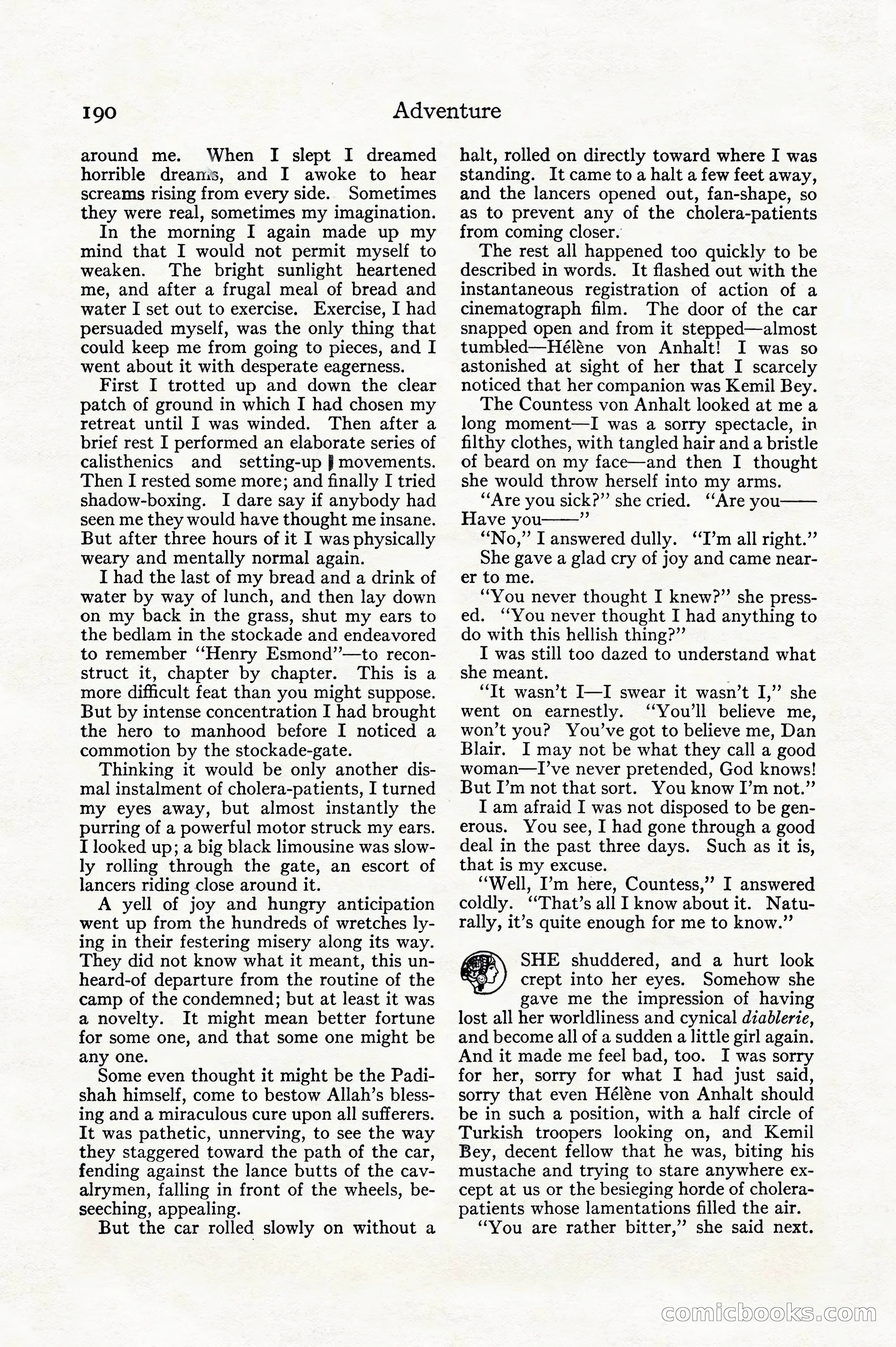
A restored page from Pulp Fiction, 1914. Page through the whole issue in the reader above.
📄 Transcribed text from this page (OCR, searchable)
Machine-transcribed from the original scan — historical spelling and the odd misread are preserved.
190 around me. When I slept I dreamed horrible dreams, and I awoke to hear screams rising from every side. Sometimes they were real, sometimes my imagination. In the morning I again made up my mind that I would not permit myself to weaken. The bright sunlight heartened me, and after a frugal meal of bread and water I set out to exercise. Exercise, I had persuaded myself, was the only thing that could keep me from going to pieces, and I went about it with desperate eagerness. First I trotted up and down the clear patch of ground in which I had chosen my retreat until I was winded. Then after a brief rest I performed an elaborate series of calisthenics and_ setting-up | movements. Then I rested some more; and finally I tried shadow-boxing. I dare say if anybody had seen me they would have thought me insane. But after three hours of it I was physically weary and mentally normal again. I had the last of my bread and a drink of water by way of lunch, and then lay down on my back in the grass, shut my ears to the bedlam in the stockade and endeavored to remember “Henry Esmond’’—to recon- struct it, chapter by chapter. This is a more difficult feat than you might suppose. But by intense concentration I had brought the hero to manhood before I noticed a commotion by the stockade-gate. Thinking it would be only another dis- mal instalment of cholera-patients, I turned my eyes away, but almost instantly the purring of a powerful motor struck my ears. I looked up; a big black limousine was slow- ly rolling through the gate, an escort of lancers riding close around it. A yell of joy and hungry anticipation went up from the hundreds of wretches ly- ing in their festering misery along its way. They did not know what it meant, this un- heard-of departure from the routine of the camp of the condemned; but at least it was a novelty. It might mean better fortune for some one, and that some one might be any one. Some even thought it might be the Padi- shah himself, come to bestow Allah’s bless- ing and a miraculous cure upon all sufferers. It was pathetic, unnerving, to see the way they staggered toward the path of the car, fending against the lance butts of the cav- alrymen, falling in front of the wheels, be- seeching, appealing. But the car rolled slowly on without a Adventure halt, rolled on directly toward where I was standing. It came toa halt a few feet away, and the lancers opened out, fan-shape, so as to prevent any of the cholera-patients from coming closer. The rest all happened too quickly to be described in words. It flashed out with the instantaneous registration of action of a cinematograph film. The door of the car snapped open and from it stepped—almost tumbled—Héléne von Anhalt! I was so astonished at sight of her that I scarcely noticed that her companion was Kemil Bey. The Countess von Anhalt looked at me a long moment—I was a sorry spectacle, in filthy clothes, with tangled hair and a bristle of beard on my face—and then I thought she would throw herself into my arms. ‘“‘Are you sick?” she cried. ‘“‘Are you—— Have you — “No,” I answered dully. “I’m all right.” She gave a glad cry of joy and came near- er to me. “You never thought I knew?” she press- ed. “You never thought I had anything to do with this hellish thing?” I was still too dazed to understand what she meant. “It wasn’t I—I swear it wasn’t I,’ she went on earnestly. ‘“‘You’ll believe me, won’t you? You’ve got to believe me, Dan Blair. I may not be what they call a good woman—lI’ve never pretended, God knows! But I’m not that sort. You know I’m not.” I am afraid I was not disposed to be gen- erous. You see, I had gone through a good deal in the past three days. Such as it is, that is my excuse. “Well, I’m here, Countess,”’ I answered coldly. “That’s all I know about it. Natu- rally, it’s quite enough for me to know.” SHE shuddered, and a hurt look crept into her eyes. Somehow she gave me the impression of having lost all her worldliness and cynical dzablerie, and become all of a sudden a little girl again. And it made me feel bad, too. I was sorry for her, sorry for what I had just said, sorry that even Héléne von Anhalt should be in such a position, with a half circle of Turkish troopers looking on, and Kemil Bey, decent fellow that he was, biting his mustache and trying to stare anywhere ex- cept at us or the besieging horde of cholera- patients whose lamentations filled the air. “You are rather bitter,’ she said next. Gomiicovook (C@