
Pulp Fiction, 1914 · page 175 of 228
Adventure, December 1914 — page 175: what you’re looking at
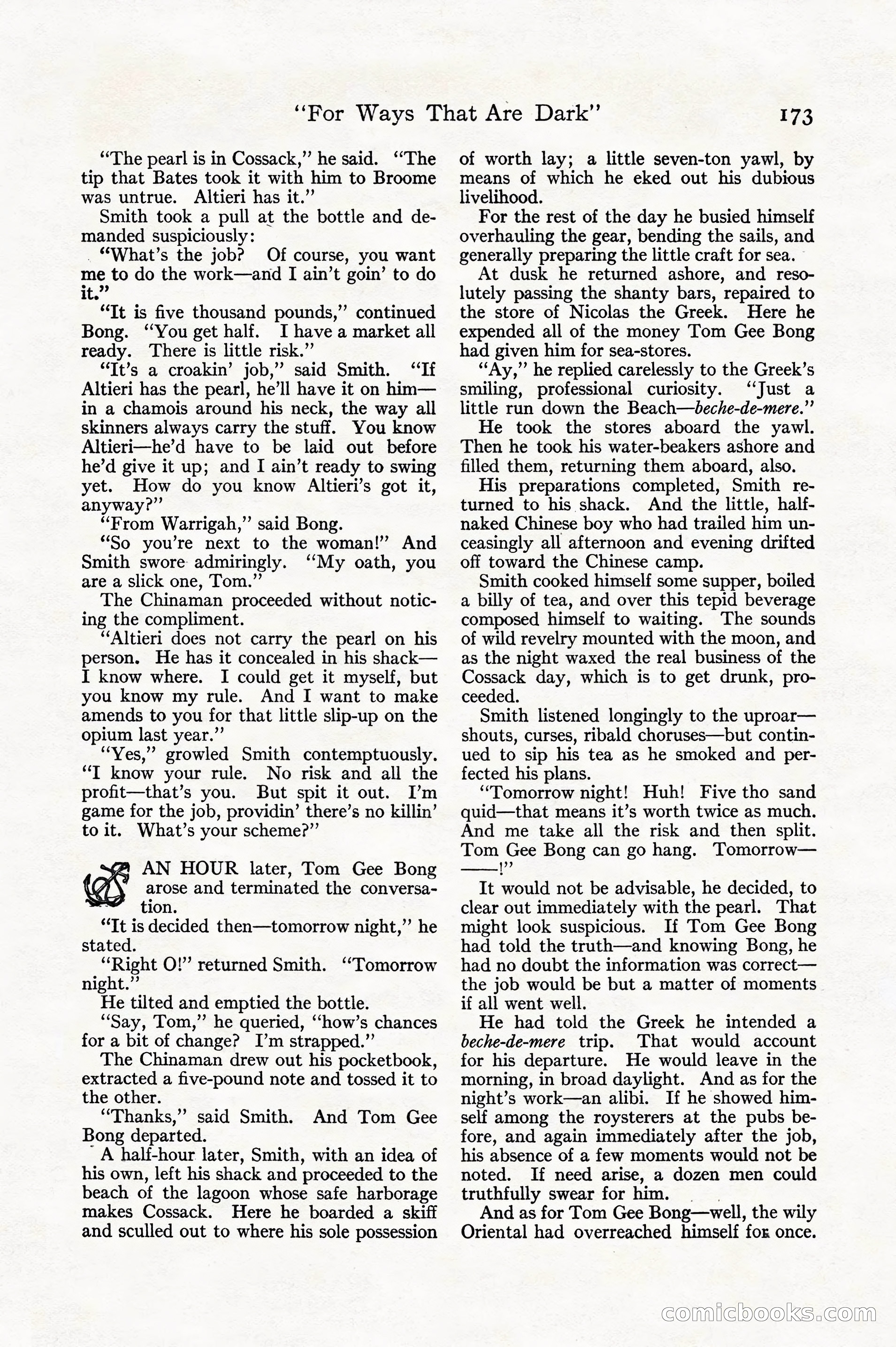
A restored page from Pulp Fiction, 1914. Page through the whole issue in the reader above.
📄 Transcribed text from this page (OCR, searchable)
Machine-transcribed from the original scan — historical spelling and the odd misread are preserved.
“Ror Ways That Are Dark” ‘The pearl is in Cossack,” he said. ‘“The tip that Bates took it with him to Broome was untrue. Altieri has it.” Smith took a pull at the bottle and de- manded suspiciously: _ “What’s the job? Of course, you want me to do the work—and I ain’t goin’ to do it.” “Tt is five thousand pounds,” continued Bong. “You get half. I have a market all ready. There is little risk.” “It’s a croakin’ job,” said Smith. “If Altieri has the pearl, he’ll have it on him— in a chamois around his neck, the way all skinners always carry the stuff. You know Altieri—he’d have to be laid out before he’d give it up; and I ain’t ready to swing yet. How do you know Altieri’s got it, anyway?” “From Warrigah,” said Bong. ‘So you’re next to the woman!” And Smith swore admiringly. ‘‘My oath, you are a slick one, Tom.”’ The Chinaman proceeded without notic- ing the compliment. “Altieri does not carry the pearl on his person. He has it concealed in his shack— I know where. I could get it myself, but you know my rule. And I want to make amends to you for that little slip-up on the opium last year.” “Yes,” growled Smith contemptuously. “T know your rule. No risk and all the profit—that’s you. But spit it out. [I’m game for the job, providin’ there’s no killin’ to it. What’s your scheme?”’ CAN arose and terminated the conversa- ~ A10n, “It is decided then—tomorrow night,” he stated. “Right O!” returned Smith. ‘“Tomorrow night.”’ He tilted and emptied the bottle. “Say, Tom,” he queried, “‘how’s chances for a bit of change? I’m strapped.” The Chinaman drew out his pocketbook, extracted a five-pound note and tossed it to the other. “Thanks,” said Smith. And Tom Gee Bong departed. A half-hour later, Smith, with an idea of his own, left his shack and proceeded to the beach of the lagoon whose safe harborage makes Cossack. Here he boarded a skiff and sculled out to where his sole possession AN HOUR later, Tom Gee Bong 173 of worth lay; a little seven-ton yawl, by means of which he eked out his dubious livelihood. For the rest of the day he busied himself overhauling the gear, bending the sails, and generally preparing the little craft for sea. At dusk he returned ashore, and reso- lutely passing the shanty bars, repaired to the store of Nicolas the Greek. Here he expended all of the money Tom Gee Bong had given him for sea-stores. “Ay,” he replied carelessly to the Greek’s smiling, professional curiosity. ‘‘Just a little run down the Beach—beche-de-mere.”’ He took the stores aboard the yawl. Then he took his water-beakers ashore and filled them, returning them aboard, also. His preparations completed, Smith re- turned to his shack. And the little, half- naked Chinese boy who had trailed him un- ceasingly all afternoon and evening drifted off toward the Chinese camp. Smith cooked himself some supper, boiled a billy of tea, and over this tepid beverage composed himself to waiting. The sounds of wild revelry mounted with the moon, and as the night waxed the real business of the Cossack day, which is to get drunk, pro- ceeded. Smith listened longingly to the uproar— shouts, curses, ribald choruses—but contin- ued to sip his tea as he smoked and per- fected his plans. ‘“‘Tomorrow night! Huh! Five tho sand quid—that means it’s worth twice as much. And me take all the risk and then split. Tom Gee Bong can go hang. —Tomorrow— As It would not be advisable, he decided, to clear out immediately with the pearl. That might look suspicious. If Tom Gee Bong had told the truth—and knowing Bong, he had no doubt the information was correct— the job would be but a matter of moments if all went well. He had told the Greek he intended a beche-de-mere trip. ‘That would account for his departure. He would leave in the morning, in broad daylight. And as for the night’s work—an alibi. If he showed him- self among the roysterers at the pubs be- fore, and again immediately after the job, his absence of a few moments would not be noted. If need arise, a dozen men could truthfully swear for him. And as for Tom Gee Bong—well, the wily Oriental had overreached himself for once. NOOK C©