
Pulp Fiction, 1914 · page 159 of 228
Adventure, December 1914 — page 159: what you’re looking at
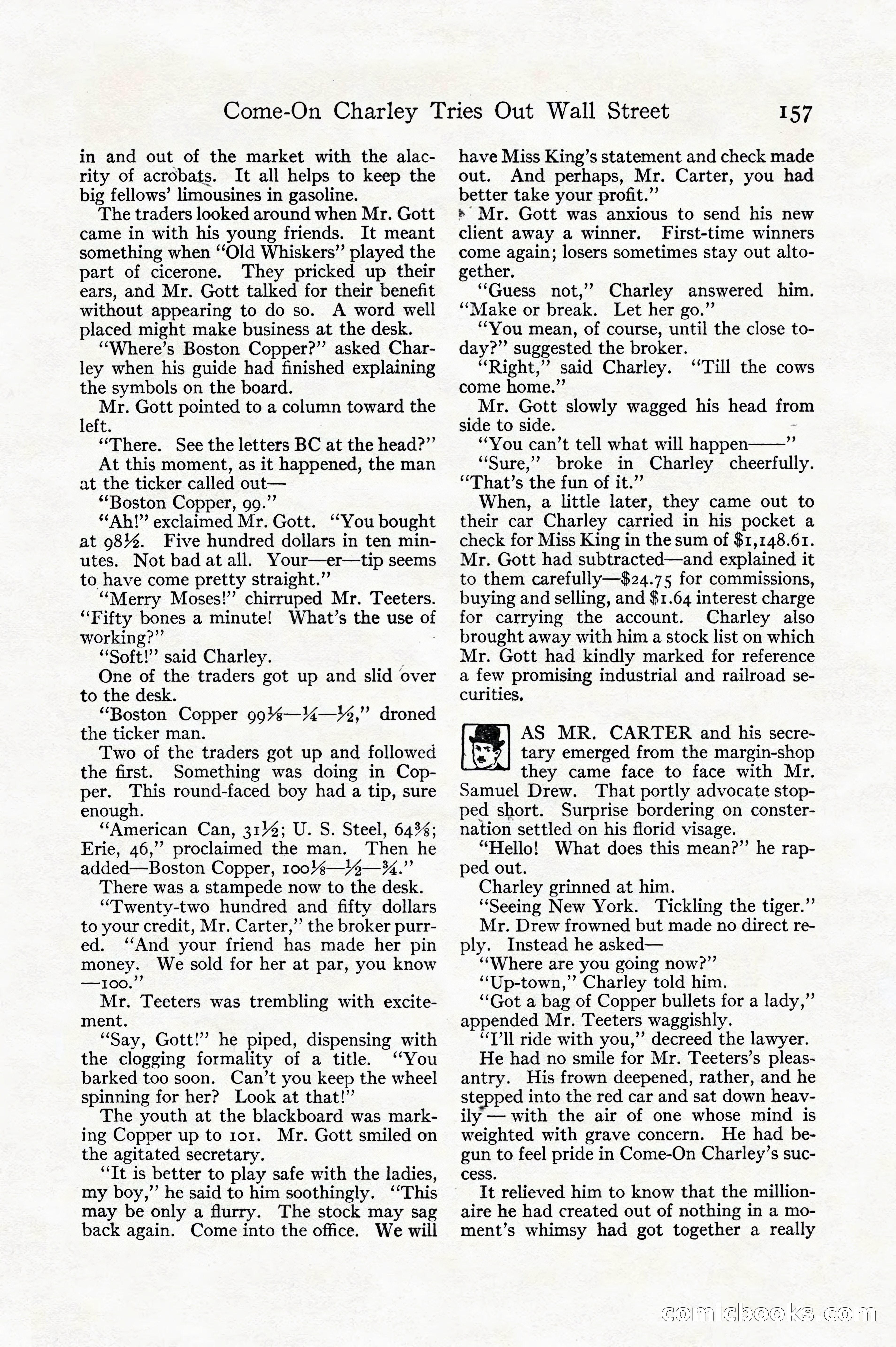
A restored page from Pulp Fiction, 1914. Page through the whole issue in the reader above.
📄 Transcribed text from this page (OCR, searchable)
Machine-transcribed from the original scan — historical spelling and the odd misread are preserved.
Come-On Charley Tries Out Wall Street in and out of the market with the alac- rity of acrobats. It all helps to keep the big fellows’ limousines in gasoline. The traders looked around when Mr. Gott came in with his young friends. It meant something when “‘Old Whiskers” played the part of cicerone. They pricked up their ears, and Mr. Gott talked for their benefit without appearing to do so. A word well placed might make business at the desk. ‘“‘Where’s Boston Copper?” asked Char- ley when his guide had finished explaining the symbols on the board. Mr. Gott pointed to a column toward the left. “There. See the letters BC at the head?”’ At this moment, as it happened, the man at the ticker called out— ‘‘Boston Copper, 99.” “Ah!” exclaimed Mr. Gott. ‘“‘You bought at 98%. Five hundred dollars in ten min- utes. Not bad at all. Your—er—tip seems to have come pretty straight.” ‘““Merry Moses!’ chirruped Mr. Teeters. “Fifty bones a minute! What’s the use of working?” . ‘Soft!’ said Charley. | One of the traders got up and slid over to the desk. “Boston Copper 994s—4—',” droned the ticker man. Two of the traders got up and followed the first. Something was doing in Cop- per. This round-faced boy had a tip, sure enough. ‘American Can, 3114; U. S. Steel, 6434; Erie, 46,” proclaimed the man. Then he added—Boston Copper, 100}44—l4—34.” There was a stampede now to the desk. “Twenty-two hundred and fifty dollars to your credit, Mr. Carter,” the broker purr- ed. “And your friend has made her pin money. We sold for her at par, you know —I100.”’ Mr. Teeters was trembling with excite- ment. “Say, Gott!’ he piped, dispensing with the clogging formality of a title. “You barked too soon. Can’t you keep the wheel spinning for her? Look at that!” The youth at the blackboard was mark- ing Copper up to ror. Mr. Gott smiled on the agitated secretary. “It is better to play safe with the ladies, my boy,” he said to him soothingly. ‘“This may be only a flurry. The stock may sag back again. Come into the office. We will I5/ have Miss King’s statement and check made out. And perhaps, Mr. Carter, you had better take your profit.”’ » Mr. Gott was anxious to send his new client away a winner. First-time winners come again; losers sometimes stay out alto- gether. ‘Guess not,’’ Charley answered him. ‘Make or break. Let her go.” ‘“You mean, of course, until the close to- day?’ suggested the broker. “Right,” said Charley. come home.”’ Mr. Gott slowly wagged his head fro side to side. “You can’t tell what will happen——”’ “Sure,” broke in Charley cheerfully. ‘“That’s the fun of it.”’ When, a little later, they came out to their car Charley carried in his pocket a check for Miss King in the sum of $1,148.61. Mr. Gott had subtracted—and explained it to them carefully—$24.75 for commissions, buying and selling, and $1.64 interest charge for carrying the account. Charley also brought away with him a stock list on which Mr. Gott had kindly marked for reference a few promising industrial and railroad se- curities. tary emerged from the margin-shop they came face to face with Mr. Samuel Drew. That portly advocate stop- ped short. Surprise bordering on conster- nation settled on his florid visage. “Hello! What does this mean?”’ he rap- ped out. Charley grinned at him. “Seeing New York. Tickling the tiger.” Mr. Drew frowned but made no direct re- ply. Instead he asked— ‘‘Where are you going now?” ‘‘Up-town,’’ Charley told him. ‘“‘“Got a bag of Copper bullets for a lady,” “Till the cows AS MR. CARTER and his secre- - appended Mr. Teeters waggishly. “T’ll ride with you,” decreed the lawyer. He had no smile for Mr. Teeters’s pleas- antry. His frown deepened, rather, and he stepped into the red car and sat down heav- ily — with the air of one whose mind is weighted with grave concern. He had be- gun to feel pride in Come-On Charley’s suc- cess. It relieved him to know that the million- aire he had created out of nothing in a mo- ment’s whimsy had got together a really DOOK C©