
Pulp Fiction, 1914 · page 151 of 228
Adventure, December 1914 — page 151: what you’re looking at
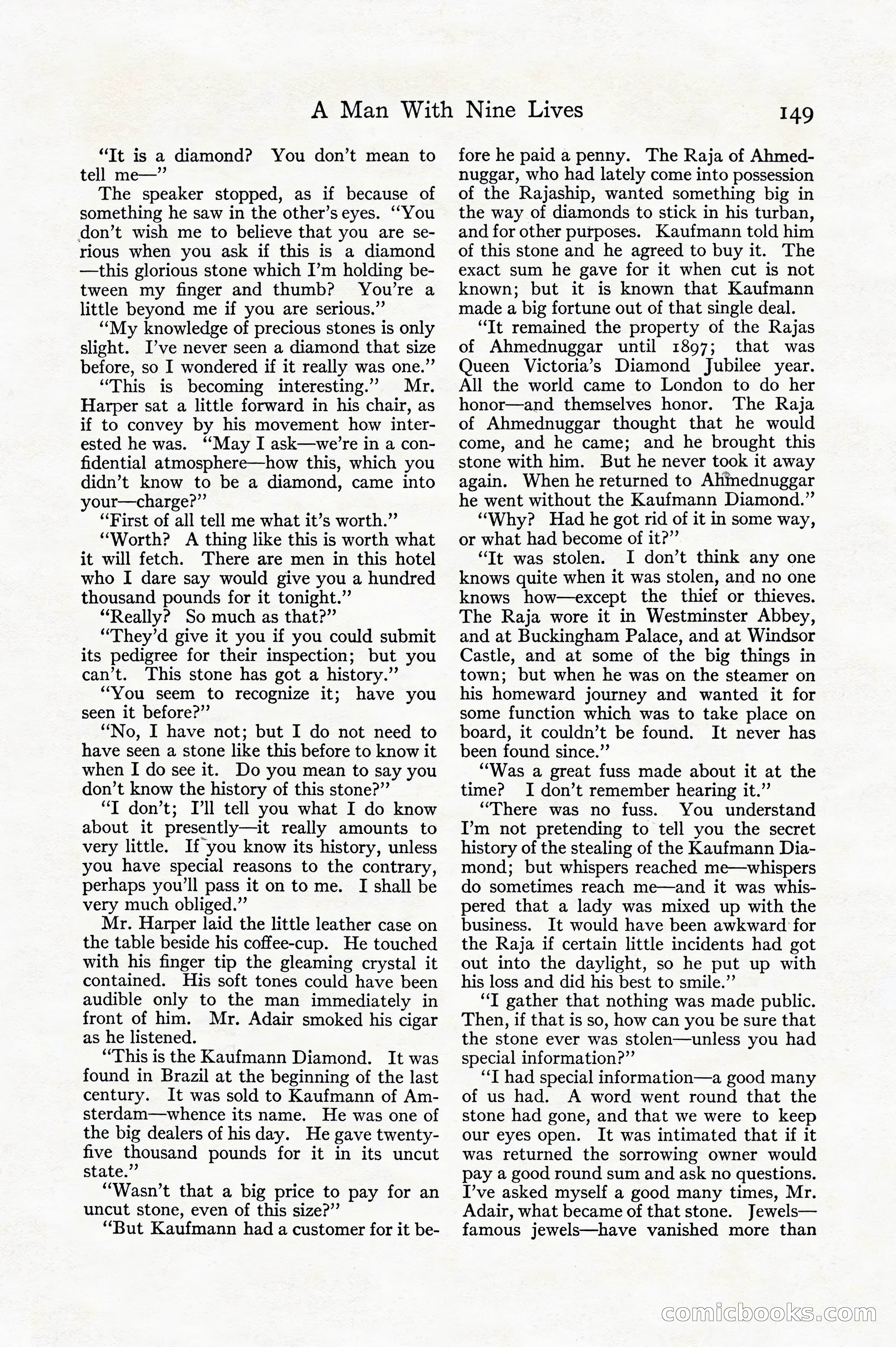
A restored page from Pulp Fiction, 1914. Page through the whole issue in the reader above.
📄 Transcribed text from this page (OCR, searchable)
Machine-transcribed from the original scan — historical spelling and the odd misread are preserved.
A Man With Nine Lives “It is a diamond? You don’t mean to tell me—” The speaker stopped, as if because of something he saw in the other’s eyes. ‘“‘You don’t wish me to believe that you are se- rious when you ask if this is a diamond —this glorious stone which I’m holding be- tween my finger and thumb? You’re a little beyond me if you are serious.” “My knowledge of precious stones is only slight. I’ve never seen a diamond that size before, so I wondered if it really was one.” “This is becoming interesting.” Mr. Harper sat a little forward in his chair, as if to convey by his movement how inter- ested he was. ‘‘May I ask—we’re in a con- fidential atmosphere—how this, which you didn’t know to be a diamond, came into your—charge?”’ “First of all tell me what it’s worth.” “Worth? A thing like this is worth what it will fetch. There are men in this hotel who I dare say would give you a hundred thousand pounds for it tonight.” “Really? So much as that?” “They’d give it you if you could submit its pedigree for their inspection; but you can’t. This stone has got a history.” “You seem to recognize it; have you seen it before?”’ “No, I have not; but I do not need to have seen a stone like this before to know it when I do see it. Do you mean to say you don’t know the history of this stone?” “T don’t; I'll tell you what I do know about it presently—it really amounts to very little. If you know its history, unless you have special reasons to the contrary, perhaps you'll pass it on to me. I shall be very much obliged.” Mr. Harper laid the little leather case on the table beside his coffee-cup. He touched with his finger tip the gleaming crystal it contained. His soft tones could have been audible only to the man immediately in front of him. Mr. Adair smoked his cigar as he listened. ‘This is the Kaufmann Diamond. It was found in Brazil at the beginning of the last century. It was sold to Kaufmann of Am- sterdam—whence its name. He was one of the big dealers of his day. He gave twenty- five thousand pounds for it in its uncut state.” “Wasn’t that a big price to pay for an uncut stone, even of this size?” “But Kaufmann had a customer for it be- 149 fore he paid a penny. The Raja of Ahmed- nuggar, who had lately come into possession of the Rajaship, wanted something big in the way of diamonds to stick in his turban, and for other purposes. Kaufmann told him of this stone and he agreed to buy it. The exact sum he gave for it when cut is not known; but it is known that Kaufmann made a big fortune out of that single deal. “It remained the property of the Rajas of Ahmednuggar until 1897; that was Queen Victoria’s Diamond Jubilee year. All the world came to London to do her honor—and themselves honor. The Raja of Ahmednuggar thought that he would come, and he came; and he brought this stone with him. But he never took it away again. When he returned to Ahmednuggar he went without the Kaufmann Diamond.” “Why? Had he got rid of it in some way, or what had become of it?”’ “Tt was stolen. I don’t think any one knows quite when it was stolen, and no one knows how—except the thief or thieves. The Raja wore it in Westminster Abbey, and at Buckingham Palace, and at Windsor Castle, and at some of the big things in town; but when he was on the steamer on his homeward journey and wanted it for some function which was to take place on board, it couldn’t be found. It never has been found since.”’ “Was a great fuss made about it at the time? I don’t remember hearing it.” “There was no fuss. You understand I’m not pretending to tell you the secret history of the stealing of the Kaufmann Dia- mond; but whispers reached me—whispers do sometimes reach me—and it was whis- pered that a lady was mixed up with the business. It would have been awkward for the Raja if certain little incidents had got out into the daylight, so he put up with his loss and did his best to smile.” “I gather that nothing was made public. Then, if that is so, how can you be sure that the stone ever was stolen—unless you had special information?” “I had special information—a good many of us had. A word went round that the stone had gone, and that we were to keep our eyes open. It was intimated that if it was returned the sorrowing owner would pay a good round sum and ask no questions. I’ve asked myself a good many times, Mr. Adair, what became of that stone. Jewels— famous jewels—have vanished more than MICLOOOLK C©