
Pulp Fiction, 1914 · page 137 of 228
Adventure, December 1914 — page 137: what you’re looking at
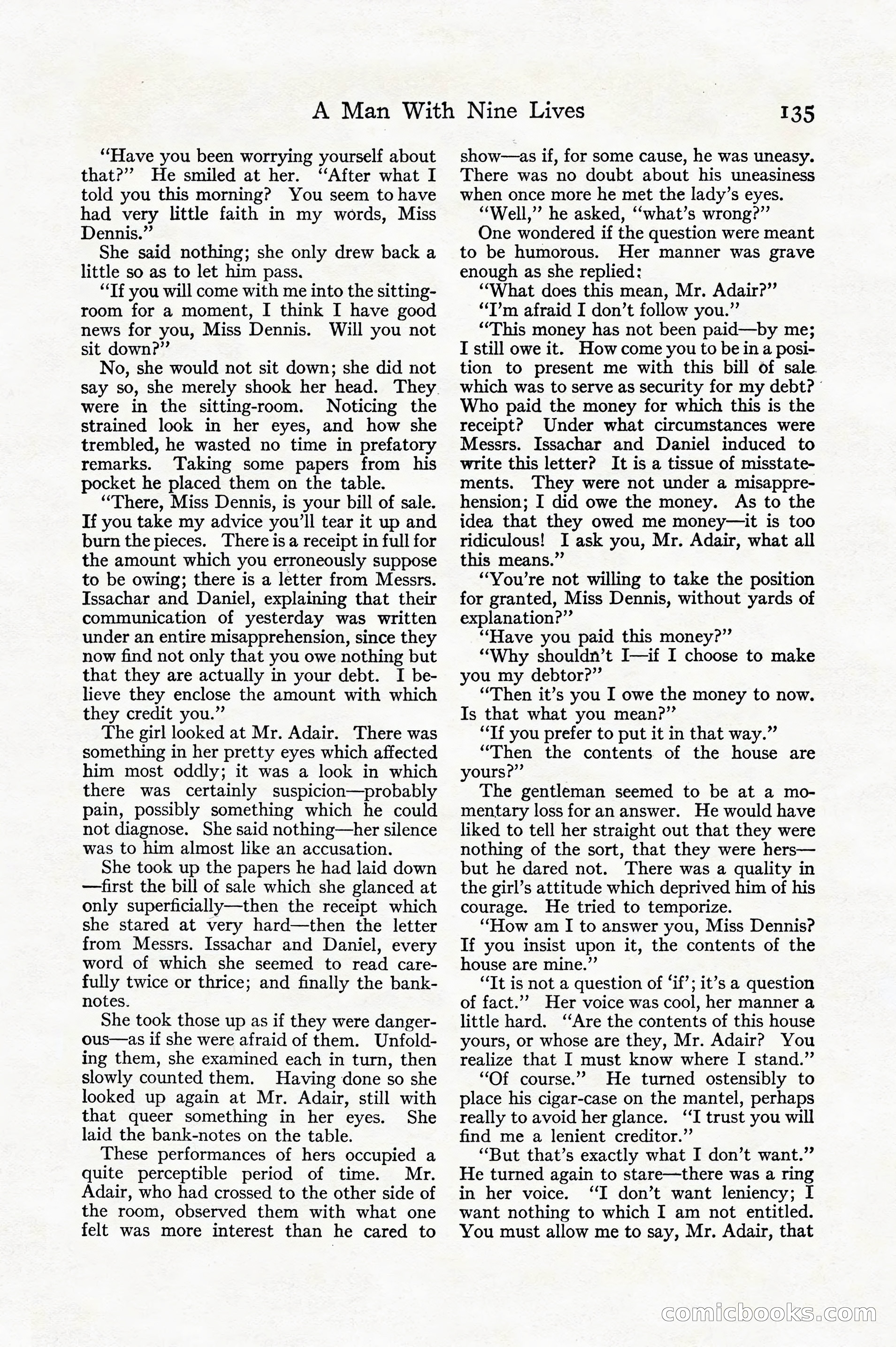
A restored page from Pulp Fiction, 1914. Page through the whole issue in the reader above.
📄 Transcribed text from this page (OCR, searchable)
Machine-transcribed from the original scan — historical spelling and the odd misread are preserved.
A Man With Nine Lives ‘““Have you been worrying yourself about that?’’ He smiled at her. “After what I told you this morning? You seem to have had very little faith in my words, Miss Dennis.” She said nothing; she only drew back a little so as to let him pass. “Tf you will come with me into the sitting- room for a moment, I think I have good news for you, Miss Dennis. Will you not sit down?” No, she would not sit down; she did not say so, she merely shook her head. They. were in the sitting-room. Noticing the strained look in her eyes, and how she trembled, he wasted no time in prefatory remarks. Taking some papers from his pocket he placed them on the table. “There, Miss Dennis, is your bill of sale. If you take my advice you'll tear it up and burn the pieces. There isa receipt in full for the amount which you erroneously suppose to be owing; there is a letter from Messrs. Issachar and Daniel, explaining that their communication of yesterday was written under an entire misapprehension, since they now find not only that you owe nothing but that they are actually in your debt. I be- lieve they enclose the amount with which they credit you.” The girl looked at Mr. Adair. There was something in her pretty eyes which affected him most oddly; it was a look in which there was certainly suspicion—probably pain, possibly something which he could not diagnose. She said nothing—her silence was to him almost like an accusation. She took up the papers he had laid down —first the bill of sale which she glanced at only superficially—then the receipt which she stared at very hard—then the letter from Messrs. Issachar and Daniel, every word of which she seemed to read care- fully twice or thrice; and finally the bank- notes. She took those up as if they were danger- ous—as if she were afraid of them. Unfold- ing them, she examined each in turn, then slowly counted them. Having done so she looked up again at Mr. Adair, still with that queer something in her eyes. She laid the bank-notes on the table. These performances of hers occupied a quite perceptible period of time. Mr. Adair, who had crossed to the other side of the room, observed them with what one felt was more interest than he cared to 135 show—as if, for some cause, he was uneasy. There was no doubt about his uneasiness when once more he met the lady’s eyes. “Well,” he asked, “‘what’s wrong?” One wondered if the question were meant to be humorous. Her manner was grave enough as she replied: ‘“‘What does this mean, Mr. Adair?”’ “T’m afraid I don’t follow you.” “This money has not been paid—by me; I still owe it. How come you to be in a posi- tion to present me with this bill of sale which was to serve as security for my debt? Who paid the money for which this is the receipt? Under what circumstances were Messrs. Issachar and Daniel induced to write this letter? It is a tissue of misstate- ments. They were not under a misappre- hension; I did owe the money. As to the idea that they owed me money—it is too ridiculous! I ask you, Mr. Adair, what all this means.” “You're not willing to take the position for granted, Miss Dennis, without yards of explanation?” “Have you paid this money?” ‘“‘Why shouldn’t I—if I choose to make you my debtor?” “Then it’s you I owe the money to now. Is that what you mean?” “If you prefer to put it in that way.” “Then the contents of the house are yours?” : The gentleman seemed to be at a mo- mentary loss for an answer. He would have liked to tell her straight out that they were nothing of the sort, that they were hers— but he dared not. There was a quality in the girl’s attitude which deprived him of his courage. He tried to temporize. “How am I to answer you, Miss Dennis? If you insist upon it, the contents of the house are mine.” “Tt is not a question of ‘if’; it’s a question of fact.”’ Her voice was cool, her manner a little hard. ‘‘Are the contents of this house yours, or whose are they, Mr. Adair? You realize that I must know where I stand.” “Of course.” He turned ostensibly to place his cigar-case on the mantel, perhaps really to avoid her glance. ‘I trust you will find me a lenient creditor.” “But that’s exactly what I don’t want.” He turned again to stare—there was a ring in her voice. ‘I don’t want leniency; I want nothing to which I am not entitled. You must allow me to say, Mr. Adair, that MICLOOOLK C@