
Pulp Fiction, 1914 · page 133 of 228
Adventure, December 1914 — page 133: what you’re looking at
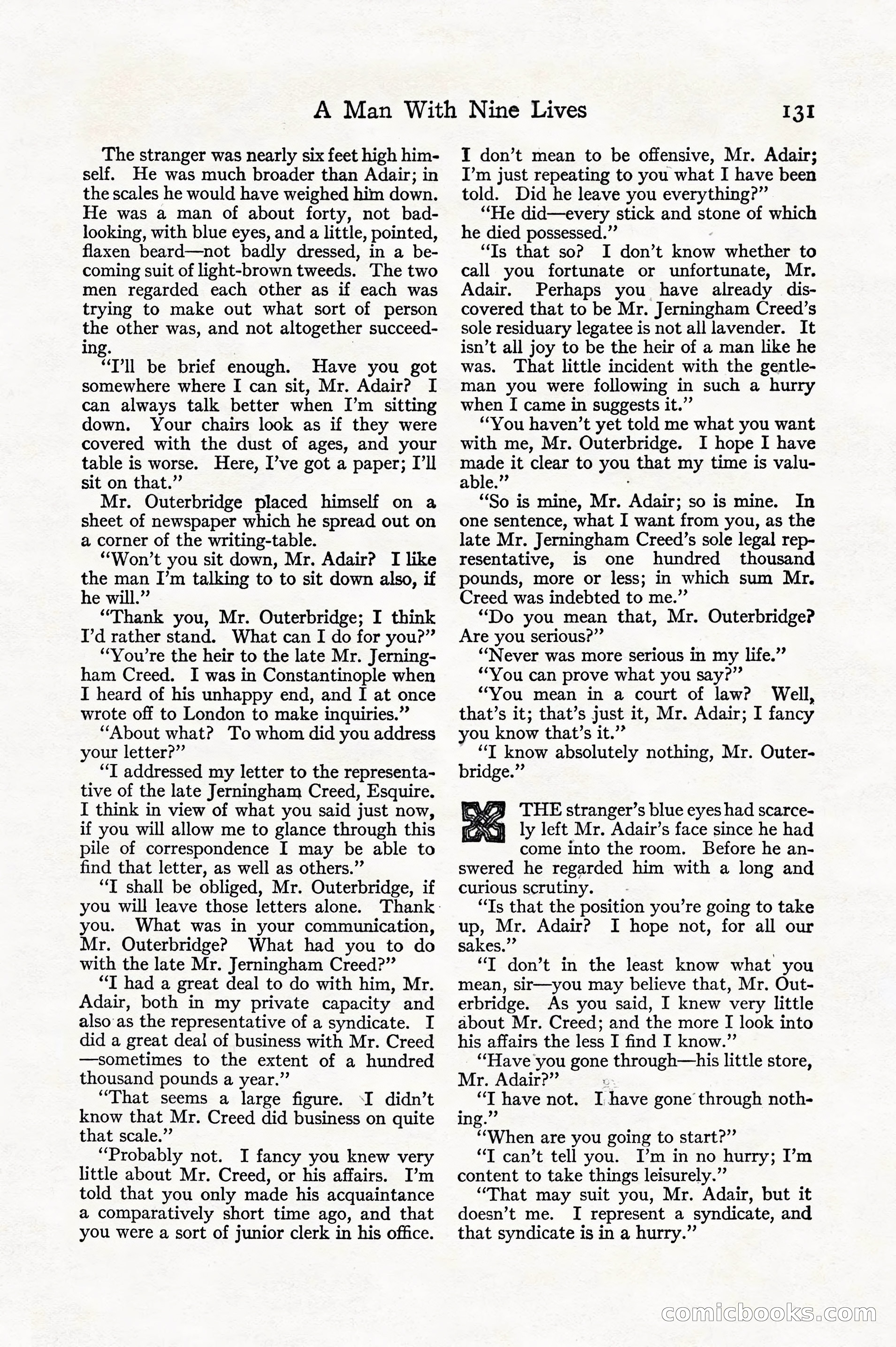
A restored page from Pulp Fiction, 1914. Page through the whole issue in the reader above.
📄 Transcribed text from this page (OCR, searchable)
Machine-transcribed from the original scan — historical spelling and the odd misread are preserved.
A Man With Nine Lives The stranger was nearly six feet high him- self. He was much broader than Adair; in the scales he would have weighed him down. He was a man of about forty, not bad- looking, with blue eyes, and a little, pointed, flaxen beard—not badly dressed, in a be- coming suit of light-brown tweeds. The two men regarded each other as if each was trying to make out what sort of person the other was, and not altogether succeed- ing. “T’ll be brief enough. Have you got somewhere where I can sit, Mr. Adair? I can always talk better when I’m sitting down. Your chairs look as if they were covered with the dust of ages, and your table is worse. Here, I’ve got a paper; I’ll sit on that.” Mr. Outerbridge placed himself on a sheet of newspaper which he spread out on a corner of the writing-table. *‘Won’t you sit down, Mr. Adair? I like the man I’m talking to to sit down also, if he will.” “Thank you, Mr. Outerbridge; I think I’d rather stand. What can I do for you?” “You're the heir to the late Mr. Jerning- ham Creed. I was in Constantinople when I heard of his unhappy end, and I at once wrote off to London to make inquiries.” ‘About what? To whom did you address your letter?” “TI addressed my letter to the representa- tive of the late Jerningham Creed, Esquire. I think in view of what you said just now, if you will allow me to glance through this pile of correspondence I may be able to find that letter, as well as others.” “T shall be obliged, Mr. Outerbridge, if you will leave those letters alone. you. What was in your communication, Mr. Outerbridge? What had you to do with the late Mr. Jerningham Creed?” “T had a great deal to do with him, Mr. Adair, both in my private capacity and also as the representative of a syndicate. I did a great deal of business with Mr. Creed —sometimes to the extent of a hundred thousand pounds a year.”’ ‘That seems a large figure. ‘I didn’t know that Mr. Creed did business on quite that scale.” “Probably not. I fancy you knew very little about Mr. Creed, or his affairs. I’m told that you only made his acquaintance a comparatively short time ago, and that you were a sort of junior clerk in his office. Thank - 131 I don’t mean to be offensive, Mr. Adair; I’m just repeating to you what I have been told. Did he leave you everything?”’ “He did—every stick and stone of which he died possessed.” “Is that so? I don’t know whether to call you fortunate or unfortunate, Mr. Adair. Perhaps you have already dis- covered that to be Mr. Jerningham Creed’s sole residuary legatee is not all lavender. It isn’t all joy to be the heir of a man like he was. That little incident with the gentle- man you were following in such a hurry when I came in suggests it.”’ “You haven’t yet told me what you want with me, Mr. Outerbridge. I hope I have made it clear to you that my time is valu- able.” “So is mine, Mr. Adair; so is mine. In one sentence, what I want from you, as the late Mr. Jerningham Creed’s sole legal rep- resentative, is one hundred thousand pounds, more or less; in which sum Mr. Creed was indebted to me.” “Do you mean that, Mr. Outerbridge? Are you serious?” ‘“‘Never was more serious in my life.” ‘You can prove what you say?” “You mean in a court of law? Well, that’s it; that’s just it, Mr. Adair; I fancy you know that’s it.” “TI know absolutely nothing, Mr. Outer- bridge.” THE stranger’s blue eyes had scarce- ly left Mr. Adair’s face since he had come into the room. Before he an- swered he regarded him with a long and curious scrutiny. “Is that the position you’re going to take up, Mr. Adair? I hope not, for all our sakes.” : “T don’t in the least know what you mean, sir—you may believe that, Mr. Out- erbridge. As you said, I knew very little about Mr. Creed; and the more I look into his affairs the less I find I know.” “Have you gone through—his little store, Mr. Adair?” : “T have not. I have gone through noth- ing.” ‘‘When are you going to start?” “T can’t tell you. I’m in no hurry; I’m content to take things leisurely.” “That may suit you, Mr. Adair, but it doesn’t me. I represent a syndicate, and that syndicate is in a hurry.” NOOK C@