
Pulp Fiction, 1914 · page 110 of 228
Adventure, December 1914 — page 110: what you’re looking at
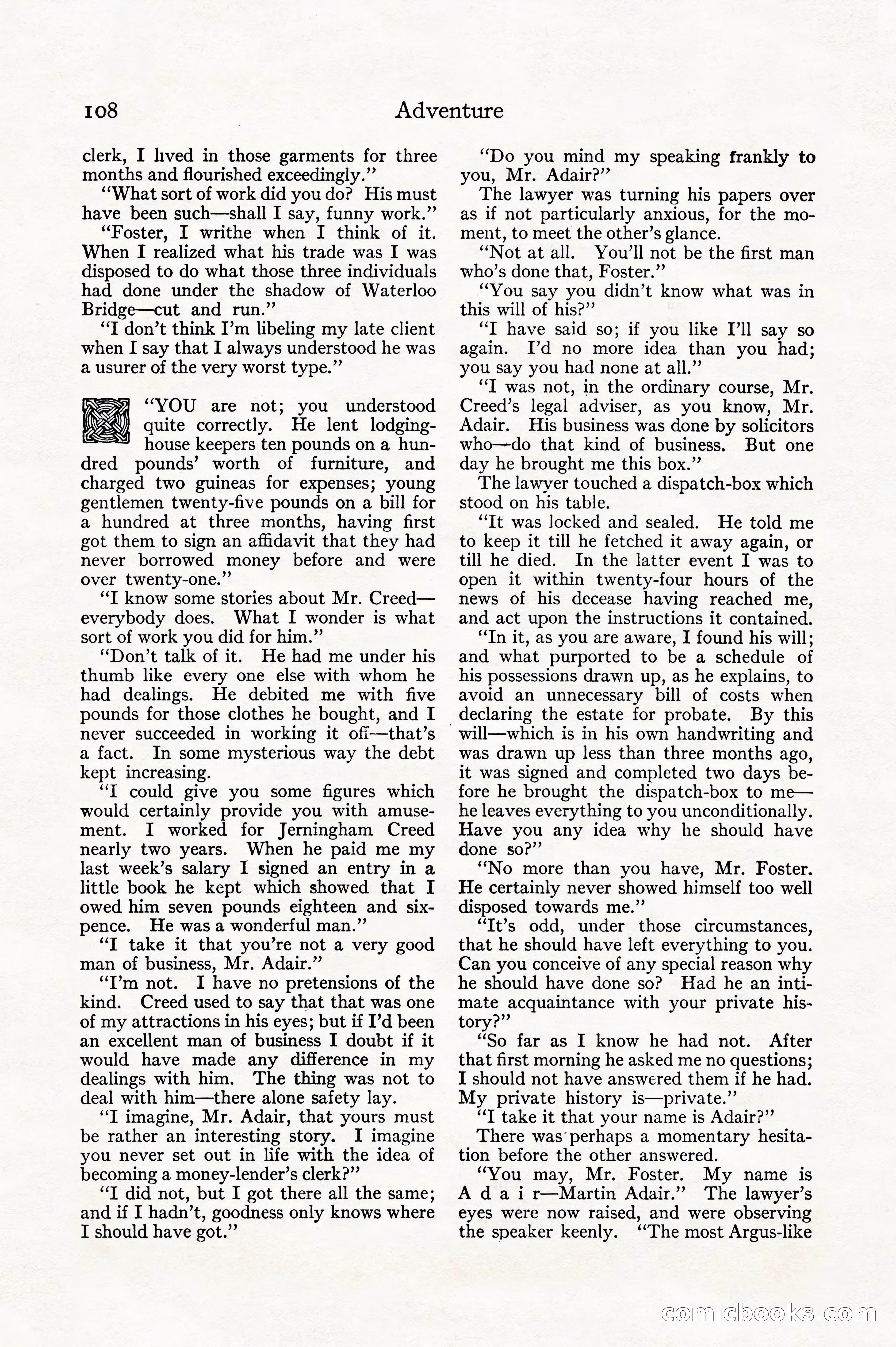
A restored page from Pulp Fiction, 1914. Page through the whole issue in the reader above.
📄 Transcribed text from this page (OCR, searchable)
Machine-transcribed from the original scan — historical spelling and the odd misread are preserved.
108 clerk, I lived in those garments for three months and flourished exceedingly.” ‘What sort of work did you do? His must have been such—shall I say, funny work.” “Foster, I writhe when I think of it. When I realized what his trade was I was disposed to do what those three individuals had done under the shadow of Waterloo Bridge—cut and run.” “T don’t think I’m libeling my late client when I say that I always understood he was a usurer of the very worst type.” RA “YOU are not; you understood Vy quite correctly. He lent lodging- house keepers ten pounds on a hun- dred pounds’ worth of furniture, and charged two guineas for expenses; young gentlemen twenty-five pounds on a bill for a hundred at three months, having first got them to sign an affidavit that they had never borrowed money before and were over twenty-one.” “I know some stories about Mr. Creed— everybody does. What I wonder is what sort of work you did for him.” “Don’t talk of it. He had me under his thumb like every one else with whom he had dealings. He debited me with five pounds for those clothes he bought, and I never succeeded in working it ofi—that’s a fact. In some mysterious way the debt kept increasing. “T could give you some figures which would certainly provide you with amuse- ment. I worked for Jerningham Creed nearly two years. When he paid me my last week’s salary I signed an entry in a little book he kept which showed that I owed him seven pounds eighteen and six- pence. He was a wonderful man.” “T take it that you’re not a very good man of business, Mr. Adair.” “I’m not. I have no pretensions of the kind. Creed used to say that that was one of my attractions in his eyes; but if I’d been an excellent man of business I doubt if it would have made any difference in my dealings with him. The thing was not to deal with him—there alone safety lay. “T imagine, Mr. Adair, that yours must be rather an interesting story. I imagine you never set out in life with the idea of becoming a money-lender’s clerk?”’ “TI did not, but I got there all the same; and if I hadn’t, goodness only knows where I should have got.” declaring the estate for probate. Adventure “Do you mind my speaking frankly to you, Mr. Adair?”’ The lawyer was turning his papers over as if not particularly anxious, for the mo- ment, to meet the other’s glance. “Not at all. You'll not be the first man who’s done that, Foster.” “You say you didn’t know what was in this will of his?” “T have said so; if you like Ill say so again. I’d no more idea than you had; you say you had none at all.” “TI was not, in the ordinary course, Mr. Creed’s legal adviser, as you know, Mr. Adair. His business was done by solicitors who—do that kind of business. But one day he brought me this box.” The lawyer touched a dispatch-box which stood on his table. “It was locked and sealed. He told me to keep it till he fetched it away again, or till he died. In the latter event I was to open it within twenty-four hours of the news of his decease having reached me, and act upon the instructions it contained. ‘In it, as you are aware, I found his will; and what purported to be a schedule of his possessions drawn up, as he explains, to avoid an unnecessary bill of costs when By this will—which is in his own handwriting and was drawn up less than three months ago, it was signed and completed two days be- fore he brought the dispatch-box to me— he leaves everything to you unconditionally. Have you any idea why he should have done so?” “No more than you have, Mr. Foster. He certainly never showed himself too well disposed towards me.” “It’s odd, under those circumstances, that he should have left everything to you. Can you conceive of any special reason why he should have done so? Had he an inti- mate acquaintance with your private his- tory?” ‘So far as I know he had not. After that first morning he asked me no questions; I should not have answered them if he had. My private history is—private.”’ “T take it that your name is Adair?” There was perhaps a momentary hesita- tion before the other answered. “You may, Mr. Foster. My name is A dai r—Martin Adair.” The lawyer’s eyes were now raised, and were observing the speaker keenly. “The most Argus-like Gomiicosook C@