
Pulp Fiction, 1911 · page 85 of 196
Adventure Magazine Cover, October 1911 — page 85: what you’re looking at
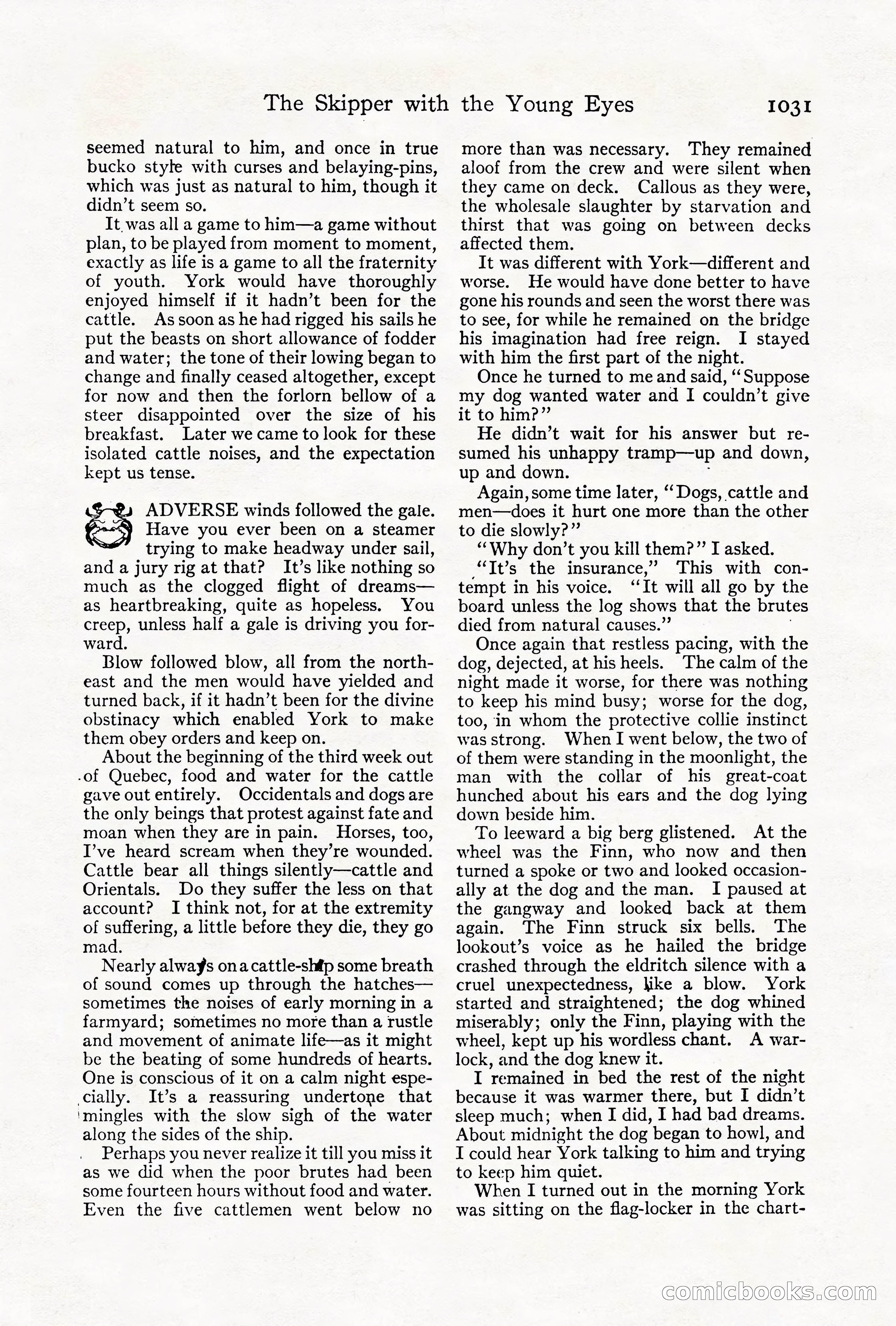
A restored page from Pulp Fiction, 1911. Page through the whole issue in the reader above.
📄 Transcribed text from this page (OCR, searchable)
Machine-transcribed from the original scan — historical spelling and the odd misread are preserved.
The Skipper with seemed natural to him, and once in true bucko styte with curses and belaying-pins, which was just as natural to him, though it didn’t seem so. It. was all a game to him—a game without plan, to be played from moment to moment, exactly as life is a game to all the fraternity of youth. York would have thoroughly enjoyed himself if it hadn’t been for the cattle. Assoon as he had rigged his sails he put the beasts on short allowance of fodder and water; the tone of their lowing began to change and finally ceased altogether, except for now and then the forlorn bellow of a steer disappointed over the size of his breakfast. Later we came to look for these isolated cattle noises, and the expectation kept us tense. te: 5 Have you ever been on a steamer trying to make headway under sail, and a jury rig at that? It’s like nothing so much as the clogged flight of dreams— as heartbreaking, quite as hopeless. You creep, unless half a gale is driving you for- ward. Blow followed blow, all from the north- east and the men would have yielded and turned back, if it hadn’t been for the divine obstinacy which enabled York to make them obey orders and keep on. About the beginning of the third week out .of Quebec, food and water for the cattle gave out entirely. Occidentals and dogs are the only beings that protest against fate and moan when they are in pain. Horses, too, I’ve heard scream when they’re wounded. Cattle bear all things silently—cattle and Orientals. Do they suffer the less on that account? I think not, for at the extremity of suffering, a little before they die, they go mad. Nearly always onacattle-shfp some breath of sound comes up through the hatches— sometimes the noises of early morning in a farmyard; sometimes no more than a rustle and movement of animate life—as it might be the beating of some hundreds of hearts. One is conscious of it on a calm night espe- cially. It’s a reassuring undertone that ‘mingles with the slow sigh of the water along the sides of the ship. Perhaps you never realize it till you miss it as we did when the poor brutes had been some fourteen hours without food and water. Even the five cattlemen went below no ADVERSE winds followed the gale. the Young Eyes 1031 more than was necessary. They remained aloof from the crew and were silent when they came on deck. Callous as they were, the wholesale slaughter by starvation and thirst that was going on between decks affected them. It was different with York—different and worse. He would have done better to have gone his rounds and seen the worst there was to see, for while he remained on the bridge his imagination had free reign. I stayed with him the first part of the night. Once he turned to me and said, “‘Suppose my dog wanted water and I couldn’t give it to him?” He didn’t wait for his answer but re- sumed his unhappy tramp—up and down, up and down. Again, some time later, “ Dogs, cattle and men—does it hurt one more than the other to die slowly?” “Why don’t you kill them? ” T asked. “Tt’s the insurance,” ‘This with con- tempt in his voice. “Tt will all go by the board unless the log shows that the brutes died from natural causes.’ Once again that restless pacing, with the dog, dejected, at his heels. ‘The calm of the night made it worse, for there was nothing to keep his mind busy; worse for the dog, too, in whom the protective collie instinct was strong. When I went below, the two of of them were standing in the moonlight, the man with the collar of his great-coat hunched about his ears and the dog lying down beside him. To leeward a big berg glistened. At the wheel was the Finn, who now and then turned a spoke or two and looked occasion- ally at the dog and the man. I paused at the gangway and looked back at them again. The Finn struck six bells. The lookout’s voice as he hailed the bridge crashed through the eldritch silence with a cruel unexpectedness, ike a blow. York started and straightened; the dog whined miserably; only the Finn, playing with the wheel, kept up his wordless chant. A war- lock, and the dog knew it. I remained in bed the rest of the night because it was warmer there, but I didn’t sleep much; when I did, I had bad dreams. About midnight the dog began to howl, and I could hear York talking to him and trying to keep him quiet. When I turned out in the morning York was sitting on the flag-locker in the chart- cComicboooks ©