
Pulp Fiction, 1911 · page 45 of 196
Adventure Magazine Cover, October 1911 — page 45: what you’re looking at
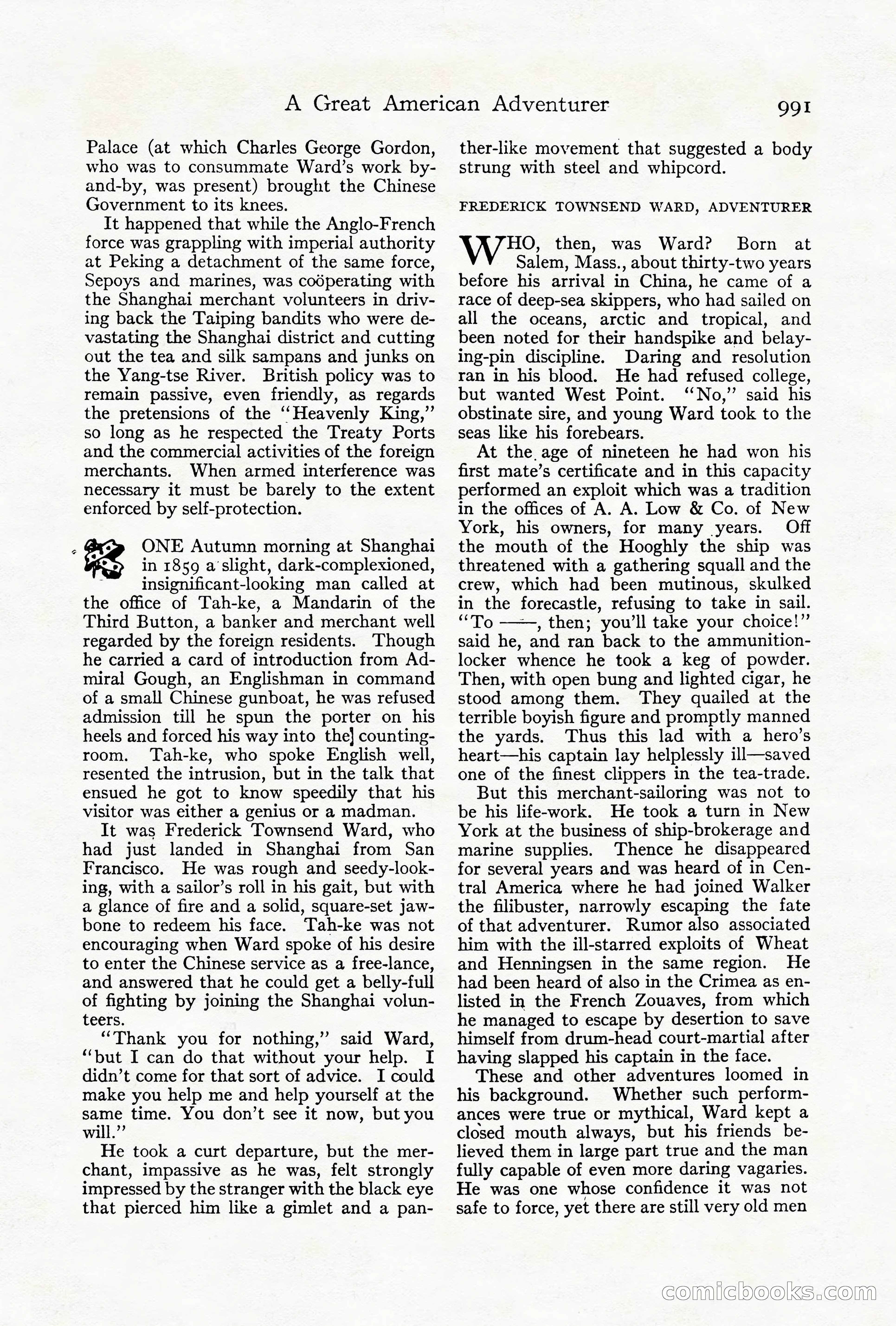
A restored page from Pulp Fiction, 1911. Page through the whole issue in the reader above.
📄 Transcribed text from this page (OCR, searchable)
Machine-transcribed from the original scan — historical spelling and the odd misread are preserved.
» A Great American Adventurer Palace (at which Charles George Gordon, who was to consummate Ward’s work by- and-by, was present) brought the Chinese Government to its knees. It happened that while the Anglo-French force was grappling with imperial authority at Peking a detachment of the same force, Sepoys and marines, was codperating with the Shanghai merchant volunteers in driv- ing back the Taiping bandits who were de- vastating the Shanghai district and cutting out the tea and silk sampans and junks on the Yang-tse River. British policy was to remain passive, even friendly, as regards the pretensions of the “‘Heavenly King,” so long as he respected the Treaty Ports and the commercial activities of the foreign merchants. When armed interference was necessary it must be barely to the extent enforced by self-protection. ONE Autumn morning at Shanghai in 1859 a slight, dark-complexioned, insignificant-looking man called at the office of Tah-ke, a Mandarin of the Third Button, a banker and merchant well regarded by the foreign residents. Though he carried a card of introduction from Ad- miral Gough, an Englishman in command of a small Chinese gunboat, he was refused admission till he spun the porter on his heels and forced his way into the} counting- room. Tah-ke, who spoke English well, resented the intrusion, but in the talk that ensued he got to know speedily that his visitor was either a genius or a madman. It was Frederick Townsend Ward, who had just landed in Shanghai from San Francisco. He was rough and seedy-look- ing, with a sailor’s roll in his gait, but with a glance of fire and a solid, square-set jaw- bone to redeem his face. Tah-ke was not encouraging when Ward spoke of his desire to enter the Chinese service as a free-lance, and answered that he could get a belly-full of fighting by joining the Shanghai volun- teers. “Thank you for nothing,” said Ward, “but I can do that without your help. I didn’t come for that sort of advice. I could make you help me and help yourself at the same time. You don’t see it now, but you will.”’ He took a curt departure, but the mer- chant, impassive as he was, felt strongly impressed by the stranger with the black eye that pierced him like a gimlet and a pan- 991 ther-like movement that suggested a body strung with steel and whipcord. FREDERICK TOWNSEND WARD, ADVENTURER Wie: then, was Ward? Born at Salem, Mass., about thirty-two years before his arrival in China, he came of a race of deep-sea skippers, who had sailed on all the oceans, arctic and tropical, and been noted for their handspike and belay- ing-pin discipline. Daring and resolution ran in his blood. He had refused college, but wanted West Point. ‘‘No,” said his obstinate sire, and young Ward took to the seas like his forebears. At the age of nineteen he had won his first mate’s certificate and in this capacity performed an exploit which was a tradition in the offices of A. A. Low & Co. of New York, his owners, for many years. Off the mouth of the Hooghly the ship was threatened with a gathering squall and the crew, which had been mutinous, skulked in the forecastle, refusing to take in sail. “To ——, then; you'll take your choice!” said he, and ran back to the ammunition- locker whence he took a keg of powder. Then, with open bung and lighted cigar, he stood among them. They quailed at the terrible boyish figure and promptly manned the yards. Thus this lad with a hero’s heart—his captain lay helplessly ill—saved one of the finest clippers in the tea-trade. But this merchant-sailoring was not to be his life-work. He took a turn in New York at the business of ship-brokerage and marine supplies. Thence he disappeared for several years and was heard of in Cen- tral America where he had joined Walker the filibuster, narrowly escaping the fate of that adventurer. Rumor also associated him with the ill-starred exploits of Wheat and Henningsen in the same region. He had been heard of also in the Crimea as en- listed in the French Zouaves, from which he managed to escape by desertion to save himself from drum-head court-martial after having slapped his captain in the face. These and other adventures loomed in his background. Whether such perform- ances were true or mythical, Ward kept a closed mouth always, but his friends be- lieved them in large part true and the man fully capable of even more daring vagaries. He was one whose confidence it was not safe to force, yet there are still very old men CoMmicbhook C©