
Pulp Fiction, 1911 · page 191 of 196
Adventure Magazine Cover, October 1911 — page 191: what you’re looking at
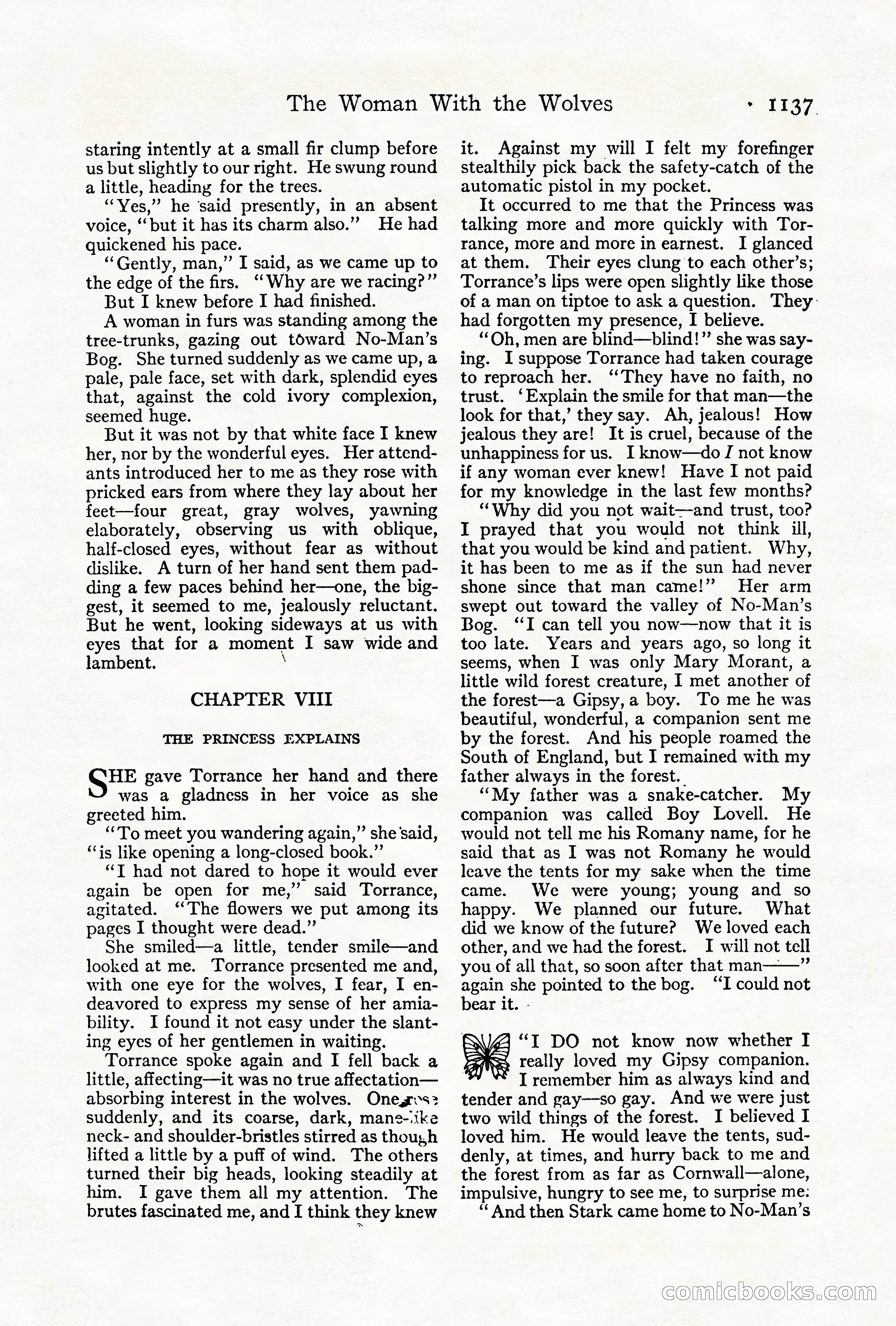
A restored page from Pulp Fiction, 1911. Page through the whole issue in the reader above.
📄 Transcribed text from this page (OCR, searchable)
Machine-transcribed from the original scan — historical spelling and the odd misread are preserved.
The Woman With the Wolves staring intently at a small fir clump before us but slightly to our right. He swung round a little, heading for the trees. “Yes,” he said presently, in an absent voice, ‘‘but it has its charm also.” He had quickened his pace. ‘“‘Gently, man,” I said, as we came up to the edge of the firs. “Why are we racing?”’ But I knew before I had finished. A woman in furs was standing among the tree-trunks, gazing out toward No-Man’s Bog. She turned suddenly as we came up, a pale, pale face, set with dark, splendid eyes that, against the cold ivory complexion, seemed huge. But it was not by that white face I knew her, nor by the wonderful eyes. Her attend- ants introduced her to me as they rose with pricked ears from where they lay about her feet—four great, gray wolves, yawning elaborately, observing us with oblique, half-closed eyes, without fear as without dislike. A turn of her hand sent them pad- ding a few paces behind her—one, the big- gest, it seemed to me, jealously reluctant. But he went, looking sideways at us with eyes that for a moment I saw wide and lambent. , CHAPTER VIII THE PRINCESS EXPLAINS GHE gave Torrance her hand and there was a gladness in her voice as she greeted him. ‘““To meet you wandering again,” she said, ‘“‘is like opening a long-closed book.”’ “T had not dared to hope it would ever again be open for me,” said Torrance, agitated. ‘‘The flowers we put among its pages I thought were dead.” She smiled—a little, tender smile—and looked at me. Torrance presented me and, with one eye for the wolves, I fear, I en- deavored to express my sense of her amia- bility. I found it not easy under the slant- ing eyes of her gentlemen in waiting. Torrance spoke again and I fell back a little, affecting—it was no true affectation— absorbing interest in the wolves. One,gvs2 suddenly, and its coarse, dark, mane-ike neck- and shoulder-bristles stirred as though lifted a little by a puff of wind. The others turned their big heads, looking steadily at him. I gave them all my attention. The brutes fascinated me, and I think they knew it. Against my will I felt my forefinger stealthily pick back the safety-catch of the automatic pistol in my pocket. It occurred to me that the Princess was talking more and more quickly with Tor- rance, more and more in earnest. I glanced at them. Their eyes clung to each other’s; Torrance’s lips were open slightly like those of a man on tiptoe to ask a question. They- had forgotten my presence, I believe. “Oh, men are blind—blind!”’ she was say- ing. I suppose Torrance had taken courage to reproach her. ‘‘They have no faith, no trust. ‘Explain the smile for that man—the look for that,’ they say. Ah, jealous! How jealous they are! It is cruel, because of the unhappiness for us. I know—do J not know if any woman ever knew! Have I not paid for my knowledge in the last few months? “Why did you not wait—and trust, too? I prayed that you would not think ill, that you would be kind and patient. Why, it has been to me as if the sun had never shone since that man came!” Her arm swept out toward the valley of No-Man’s Bog. ‘I can tell you now—now that it is too late. Years and years ago, so long it seems, when I was only Mary Morant, a little wild forest creature, I met another of the forest—a Gipsy, a boy. To me he was beautiful, wonderful, a companion sent me by the forest. And his people roamed the South of England, but I remained with my father always in the forest. ““My father was a snake-catcher. My companion was called Boy Lovell. He would not tell me his Romany name, for he said that as I was not Romany he would leave the tents for my sake when the time came. We were young; young and so happy. We planned our future. What did we know of the future? We loved each other, and we had the forest. I will not tell you of all that, so soon after that man——_”’ again she pointed to the bog. “I could not bear it. - ae really loved my Gipsy companion. 3 I remember him as always kind and tender and gay—so gay. And we were just two wild things of the forest. I believed I loved him. He would leave the tents, sud- denly, at times, and hurry back to me and the forest from as far as Cornwall—alone, impulsive, hungry to see me, to surprise me: “ And then Stark came home to No-Man’s “T DO not know now whether I CoMmicbhook * 1137. CO