
Pulp Fiction, 1911 · page 176 of 196
Adventure Magazine Cover, October 1911 — page 176: what you’re looking at
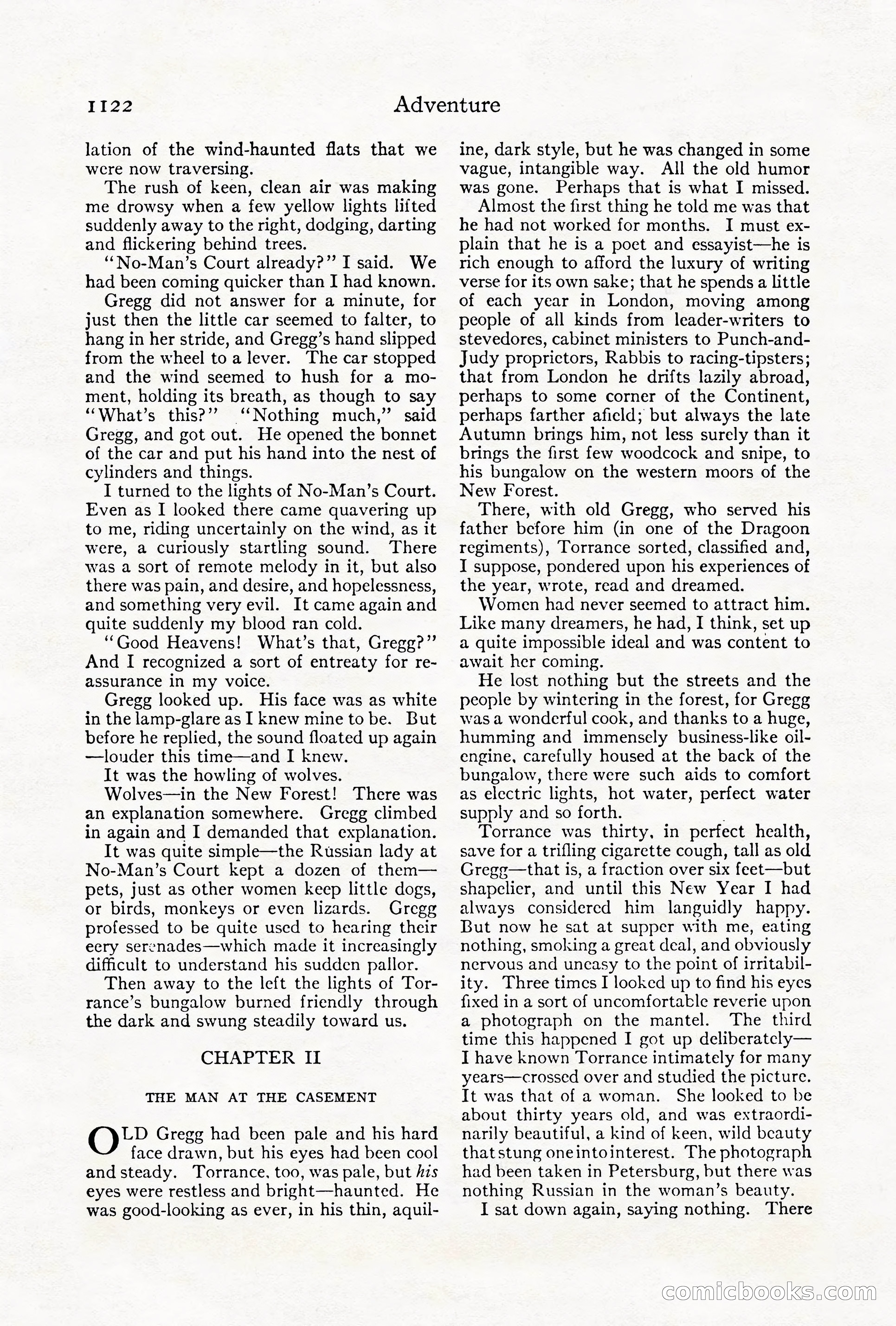
A restored page from Pulp Fiction, 1911. Page through the whole issue in the reader above.
📄 Transcribed text from this page (OCR, searchable)
Machine-transcribed from the original scan — historical spelling and the odd misread are preserved.
I1I22 lation of the wind-haunted flats that we were now traversing. The rush of keen, clean air was making me drowsy when a few yellow lights lifted suddenly away to the right, dodging, darting and flickering behind trees. ‘““No-Man’s Court already?” I said. We had been coming quicker than I had known. Gregg did not answer for a minute, for just then the little car seemed to falter, to hang in her stride, and Gregg’s hand slipped from the wheel to a lever. The car stopped and the wind seemed to hush for a mo- ment, holding its breath, as though to say “‘What’s this??? ‘‘Nothing much,” said Gregg, and got out. He opened the bonnet of the car and put his hand into the nest of cylinders and things. I turned to the lights of No-Man’s Court. Even as I looked there came quavering up to me, riding uncertainly on the wind, as it were, a curiously startling sound. There was a sort of remote melody in it, but also there was pain, and desire, and hopelessness, and something very evil. It came again and quite suddenly my blood ran cold. ‘“Good Heavens! What’s that, Gregg?” And I recognized a sort of entreaty for re- assurance in my voice. Gregg looked up. His face was as white in the lamp-glare as I knew mine to be. But before he replied, the sound floated up again —louder this time—and I knew. It was the howling of wolves. Wolves—in the New Forest! There was an explanation somewhere. Gregg climbed in again and I demanded that explanation. It was quite simple—the Russian lady at No-Man’s Court kept a dozen of them— pets, just as other women keep little dogs, or birds, monkeys or even lizards. Gregg professed to be quite used to hearing their eery serenades—which made it increasingly difficult to understand his sudden pallor. Then away to the left the lights of Tor- rance’s bungalow burned friendly through the dark and swung steadily toward us. CHAPTER II THE MAN AT THE CASEMENT '@ len Gregg had been pale and his hard face drawn, but his eyes had been cool and steady. Torrance, too, was pale, but hzs eyes were restless and bright—haunted. He was good-looking as ever, in his thin, aquil- Adventure ine, dark style, but he was changed in some vague, intangible way. All the old humor was gone. Perhaps that is what I missed. Almost the first thing he told me was that he had not worked for months. I must ex- plain that he is a poet and essayist—he is rich enough to afford the luxury of writing verse for its own sake; that he spends a little of each year in London, moving among people of all kinds from leader-writers to stevedores, cabinet ministers to Punch-and- Judy proprictors, Rabbis to racing-tipsters; that from London he drifts lazily abroad, perhaps to some corner of the Continent, perhaps farther aficld; but always the late Autumn brings him, not less surely than it brings the first few woodcock and snipe, to his bungalow on the western moors of the New Forest. There, with old Gregg, who served his father before him (in one of the Dragoon regiments), Torrance sorted, classified and, I suppose, pondered upon his experiences of the year, wrote, read and dreamed. Women had never seemed to attract him. Like many dreamers, he had, I think, set up a quite impossible ideal and was content to await her coming. He lost nothing but the streets and the people by wintcring in the forest, for Gregg was a wonderful cook, and thanks to a huge, humming and immensely business-like oil- engine, carefully housed at the back of the bungalow, there were such aids to comfort as electric lights, hot water, perfect water supply and so forth. Torrance was thirty, in perfect health, save for a trifling cigarette cough, tall as old Gregg—that is, a fraction over six feet—but shapelier, and until this New Year I had always considered him languidly happy. But now he sat at supper with me, eating nothing, smoking a great deal, and obviously nervous and uncasy to the point of irritabil- ity. Three times I looked up to find his eyes fixed in a sort of uncomfortable reverie upon a photograph on the mantel. The third time this happened I got up deliberatcly— I have known Torrance intimately for many years—crossed over and studied the picture. It was that of a woman. She looked to be about thirty years old, and was extraordi- narily beautiful, a kind of keen, wild beauty thatstung oneintointerest. The photograph had been taken in Petersburg, but there was nothing Russian in the woman’s beauty. I sat down again, saying nothing. There CO MICLOOKS CO