
Pulp Fiction, 1911 · page 167 of 196
Adventure Magazine Cover, October 1911 — page 167: what you’re looking at
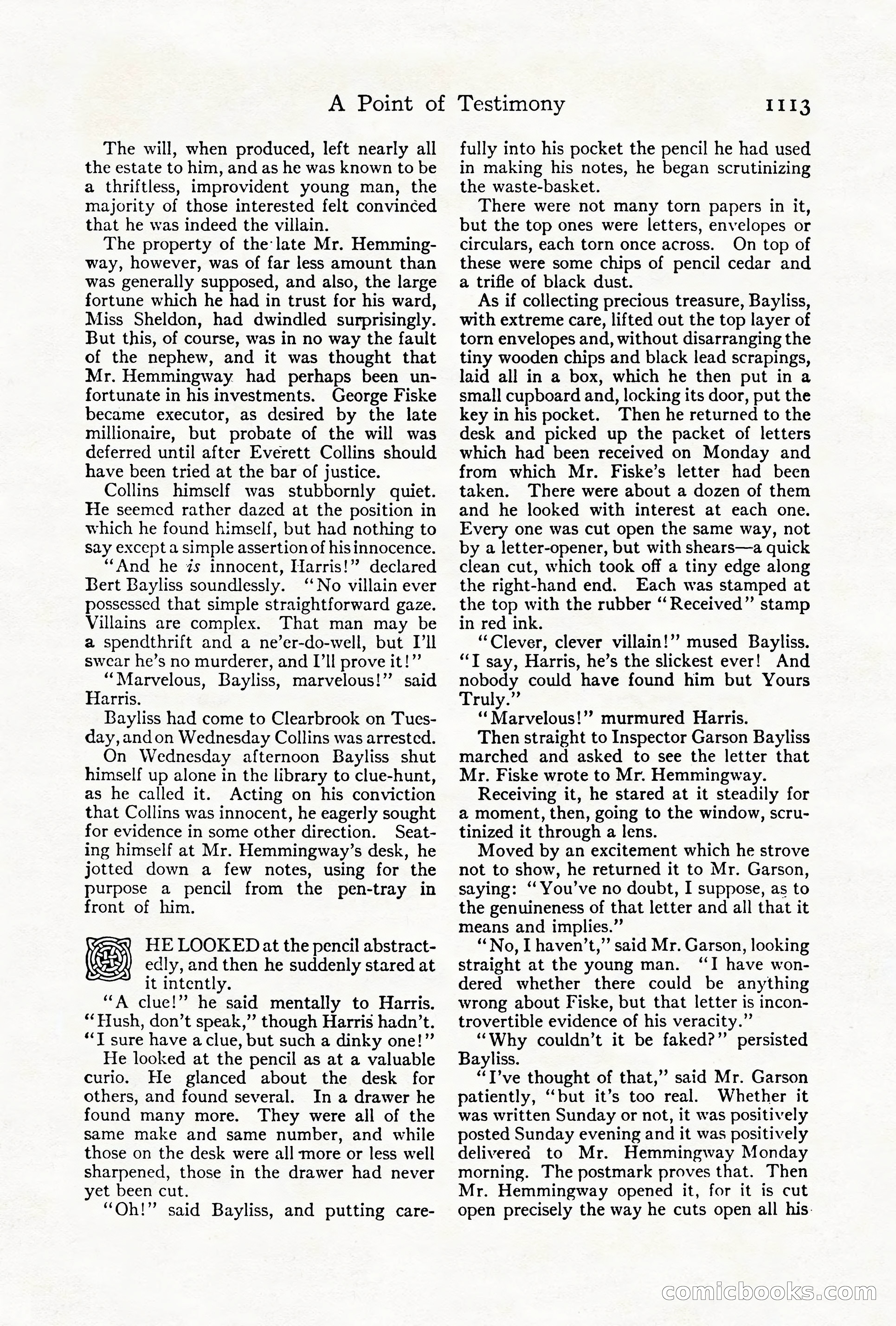
A restored page from Pulp Fiction, 1911. Page through the whole issue in the reader above.
📄 Transcribed text from this page (OCR, searchable)
Machine-transcribed from the original scan — historical spelling and the odd misread are preserved.
A Point of Testimony The will, when produced, left nearly all the estate to him, and as he was known to be a thriftless, improvident young man, the majority of those interested felt convinced that he was indeed the villain. The property of the: late Mr. Hemming- way, however, was of far less amount than was generally supposed, and also, the large fortune which he had in trust for his ward, Miss Sheldon, had dwindled surprisingly. But this, of course, was in no way the fault of the nephew, and it was thought that Mr. Hemmingway had perhaps been un- fortunate in his investments. George Fiske became executor, as desired by the late millionaire, but probate of the will was deferred until after Everett Collins should have been tried at the bar of justice. Collins himself was stubbornly quiet. He seemed rather dazed at the position in which he found himself, but had nothing to Say except a simple assertion of his innocence. “‘And he zs innocent, Harris!” declared Bert Bayliss soundlessly. ‘No villain ever possessed that simple straightforward gaze. Villains are complex. That man may be a spendthrift and a ne’er-do-well, but I'll swear he’s no murderer, and I'll prove it!”’ ““Marvelous, Bayliss, marvelous!’ said Harris. Bayliss had come to Clearbrook on Tues- day,andon Wednesday Collins was arrested. On Wednesday afternoon Bayliss shut himself up alone in the library to clue-hunt, as he called it. Acting on his conviction that Collins was innocent, he eagerly sought for evidence in some other direction. Seat- ing himself at Mr. Hemmingway’s desk, he jotted down a few notes, using for the purpose a pencil from the pen-tray in front of him. HE LOOKEDat the pencil abstract- edly, and then he suddenly stared at it intently. ‘““A clue!”’ he said mentally to Harris. “‘Hush, don’t speak,” though Harris hadn’t. “IT sure have aclue, but such a dinky one!” He looked at the pencil as at a valuable curio. He glanced about the desk for others, and found several. In a drawer he found many more. They were all of the same make and same number, and while those on the desk were all more or less well sharpened, those in the drawer had never yet been cut. “Oh!” said Bayliss, and putting care- LY on x Te H 1113 fully into his pocket the pencil he had used in making his notes, he began scrutinizing the waste-basket. There were not many torn papers in it, but the top ones were letters, envelopes or circulars, each torn once across. On top of these were some chips of pencil cedar and a trifle of black dust. As if collecting precious treasure, Bayliss, with extreme care, lifted out the top layer of torn envelopes and, without disarranging the tiny wooden chips and black lead scrapings, laid all in a box, which he then put in a small cupboard and, locking its door, put the key in his pocket. Then he returned to the desk and picked up the packet of letters which had been received on Monday and from which Mr. Fiske’s letter had been taken. There were about a dozen of them and he looked with interest at each one. Every one was cut open the same way, not by a letter-opener, but with shears—a quick clean cut, which took off a tiny edge along the right-hand end. Each was stamped at the top with the rubber “ Received”’ stamp in red ink. “Clever, clever villain!’’ mused Bayliss. “T say, Harris, he’s the slickest ever! And nobody could have found him but Yours Truly.” “‘Marvelous!”? murmured Harris. Then straight to Inspector Garson Bayliss marched and asked to see the letter that Mr. Fiske wrote to Mr. Hemmingway. Receiving it, he stared at it steadily for a moment, then, going to the window, scru- tinized it through a lens. Moved by an excitement which he strove not to show, he returned it to Mr. Garson, saying: ‘‘You’ve no doubt, I suppose, as to the genuineness of that letter and all that it means and implies.” ““No, I haven’t,” said Mr. Garson, looking straight at the young man. “I have won- dered whether there could be anything wrong about Fiske, but that letter is incon- trovertible evidence of his veracity.” “Why couldn’t it be faked?” persisted Bayliss. “T’ve thought of that,” said Mr. Garson patiently, “but it’s too real. Whether it was written Sunday or not, it was positively posted Sunday evening and it was positively delivered to Mr. Hemmingway Monday morning. The postmark proves that. Then Mr. Hemmingway opened it, for it is cut open precisely the way he cuts open all his. CO MICLOOKS C©