
Pulp Fiction, 1911 · page 164 of 196
Adventure Magazine Cover, October 1911 — page 164: what you’re looking at
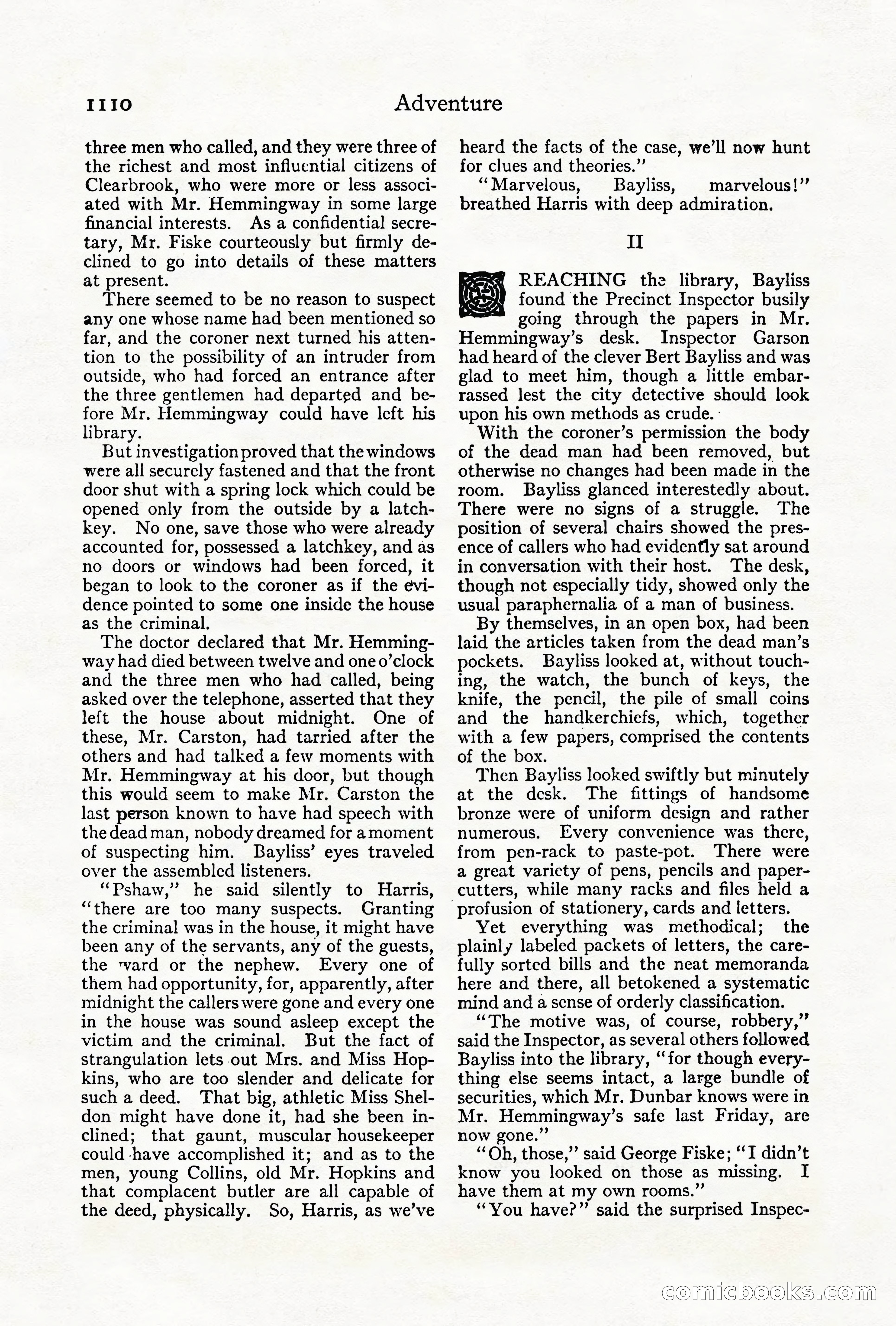
A restored page from Pulp Fiction, 1911. Page through the whole issue in the reader above.
📄 Transcribed text from this page (OCR, searchable)
Machine-transcribed from the original scan — historical spelling and the odd misread are preserved.
IIo three men who called, and they were three of the richest and most influential citizens of Clearbrook, who were more or less associ- ated with Mr. Hemmingway in some large financial interests. As a confidential secre- tary, Mr. Fiske courteously but firmly de- clined to go into details of these matters at present. There seemed to be no reason to suspect any one whose name had been mentioned so far, and the coroner next turned his atten- tion to the possibility of an intruder from outside, who had forced an entrance after the three gentlemen had departed and be- fore Mr. Hemmingway could have left his library. But investigation proved that the windows were all securely fastened and that the front door shut with a spring lock which could be opened only from the outside by a latch- key. No one, save those who were already accounted for, possessed a latchkey, and as no doors or windows had been forced, it began to look to the coroner as if the evi- dence pointed to some one inside the house as the criminal. The doctor declared that Mr. Hemming- way had died between twelve and oneo’clock and the three men who had called, being asked over the telephone, asserted that they left the house about midnight. One of these, Mr. Carston, had tarried after the others and had talked a few moments with Mr. Hemmingway at his door, but though this would seem to make Mr. Carston the last person known to have had speech with the dead man, nobody dreamed for amoment of suspecting him. Bayliss’ eyes traveled over the assembled listeners. “Pshaw,” he said silently to Harris, “‘there are too many suspects. Granting the criminal was in the house, it might have been any of the servants, any of the guests, the ~vard or the nephew. Every one of them had opportunity, for, apparently, after midnight the callers were gone and every one in the house was sound asleep except the victim and the criminal. But the fact of strangulation lets-out Mrs. and Miss Hop- kins, who are too slender and delicate for such a deed. ‘That big, athletic Miss Shel- don might have done it, had she been in- clined; that gaunt, muscular housekeeper could have accomplished it; and as to the men, young Collins, old Mr. Hopkins and that complacent butler are all capable of the deed, physically. So, Harris, as we’ve Adventure heard the facts of the case, we’ll now hunt for clues and theories.” “Marvelous, _ Bayliss, marvelous!’’ breathed Harris with deep admiration. II REACHING the library, Bayliss found the Precinct Inspector busily going through the papers in Mr. Hemmingway’s desk. Inspector Garson had heard of the clever Bert Bayliss and was glad to meet him, though a little embar- rassed lest the city detective should look upon his own methods as crude. With the coroner’s permission the body of the dead man had been removed, but otherwise no changes had been made in the room. Bayliss glanced interestedly about. There were no signs of a struggle. The position of several chairs showed the pres- ence of callers who had evidently sat around in conversation with their host. The desk, though not especially tidy, showed only the usual paraphernalia of a man of business. By themselves, in an open box, had been laid the articles taken from the dead man’s pockets. Bayliss looked at, without touch- ing, the watch, the bunch of keys, the knife, the pencil, the pile of small coins and the handkerchiefs, which, together with a few papers, comprised the contents of the box. Then Bayliss looked swiftly but minutely at the desk. The fittings of handsome bronze were of uniform design and rather numerous. Every convenience was there, from pen-rack to paste-pot. There were a great variety of pens, pencils and paper- cutters, while many racks and files held a (tet) ‘profusion of stationery, cards and letters. Yet everything was methodical; the plainly labeled packets of letters, the care- fully sorted bills and the neat memoranda here and there, all betokened a systematic mind and a sense of orderly classification. “The motive was, of course, robbery,” said the Inspector, as several others followed Bayliss into the library, “for though every- thing else seems intact, a large bundle of securities, which Mr. Dunbar knows were in Mr. Hemmingway’s safe last Friday, are now gone.” “Oh, those,”’ said George Fiske; “‘TI didn’t know you looked on those as missing. I have them at my own rooms.” “You have?” said the surprised Inspec- CO MICLMOOKS C©