
Pulp Fiction, 1911 · page 161 of 196
Adventure Magazine Cover, October 1911 — page 161: what you’re looking at
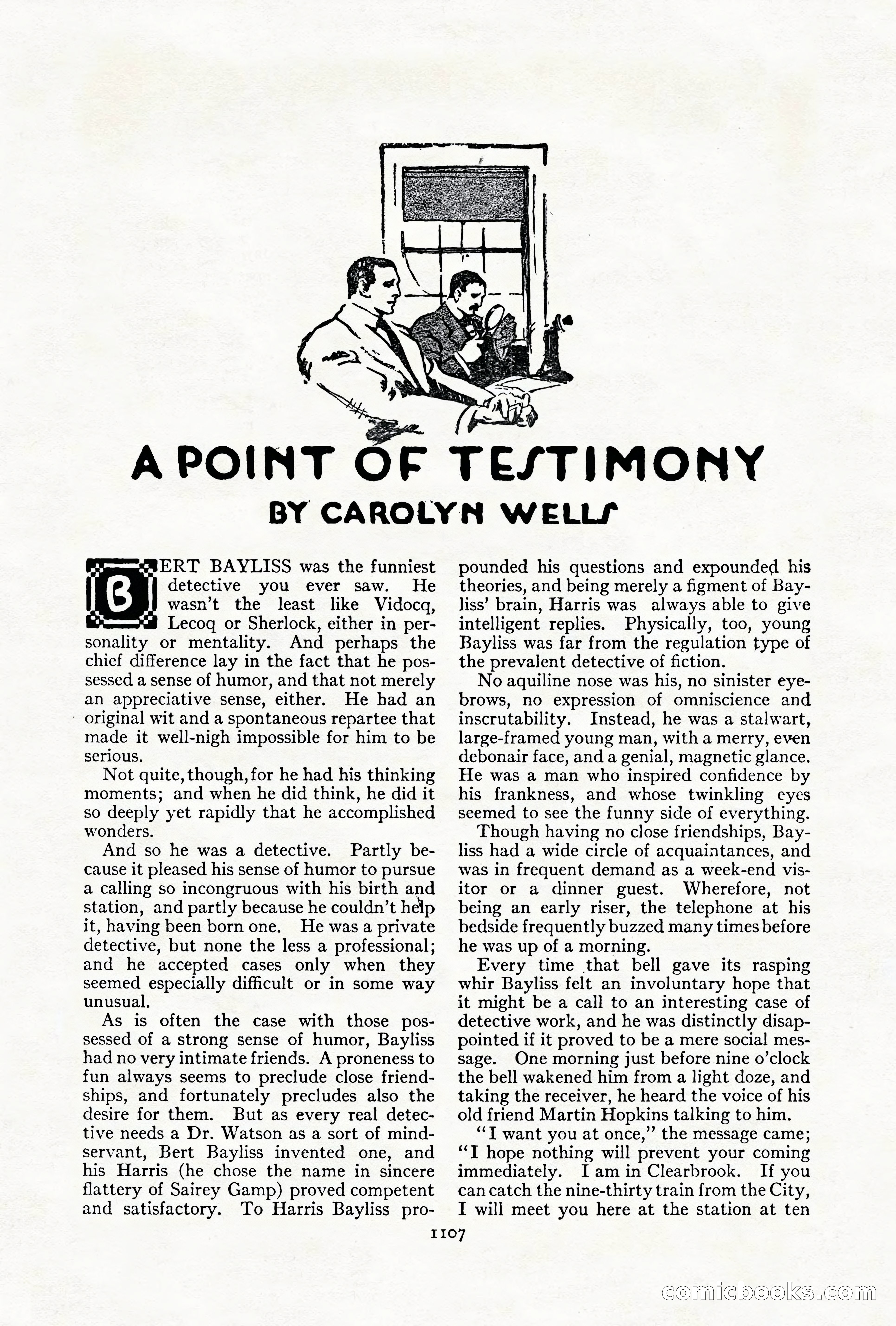
A restored page from Pulp Fiction, 1911. Page through the whole issue in the reader above.
📄 Transcribed text from this page (OCR, searchable)
Machine-transcribed from the original scan — historical spelling and the odd misread are preserved.
Eee FO we Sage eo OT Saw aheee tiga 5 igre roe 3 nd ¢ \ == ieee a La q, re Ss Sed A POINT OF TESTIMONY BY CAROLYN WELLS ERT BAYLISS was the funniest detective you ever saw. He wasn’t the least like Vidoca, Lecoq or Sherlock, either in per- sonality or mentality. And perhaps the chief difference lay in the fact that he pos- sessed a sense of humor, and that not merely an appreciative sense, either. He had an - original wit and a spontaneous repartee that made it well-nigh impossible for him to be serious. Not quite, though, for he had his thinking moments; and when he did think, he did it so deeply yet rapidly that he accomplished wonders. And so he was a detective. Partly be- cause it pleased his sense of humor to pursue a calling so incongruous with his birth and station, and partly because he couldn’t help it, having been born one. He was a private detective, but none the less a professional; and he accepted cases only when they seemed especially dificult or in some way unusual, As is often the case with those pos- sessed of a strong sense of humor, Bayliss had no very intimate friends. A proneness to fun always seems to preclude close friend- ships, and fortunately precludes also the desire for them. But as every real detec- tive needs a Dr. Watson as a sort of mind- servant, Bert Bayliss invented one, and his Harris (he chose the name in sincere flattery of Sairey Gamp) proved competent and satisfactory. To Harris Bayliss pro- pounded his questions and expounded his theories, and being merely a figment of Bay- liss’ brain, Harris was always able to give intelligent replies. Physically, too, young Bayliss was far from the regulation type of the prevalent detective of fiction. No aquiline nose was his, no sinister eye- brows, no expression of omniscience and inscrutability. Instead, he was a stalwart, large-framed young man, with a merry, even debonair face, and a genial, magnetic glance. He was a man who inspired confidence by his frankness, and whose twinkling eyes seemed to see the funny side of everything. Though having no close friendships, Bay- liss had a wide circle of acquaintances, and was in frequent demand as a week-end vis- itor or a dinner guest. Wherefore, not being an early riser, the telephone at his bedside frequently buzzed many times before he was up of a morning. Every time that bell gave its rasping whir Bayliss felt an involuntary hope that it might be a call to an interesting case of detective work, and he was distinctly disap- pointed if it proved to be a mere social mes- sage. One morning just before nine o’clock the bell wakened him from a light doze, and taking the receiver, he heard the voice of his old friend Martin Hopkins talking to him. ““T want you at once,” the message came; “IT hope nothing will prevent your coming immediately. I amin Clearbrook. If you can catch the nine-thirty train from the City, I will meet you here at the station at ten 1107 C© MICLMOOOKS C© 5}