
Pulp Fiction, 1911 · page 132 of 196
Adventure Magazine Cover, October 1911 — page 132: what you’re looking at
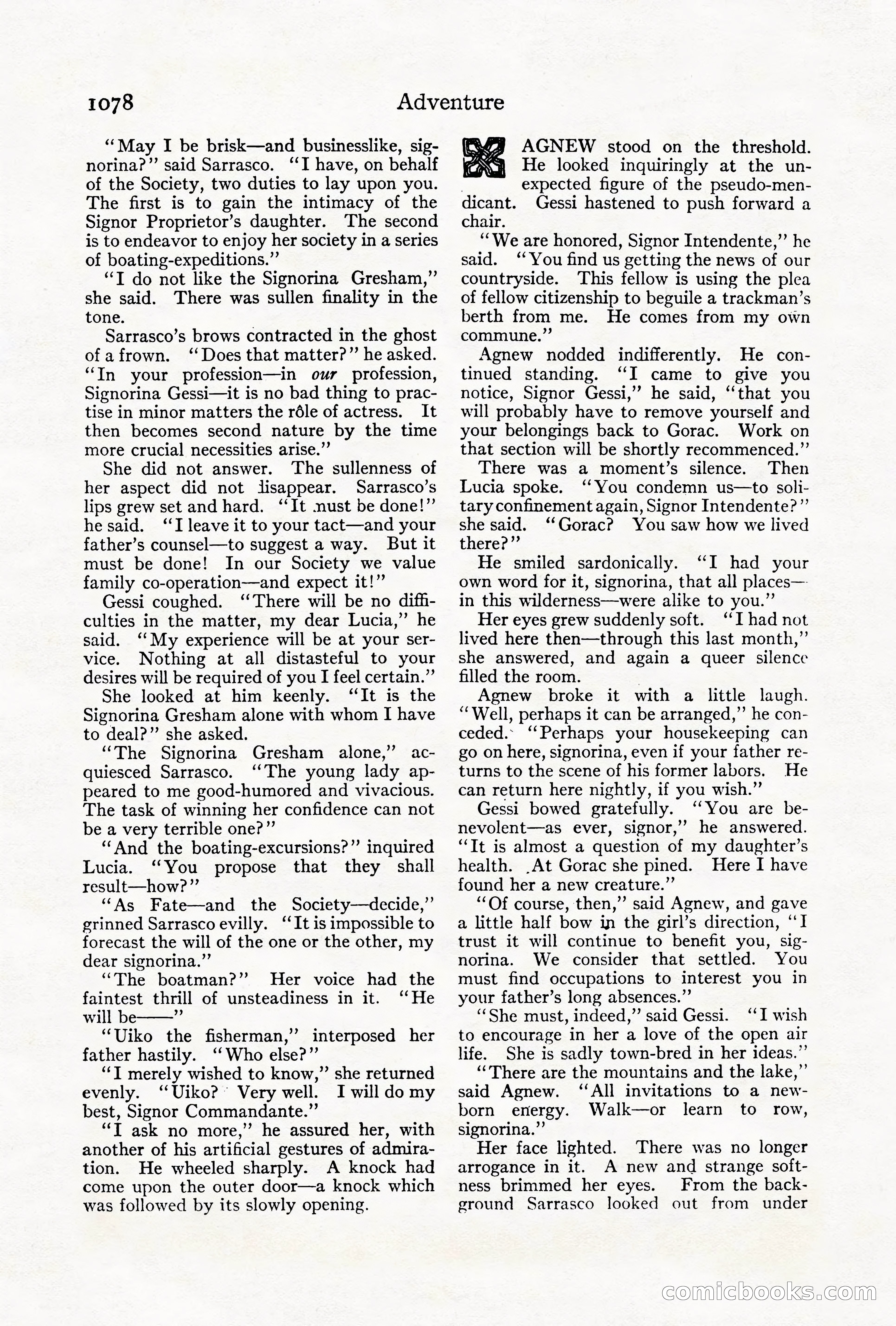
A restored page from Pulp Fiction, 1911. Page through the whole issue in the reader above.
📄 Transcribed text from this page (OCR, searchable)
Machine-transcribed from the original scan — historical spelling and the odd misread are preserved.
1078 ‘“May I be brisk—and businesslike, sig- norina?”’ said Sarrasco. ‘‘I have, on behalf of the Society, two duties to lay upon you. The first is to gain the intimacy of the Signor Proprietor’s daughter. The second is to endeavor to enjoy her society in a series of boating-expeditions.”’ “‘T do not like the Signorina Gresham,”’ she said. There was sullen finality in the tone. Sarrasco’s brows contracted in the ghost ofafrown. ‘Does that matter?” he asked. “In your profession—in our profession, Signorina Gessi—it is no bad thing to prac- tise in minor matters the réle of actress. It then becomes second nature by the time more crucial necessities arise.”’ She did not answer. The sullenness of her aspect did not lisappear. Sarrasco’s lips grew set and hard. ‘“‘It must be done!” he said. “I leave it to your tact—and your father’s counsel—to suggest a way. But it must be done! In our Society we value family co-operation—and expect it!” Gessi coughed. ‘There will be no difh- culties in the matter, my dear Lucia,” he said. ‘‘My experience will be at your ser- vice. Nothing at all distasteful to your desires will be required of you I feel certain.”’ She looked at him keenly. “It is the Signorina Gresham alone with whom I have to deal?” she asked. “The Signorina Gresham alone,” ac- quiesced Sarrasco. ‘‘The young lady ap- peared to me good-humored and vivacious. The task of winning her confidence can not be a very terrible one?” ‘‘And the boating-excursions?” inquired Lucia. “You propose that they shall result—how?”’ “As Fate—and the Society—decide,”’ grinned Sarrasco evilly. ‘It is impossible to forecast the will of the one or the other, my dear signorina.”’ “The boatman?” faintest thrill of unsteadiness in it. will be——”’ “Uiko the fisherman,’’ interposed her father hastily. ‘Who else?” ‘“‘I merely wished to know,” she returned evenly. “Uiko?~ Very well. I will do my best, Signor Commandante.” “T ask no more,” he assured her, with another of his artificial gestures of admira- tion. He wheeled sharply. A knock had come upon the outer door—a knock which was followed by its slowly opening. Her voice had the “He Adventure AGNEW stood on the threshold. He looked inquiringly at the un- expected figure of the pseudo-men- Gessi hastened to push forward a dicant. chair. ‘“We are honored, Signor Intendente,”’ he said. “You find us getting the news of our countryside. This fellow is using the plea of fellow citizenship to beguile a trackman’s berth from me. He comes from my own commune.” Agnew nodded indifferently. He con- tinued standing. “I came to give you notice, Signor Gessi,” he said, ‘‘that you will probably have to remove yourself and your belongings back to Gorac. Work on that section will be shortly recommenced.” There was a moment’s silence. Then Lucia spoke. ‘‘ You condemn us—to soli- tary confinement again, Signor Intendente?”’ she said. ‘“‘Gorac? You saw how we lived there?”’ He smiled sardonically. “I had your own word for it, signorina, that all places— in this wilderness—were alike to you.” Her eyes grew suddenly soft. “I had not lived here then—through this last month,”’ she answered, and again a queer silence filled the room. | Agnew broke it with a little laugh. “Well, perhaps it can be arranged,’’ he con- ceded.. “Perhaps your housekeeping can go on here, signorina, even if your father re- turns to the scene of his former labors. He can return here nightly, if you wish.” Gessi bowed gratefully. ‘“‘You are be- nevolent—as ever, signor,”’ he answered. “Tt is almost a question of my daughter’s health. .At Gorac she pined. Here I have found her a new creature.”’ ‘‘Of course, then,” said Agnew, and gave a little half bow in the girl’s direction, “I trust it will continue to benefit you, sig- norina. We consider that settled. You must find occupations to interest you in your father’s long absences.” ‘“‘She must, indeed,” said Gessi. ‘I wish to encourage in her a love of the open air life. She is sadly town-bred in her ideas.”’ ‘There are the mountains and the lake,”’ said Agnew. ‘‘All invitations to a new- born energy. Walk—or learn to row, signorina.”’ Her face lighted. There was no longer arrogance in it. A new and strange soft- ness brimmed her eyes. From the back- ground Sarrasco looked out from under CO MICLOOKS (©