
Pulp Fiction, 1911 · page 130 of 196
Adventure Magazine Cover, October 1911 — page 130: what you’re looking at
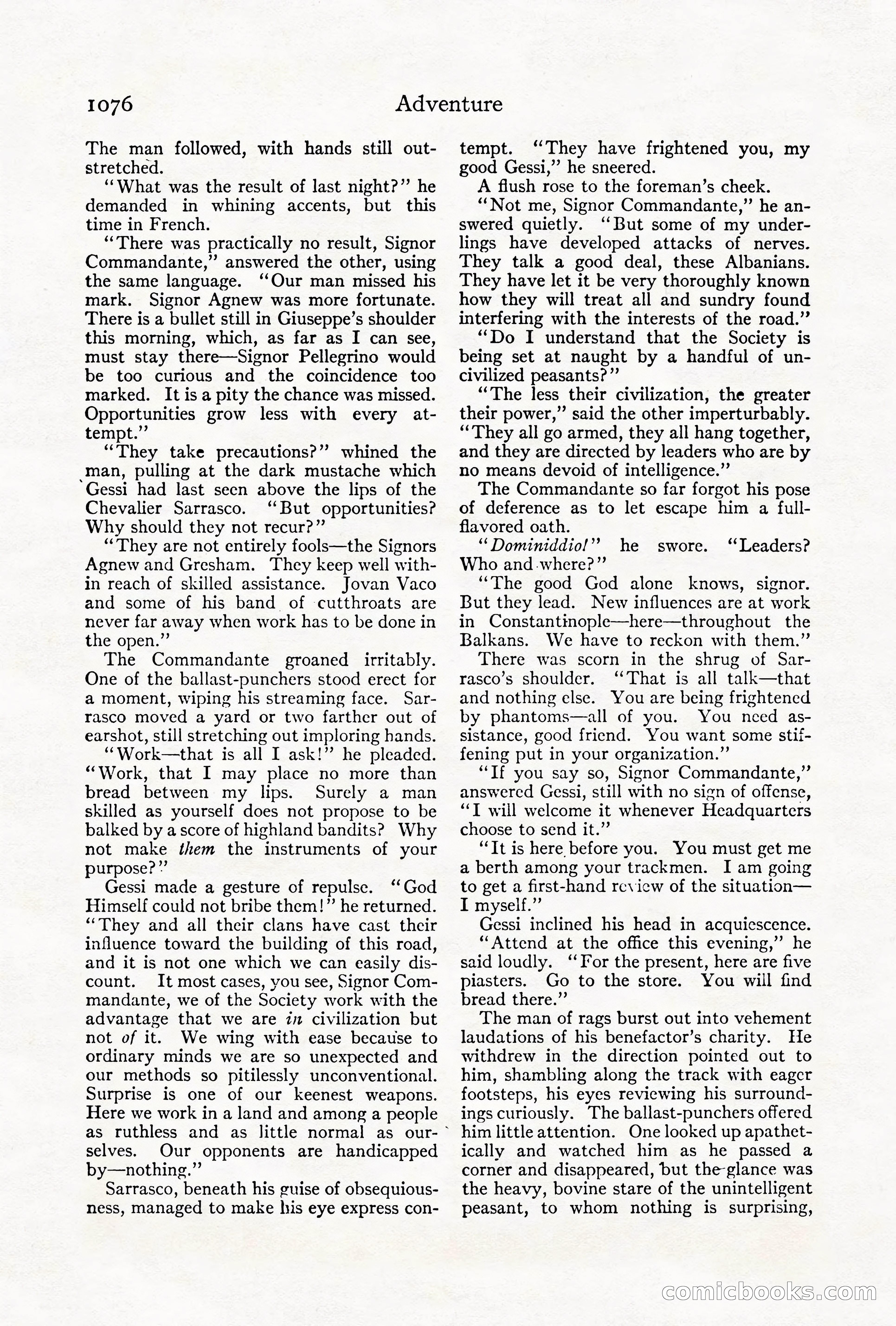
A restored page from Pulp Fiction, 1911. Page through the whole issue in the reader above.
📄 Transcribed text from this page (OCR, searchable)
Machine-transcribed from the original scan — historical spelling and the odd misread are preserved.
1076 The man followed, with hands still out- stretched. ‘“What was the result of last night?” he demanded in whining accents, but this time in French. “There was practically no result, Signor Commandante,” answered the other, using the same language. ‘“‘Our man missed his mark. Signor Agnew was more fortunate. There is a bullet still in Giuseppe’s shoulder this morning, which, as far as I can see, must stay there—Signor Pellegrino would be too curious and the coincidence too marked. It isa pity the chance was missed. Opportunities grow less with every at- tempt.” “They take precautions?’”’ whined the man, pulling at the dark mustache which Gessi had last seen above the lips of the Chevalier Sarrasco. “But opportunities? Why should they not recur?”’ “They are not entirely fools—the Signors Agnew and Gresham. They keep well with- in reach of skilled assistance. Jovan Vaco and some of his band of cutthroats are never far away when work has to be done in the open.” The Commandante groaned _irritably. One of the ballast-punchers stood erect for a moment, wiping his streaming face. Sar- rasco moved a yard or two farther out of earshot, still stretching out imploring hands. ‘““Work—that is all I ask!” he pleaded. “Work, that I may place no more than bread between my lips. Surely a man skilled as yourself does not propose to be balked by a score of highland bandits? Why not make them the instruments of your purpose? *’ Gessi made a gesture of repulse. ‘‘God Himself could not bribe them!” he returned. “‘They and all their clans have cast their influence toward the building of this road, and it is not one which we can easily dis- count. It most cases, you see, Signor Com- mandante, we of the Society work with the advantage that we are 7 civilization but not of it. We wing with ease because to ordinary minds we are so unexpected and our methods so pitilessly unconventional. Surprise is one of our keenest weapons. Here we work in a land and among a people as ruthless and as little normal as our-- selves. Our opponents are handicapped by—nothing.” Sarrasco, beneath his guise of obsequious- ness, managed to make his eye express con- Adventure tempt. ‘They have frightened you, my good Gessi,”’ he sneered. A flush rose to the foreman’s cheek. “‘Not me, Signor Commandante,”’ he an- swered quietly. ‘But some of my under- lings have developed attacks of nerves. They talk a good deal, these Albanians. They have let it be very thoroughly known how they will treat all and sundry found interfering with the interests of the road.” “Do I understand that the Society is being set at naught by a handful of un- civilized peasants? ”’ “The less their civilization, the greater their power,” said the other imperturbably. “They all go armed, they all hang together, and they are directed by leaders who are by no means devoid of intelligence.” The Commandante so far forgot his pose of deference as to let escape him a full- flavored oath. “* Dominiddio!”’ Who and where?” “The good God alone knows, signor. But they lead. New influences are at work in Constantmople—here—throughout the Balkans. We have to reckon with them.” There was scorn in the shrug of Sar- rasco’s shoulder. ‘“‘That is all talk—that and nothing else. You are being frightened by phantoms—all of you. You need as- sistance, good friend. You want some stif- fening put in your organization.” “If you say so, Signor Commandante,”’ answered Gessi, still with no sign of offense, “TI will welcome it whenever Headquarters choose to send it.” “It is here before you. You must get me a berth among your trackmen. I am going to get a first-hand review of the situation— I myself.” Gessi inclined his head in acquiescence. “Attend at the office this evening,” he said loudly. ‘Tor the present, here are five piasters. Go to the store. You will find bread there.’ The man of rags burst out into vehement laudations of his benefactor’s charity. He withdrew in the direction pointed out to him, shambling along the track with eager footsteps, his eyes reviewing his surround- ings curiously. The ballast-punchers offered him little attention. One looked up apathet- ically and watched him as he passed a corner and disappeared, but the-glance was the heavy, bovine stare of the unintelligent peasant, to whom nothing is surprising, he swore. ‘“‘ Leaders? CO MICLOOOKS CO