
Pulp Fiction, 1911 · page 123 of 196
Adventure Magazine Cover, October 1911 — page 123: what you’re looking at
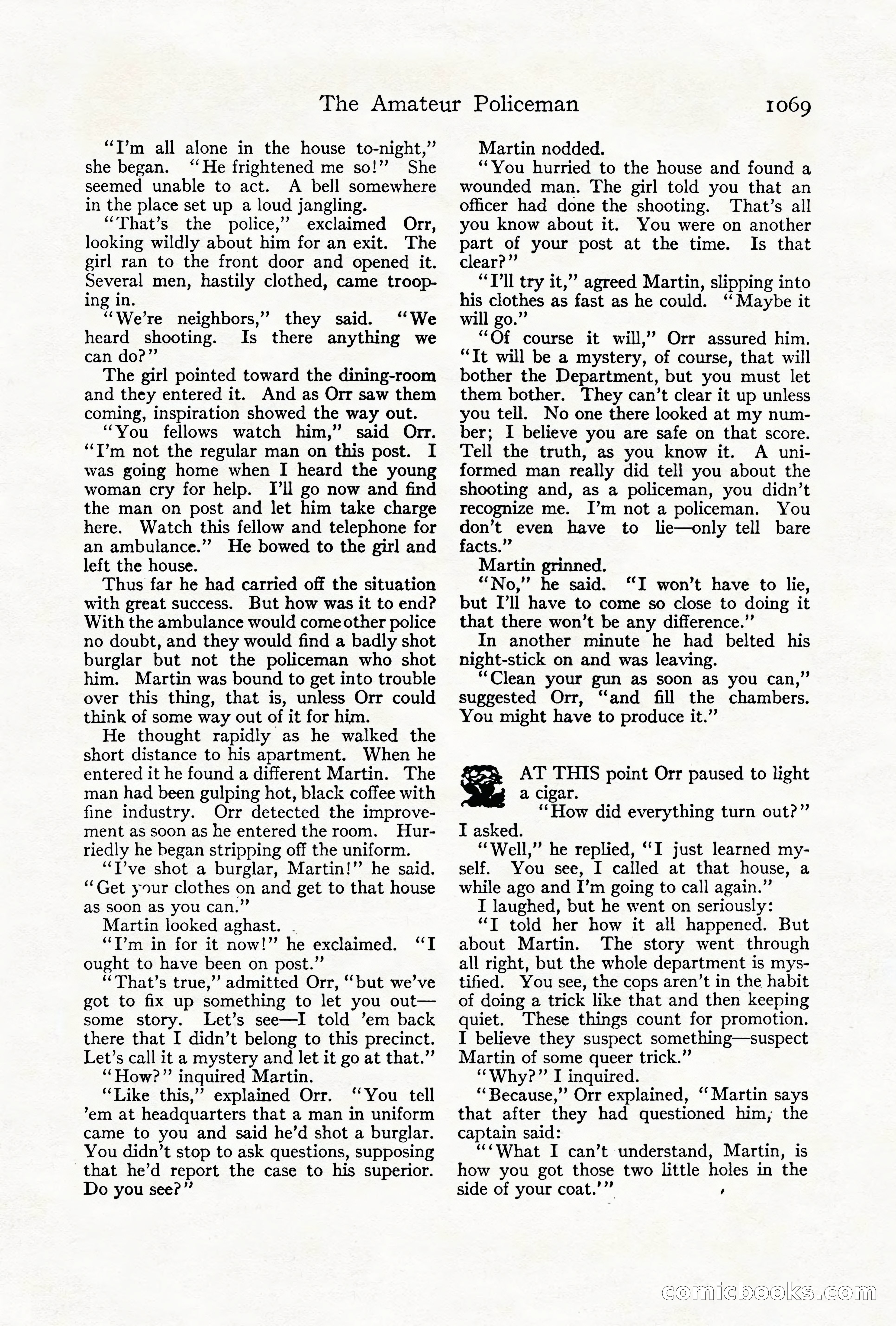
A restored page from Pulp Fiction, 1911. Page through the whole issue in the reader above.
📄 Transcribed text from this page (OCR, searchable)
Machine-transcribed from the original scan — historical spelling and the odd misread are preserved.
The Amateur Policeman “T’m all alone in the house to-night,” she began. ‘‘He frightened me so!’’? She seemed unable to act. A bell somewhere in the place set up a loud jangling. “That’s the police,’ exclaimed Orr, looking wildly about him for an exit. The girl ran to the front door and opened it. Several men, hastily clothed, came troop- ing in. ‘“We’re neighbors,” they said. ‘We heard shooting. Is there anything we can do?”’ The girl pointed toward the dining-room and they entered it. And as Orr saw them coming, inspiration showed the way out. “You fellows watch him,” said Orr. “I’m not the regular man on this post. I was going home when [I heard the young woman cry for help. IJ’ll go now and find the man on post and let him take charge here. Watch this fellow and telephone for an ambulance.”” He bowed to the girl and left the house. Thus far he had carried off the situation with great success. But how was it to end? With the ambulance would come other police no doubt, and they would find a badly shot burglar but not the policeman who shot him. Martin was bound to get into trouble over this thing, that is, unless Orr could think of some way out of it for him. He thought rapidly as he walked the short distance to his apartment. When he entered it he found a different Martin. The man had been gulping hot, black coffee with fine industry. Orr detected the improve- ment as soon as he entered the room. MHur- riedly he began stripping off the uniform. ‘““T’ve shot a burglar, Martin!” he said. “Get your clothes on and get to that house as soon as you can.” Martin looked aghast. . “I’m in for it now!” he exclaimed. ought to have been on post.” ‘““That’s true,’’ admitted Orr, ‘but we’ve got to fix up something to let you out— some story. Let’s see—I told ’em back there that I didn’t belong to this precinct. Let’s call it a mystery and let it go at that.” “How?” inquired Martin. “Like this,” explained Orr. “You tell ’em at headquarters that a man in uniform came to you and said he’d shot a burglar. You didn’t stop to ask questions, supposing that he’d report the case to his superior. Do you see?” spt | 1069 Martin nodded. “You hurried to the house and found a wounded man. The girl told you that an officer had done the shooting. That’s all you know about it. You were on another part of your post at the time. Is that clear?”’ “*T’ll try it,’’ agreed Martin, slipping into his clothes as fast as he could. ‘‘Maybe it will go.”’ “Of course it will,” Orr assured him. “It will be a mystery, of course, that will bother the Department, but you must let them bother. They can’t clear it up unless you tell. No one there looked at my num- ber; I believe you are safe on that score. Tell the truth, as you know it. A _ uni- formed man really did tell you about the shooting and, as a policeman, you didn’t recognize me. I’m not a policeman. You don’t even have to lie—only tell bare facts.” Martin grinned. “No,” he said. “I won’t have to lie, but I’ll have to come so close to doing it that there won’t be any difference.” In another minute he had belted his night-stick on and was leaving. “Clean your gun as soon as you can,” suggested Orr, “and fill the chambers. You might have to produce it.” AT THIS point Orr paused to light a cigar. “How did everything turn out?” cr I asked. “Well,” he replied, “‘I just learned my- self. You see, I called at that house, a while ago and I’m going to call again.” I laughed, but he went on seriously: “‘T told her how it all happened. But about Martin. The story went through all right, but the whole department is mys- tified. You see, the cops aren’t in the habit of doing a trick like that and then keeping quiet. These things count for promotion. I believe they suspect something—suspect Martin of some queer trick.” “Why?” I inquired. “Because,” Orr explained, ‘‘ Martin says that after they had questioned him, the captain said: “What I can’t understand, Martin, is how you got those two little holes in the side of your coat.’’”” , Comicbook CO