
Pulp Fiction, 1911 · page 121 of 196
Adventure Magazine Cover, October 1911 — page 121: what you’re looking at
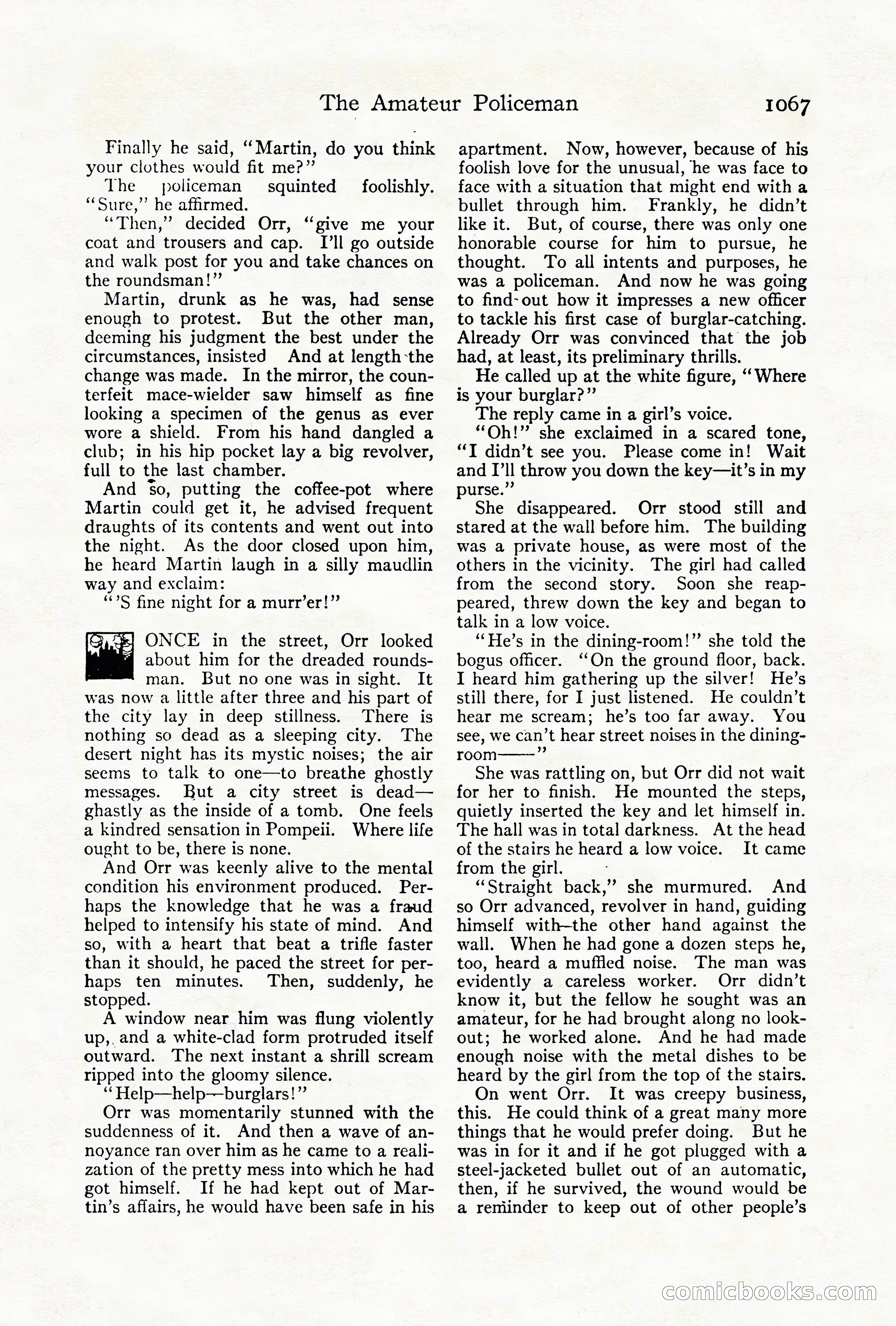
A restored page from Pulp Fiction, 1911. Page through the whole issue in the reader above.
📄 Transcribed text from this page (OCR, searchable)
Machine-transcribed from the original scan — historical spelling and the odd misread are preserved.
The Amateur Policeman Finally he said, “Martin, do you think your clothes would fit me?” The policeman squinted ‘Sure,’ he affirmed. “Then,” decided Orr, “give me your coat and trousers and cap. I'll go outside and walk post for you and take chances on the roundsman!”’ Martin, drunk as he was, had sense enough to protest. But the other man, deeming his judgment the best under the circumstances, insisted And at length-the change was made. In the mirror, the coun- terfeit mace-wielder saw himself as fine looking a specimen of the genus as ever wore a Shield. From his hand dangled a club; in his hip pocket lay a big revolver, full to the last chamber. And ‘so, putting the coffee-pot where Martin could get it, he advised frequent draughts of its contents and went out into the night. As the door closed upon him, he heard Martin laugh in a silly maudlin way and exclaim: “?S fine night for a murr’er!”’ foolishly. ONCE in the street, Orr looked about him for the dreaded rounds- man. But no one was in sight. It was now a little after three and his part of the city lay in deep stillness. There is nothing so dead as a sleeping city. The desert night has its mystic noises; the air seems to talk to one—to breathe ghostly messages. But a city street is dead— ghastly as the inside of a tomb. One feels a kindred sensation in Pompeii. Where life ought to be, there is none. And Orr was keenly alive to the mental condition his environment produced. Per- haps the knowledge that he was a fraud helped to intensify his state of mind. And so, with a heart that beat a trifle faster than it should, he paced the street for per- haps ten minutes. Then, suddenly, he stopped. A window near him was flung violently up,, and a white-clad form protruded itself outward. The next instant a shrill scream ripped into the gloomy silence. ‘‘Help—help—burglars!” Orr was momentarily stunned with the suddenness of it. And then a wave of an- noyance ran over him as he came to a reali- zation of the pretty mess into which he had got himself. If he had kept out of Mar- tin’s affairs, he would have been safe in his 1067 apartment. Now, however, because of his foolish love for the unusual, he was face to face with a situation that might end witha bullet through him. Frankly, he didn’t like it. But, of course, there was only one honorable course for him to pursue, he thought. To all intents and purposes, he was a policeman. And now he was going to find-out how it impresses a new officer to tackle his first case of burglar-catching. Already Orr was convinced that the job had, at least, its preliminary thrills. He called up at the white figure, ‘“‘Where is your burglar?”’ The reply came in a girl’s voice. “Oh!” she exclaimed in a scared tone, “TI didn’t see you. Please come in! Wait and I’ll throw you down the key—it’s in my purse.” She disappeared. Orr stood still and stared at the wall before him. The building was a private house, as were most of the others in the vicinity. The girl had called from the second story. Soon she reap- peared, threw down the key and began to talk in a low voice. ‘‘He’s in the dining-room!”’ she told the bogus officer. ‘On the ground floor, back. I heard him gathering up the silver! He’s still there, for I just listened. He couldn’t hear me scream; he’s too far away. You see, we can’t hear street nolses in the dining- room bs She was rattling on, but Orr did not wait for her to finish. He mounted the steps, quietly inserted the key and let himself in. The hall was in total darkness. At the head of the stairs he heard a low voice. It came from the girl. “Straight back,’”? she murmured. And so Orr advanced, revolver in hand, guiding himself with—the other hand against the wall. When he had gone a dozen steps he, too, heard a muffled noise. The man was evidently a careless worker. Orr didn’t know it, but the fellow he sought was an amateur, for he had brought along no look- out; he worked alone. And he had made enough noise with the metal dishes to be heard by the girl from the top of the stairs. On went Orr. It was creepy business, this. He could think of a great many more things that he would prefer doing. But he was in for it and if he got plugged with a steel-jacketed bullet out of an automatic, then, if he survived, the wound would be a reminder to keep out of other people’s CO MICLOOKS C©